


GTM Engineering has become one of the fastest-emerging roles in modern revenue teams, but the title still carries remarkably little agreement about the work itself. Companies are using it to describe different combinations of RevOps, automation, data engineering, AI implementation and systems architecture, often with very different expectations attached.
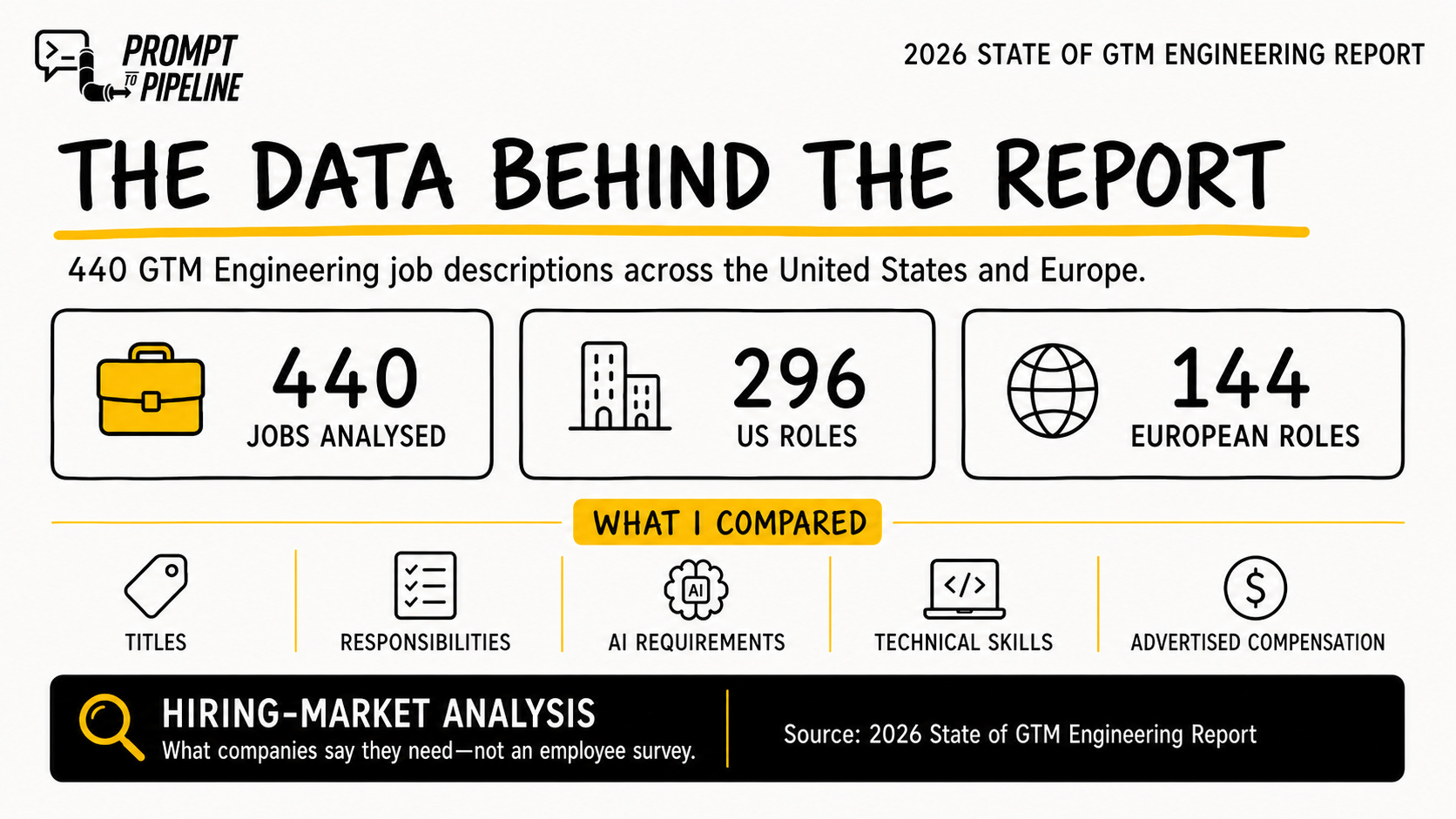
To understand what employers are actually hiring for, I analyzed 440 GTM Engineering and adjacent job descriptions across the US and Europe. The research examined how companies define the role, which capabilities they prioritize, where the role sits organizationally and how those differences affect compensation.
This article maps the five mandates hiding beneath the GTM Engineer label - from RevOps operator to AI-native architect - and shows how each changes the required skills, operating scope and compensation, with advertised US salaries reaching $350,000.
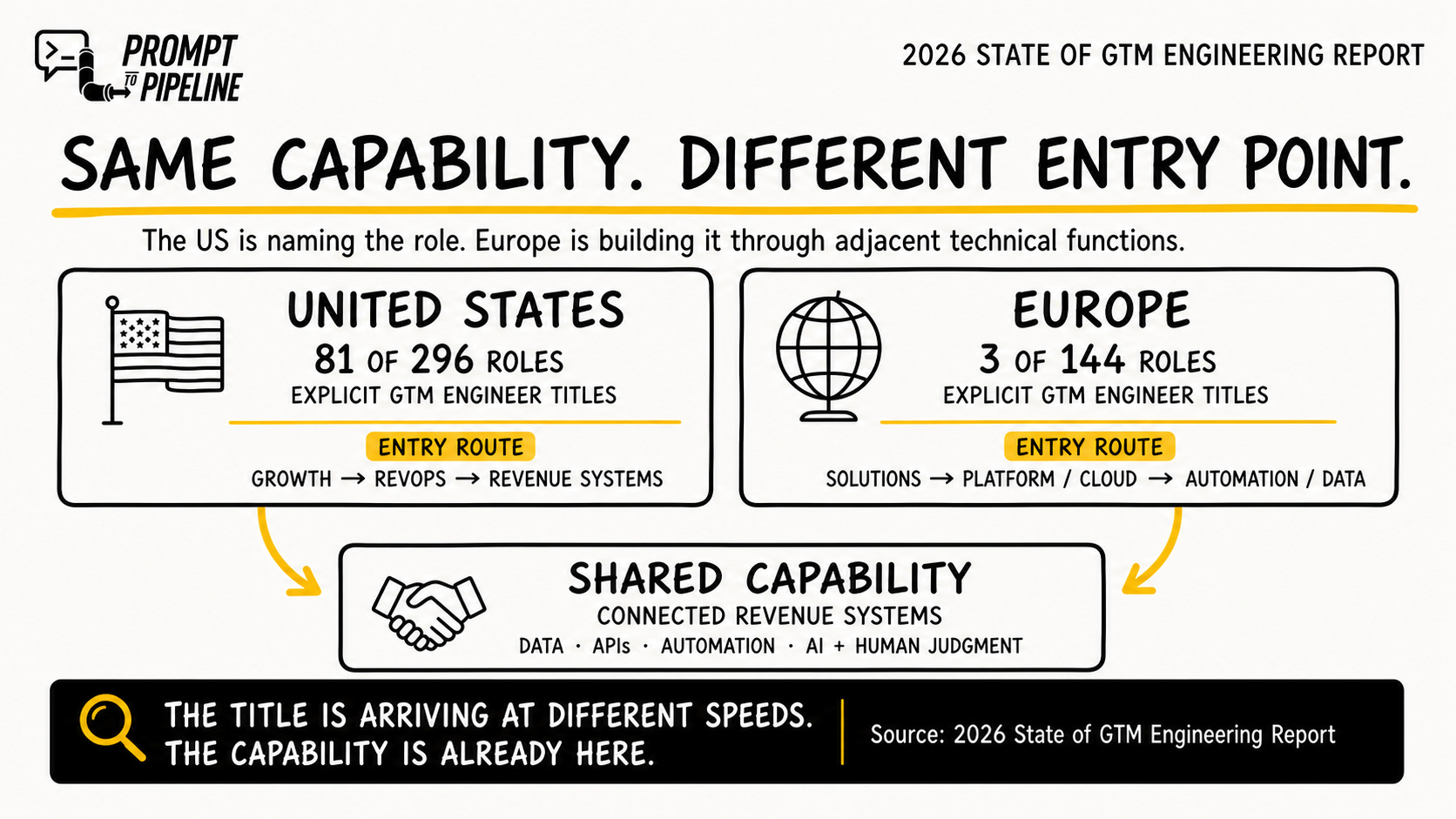
It also explains why the US sample contains 81 explicit GTM Engineer titles while Europe contains only three, even as both markets build similar capabilities through different role families.
For candidates, it provides a clearer career map; for leaders, a practical way to distinguish tool administration, workflow design and revenue-system ownership before an expensive title begins making decisions on their behalf.
What you will learn
This article explains:
How GTM Engineering is emerging in the United States and Europe—and why similar work appears under different titles.
What companies are paying and which technical skills, tools and AI capabilities they expect.
How regional operating models shape workflow ownership and where the market is heading next.
How to distinguish the five GTM Engineering mandates and translate them into better hiring and career decisions.
Methodology note
I compared titles, responsibilities, AI requirements, technical skills and advertised compensation across 440 job descriptions: 296 US roles and 144 European roles. The findings reflect employer demand, not employee adoption or implementation outcomes. Salary figures are directional, based on 75 US and 29 European roles with usable compensation data.
The emergence of GTM Engineering as a distinct function
GTM Engineering is becoming a distinct function because revenue work no longer stays inside one CRM, automation platform or department. Qualification, routing, research, lifecycle management and customer handoffs now depend on connected data, APIs, code and AI. Once those systems influence commercial decisions, someone has to own the workflow as a whole.
The title is formalizing unevenly: among 296 US roles, 81 explicitly use GTM Engineer; among 144 European roles, only three do. Europe has not misplaced the profession somewhere between Lisbon and Helsinki. The capability appears through Solutions and Sales Engineering, Platform and Cloud, Automation, RevOps, Operations and Data roles.
The surrounding evidence confirms that the work already exists. The US sample includes 95 Solutions or Sales Engineering signals, 150 AI-core or agentic roles and 152 API signals. Europe includes 47 Solutions or Sales Engineering signals, 32 AI-core or agentic roles and 48 API signals.
For candidates, the implication is practical: search by capability as well as title. For hiring leaders, the warning runs in the other direction. A familiar title can still conceal three departments’ worth of responsibility and a heroic Slack channel.
GTM Engineer salary in 2026
If one title covers several mandates, salary benchmarking by title can only be directional.
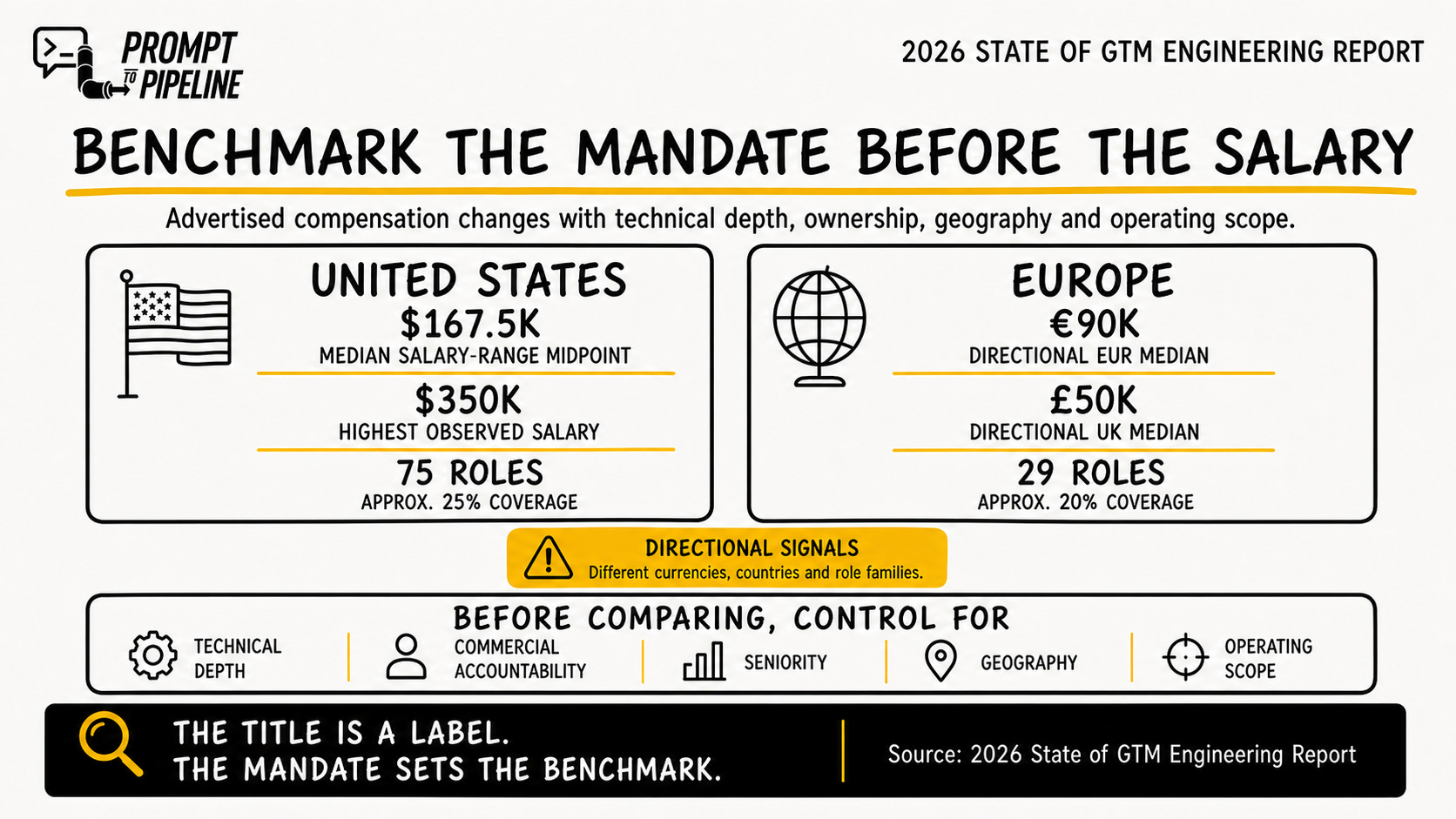
In the United States:
75 of 296 roles contain usable salary information
Coverage is approximately 25%
The median salary-range midpoint is $167,500
The highest observed salary is $350,000
In Europe:
29 of 144 roles contain salary information
Coverage is approximately 20%
The directional EUR median signal is around €90,000
The directional UK median signal is around £50,000
These figures are market signals, not a clean transatlantic benchmark. European roles span countries, currencies and role families; US descriptions may combine base salary, OTE and different seniority levels. The work itself also varies sharply.
A tool operator may configure enrichment, CRM rules and outbound workflows inside a defined platform environment. An AI-native architect may own custom integrations, production agents, monitoring, human review and commercially sensitive decisions. Pricing them as equivalent creates the comforting appearance of precision while comparing different jobs.
Benchmark the mandate before you benchmark the salary.
For leaders, that means controlling for technical depth, commercial accountability, seniority, geography and operating scope. For candidates, it means evaluating the ownership behind the offer rather than assuming the title explains the opportunity.
GTM Engineer skills and technical stack
The technology requirements reveal which version of the role a company expects to hire.
United States GTM Engineer tech stack
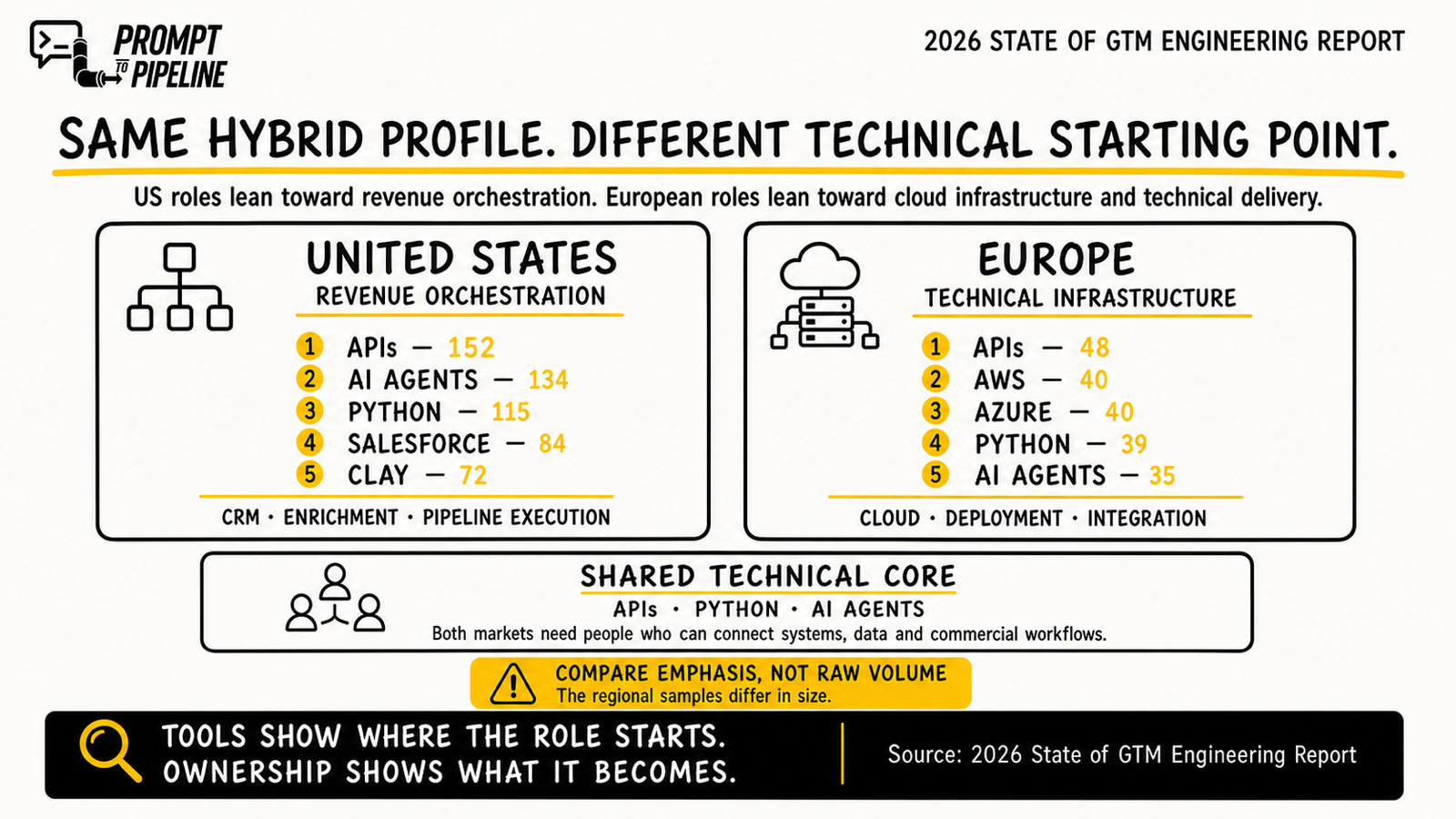
The strongest US technical signals are:
APIs: 152 mentions
AI agents: 134
Python: 115
Salesforce: 84
Clay: 72
JavaScript: 68
SQL: 61
REST: 57
Claude: 46
HubSpot: 43
The US stack sits between revenue operations and custom systems development. Salesforce, HubSpot and Clay anchor the role in CRM, enrichment and pipeline execution. APIs, Python, JavaScript and SQL show where configuration ends and integration work begins. AI agents add a further requirement: governing context, actions and human review.
European GTM Engineer tech stack
The strongest European technical signals are:
APIs: 48 mentions
AWS: 40
Microsoft Azure: 40
Python: 39
AI agents: 35
Kubernetes: 30
Terraform: 25
Docker: 24
REST: 22
Google Cloud: 20
The European stack starts closer to cloud infrastructure, deployment and technical delivery. APIs, Python and agentic requirements then connect that foundation to commercial workflows.
From tool lists to capability design
Across both regions, the strongest profiles combine:
Understanding of pipeline and customer workflows
CRM and revenue-data fluency
APIs and system integration
Workflow automation
Data handling and transformation
Coding where platform configuration reaches its limits
AI orchestration with review and governance
Ability to connect technical work to commercial outcomes
For candidates, this is a development map rather than a shopping list of certificates. For leaders, it is a reminder that knowing Clay, Salesforce or Python says little about which workflow a person can own. Several purchasing decisions may have formed a small support group; that does not make them an operating model.
Regional differences in role standardization
The clearest regional difference is the organizational starting point. US roles more often begin near Growth, RevOps, pipeline orchestration and revenue systems, becoming more technical as workflows require integrations, code and AI governance. European roles more often begin in Solutions, Platform, Cloud, Automation or Data, then expand toward commercial systems ownership.
That distinction changes how companies should search and benchmark. US candidates can find the title more easily but still need to interrogate the mandate. European candidates may already be doing the work under a different role family. A hiring leader comparing the two markets should therefore look at workflow ownership, technical depth and commercial risk before title or salary.
Both markets are converging on the same requirement: one accountable owner for the systems connecting revenue workflows, data, automation, APIs, AI and human judgment. The title is simply arriving at different speeds.
Market trends and the next 12–24 months
The market is moving toward a more technical, integrated revenue function. AI-core or active requirements appear in 253 US roles and 96 European roles, while APIs are the leading shared technical signal in both regions. Companies are adding AI alongside CRM, data, programming and infrastructure skills because useful automation depends on connected systems.
My operator view is that US title standardization will continue, while Europe will keep converging through adjacent roles before the label catches up. APIs will increasingly be treated as GTM infrastructure. Agentic workflows will move into monitored production, where permissions, observability, escalation and human review matter rather more than the demo’s enthusiasm.
That shifts value toward systems builders who can design reusable workflows, make failures visible and connect technical decisions to commercial outcomes. Candidates should build evidence of that ownership. Leaders should hire for it. Anyone watching the market should expect the title to become clearer before the mandate does.
Subscribe to receive the complete 2026 State of GTM Engineering report, including compensation signals, regional skill data, the five-level Mandate Framework and the hiring maturity diagnostic.
