


Most B2B companies already have enough data to identify warmer paths into pipeline. They know who fits the ICP, which accounts are showing intent, where former champions have moved, which opportunities were lost because of timing, and which contacts already have a relationship with the business. The problem is that these signals arrive across different systems and rarely become coordinated action.
Outbound still pays the bills for many companies, but the version that works increasingly depends on timing and context. Buyers have developed a reasonable allergy to generic AI outreach, while messages connected to an actual relationship, business change, or demonstrated interest still have a credible reason to exist. Warm outbound now includes far more than referrals and introductions; it can begin with any reliable signal that gives the account a reason to care and the seller a reason to reach out.
A relatively advanced workflow used to mean detecting a signal, enriching the account in Clay, generating an AI-written email, and adding the contact to a sequence. In 2026, agents can monitor signals continuously, retrieve CRM, conversation, website, and relationship context, recommend an action, route it to the appropriate owner, and write the outcome back into the system.
This creates a practical opening for RevOps. The seven plays that follow apply this logic across relationship activation, champion tracking, LinkedIn engagement, focused outbound campaigns, website intent, account briefing, and dormant opportunities. The goal is to turn existing signals into better commercial decisions and conversations without treating every new data point as permission to send another automated message.
What You Will Learn
This article shows how to design seven practical AI agents for RevOps, with the trigger, context, human review point, action, and tool chain required for each workflow.
- Seven workflows covering existing relationships, customer champions, LinkedIn signals, focused outbound campaigns, website intent, account briefing, and dormant opportunities.
- How to determine what the agent should monitor, what it should prepare or execute, and where a human must make the commercial decision.
- How to build a clean tool chain with one primary platform responsible for each function.
- How to test one play manually, record the outcome in the CRM, and decide whether the workflow is ready for automation.
Play 1: Relationship Signal Engine-
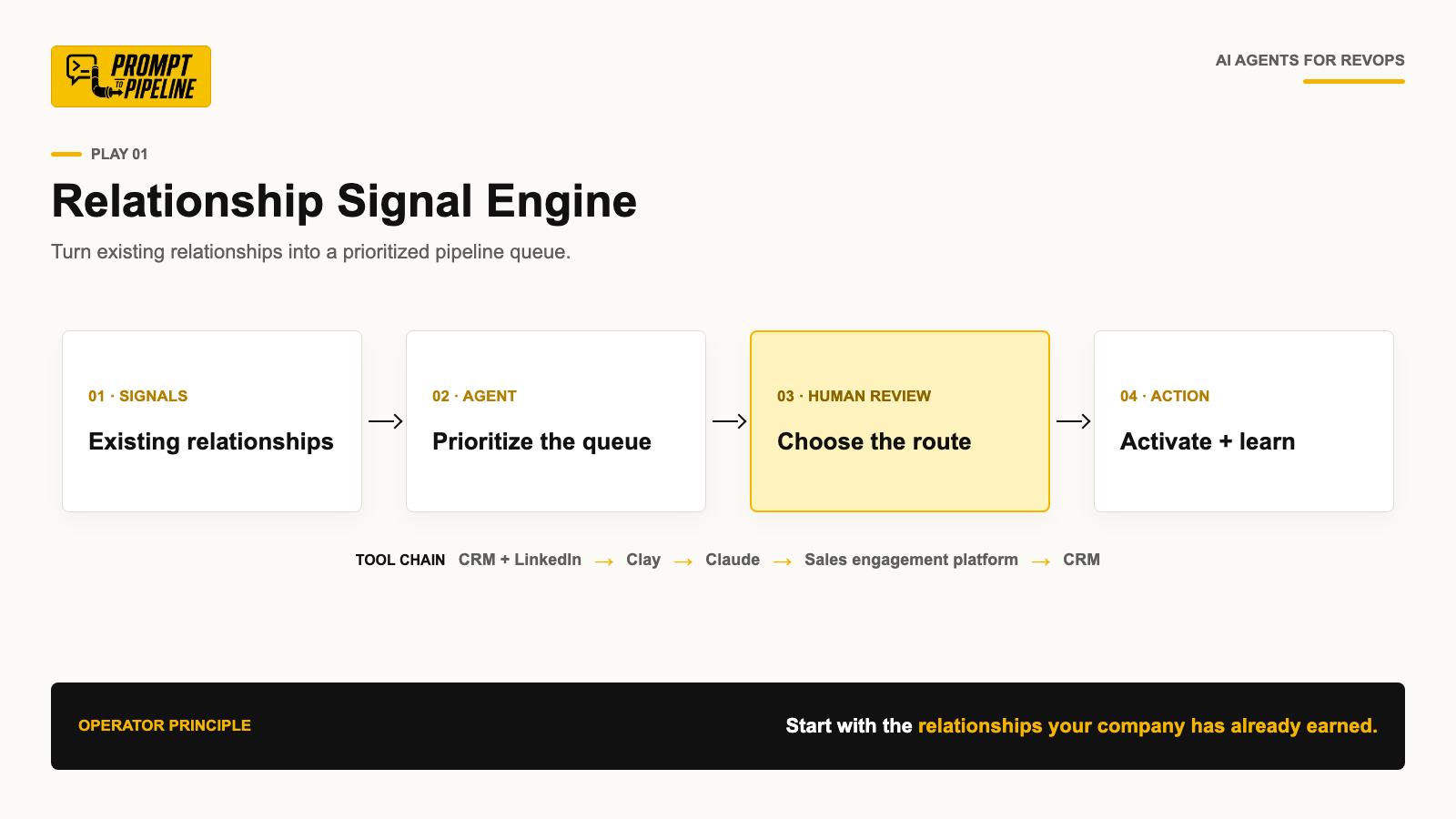
GTM teams reach for another cold list surprisingly often while warm contacts sit quietly across the CRM, LinkedIn network, and opportunity history.
Main purpose: An agent turns your existing relationships into a prioritized pipeline queue.
The workflow begins with customers, former customers, LinkedIn connections, proposal recipients, event contacts, referrals, and previous sales conversations. The agent cleans the records, enriches current roles and companies, and scores each relationship using ICP fit, history, seniority, engagement, and timing.
When a contact crosses the scoring threshold, the agent retrieves the relevant CRM notes and relationship history, then prepares a short context brief and recommends the next step. Tier 1 relationships route to the founder or an executive for a personal message. Sales can handle lower-risk contacts, while weak or sensitive opportunities remain in nurture.
Use case: One founder-led company had approximately 6,000 LinkedIn contacts alongside years of CRM and BDR activity. The first activation pass reduced that network to 300–400 relevant contacts, then identified which relationships justified a founder note, sales follow-up, referral request, or no outreach.
The key shift: Relationship history becomes a continuously updated pipeline asset rather than a contact database reviewed whenever cold outbound starts underperforming.
Tool chain: CRM or contact database → LinkedIn export or relationship data → Clay (or Apollo (cleanup and enrichment) → Claude or another LLM (scoring, context briefs, and draft preparation) → Slack or Notion (human review) → sales engagement platform or direct founder outreach → CRM writeback.
Play 2: Champion Tracking and Customer Alumni Graph
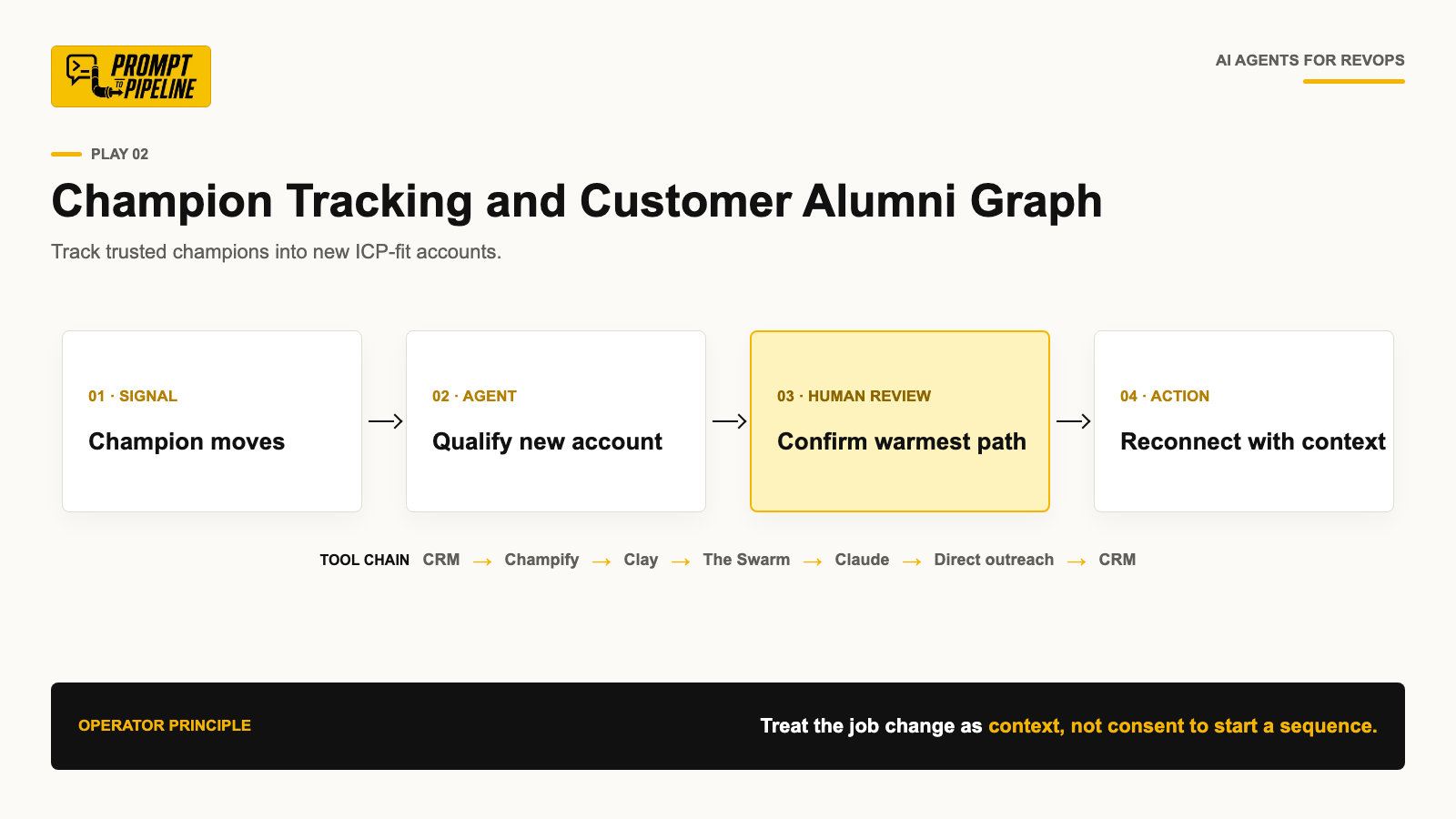
A former champion changing jobs creates a warm path into a new account, yet many teams reduce that relationship to an automated “congratulations on the new role” email followed by a meeting request with all the subtlety of airport lighting.
Main purpose: An agent tracks where champions and customer alumni move, then identifies when their new company creates a credible opportunity.
The trigger is a verified job change into an ICP-fit company, ideally combined with another relevant signal such as new funding, team expansion, a strategic initiative, or hiring around the problem your product solves.
When the trigger fires, the agent retrieves the previous relationship, the contact’s role in the original deal, the problems they cared about, and the internal owner who knows them best. It enriches the new company, evaluates the commercial fit, and recommends a personal congratulations, a relationship-led reconnection, an executive introduction, or quiet monitoring.
Example: A former customer champion joins an ICP-fit company that is hiring RevOps and automation roles. The agent connects the job change with the champion’s previous use case, prepares a short account brief, and routes it to the original relationship owner. The human decides whether the moment deserves a conversation or simply a thoughtful note with no ask attached.
The key shift: Champion tracking becomes relationship intelligence rather than a job-change alert with an email sequence attached.
Tool chain: CRM and customer records → UserGems, Champify, LoneScale, LinkedIn, or another job-change source → Clay (company enrichment and ICP scoring) → The Swarm or relationship graph tooling (relationship paths and ownership) → Claude or another LLM (context brief and recommended action) → Slack or Notion (human review) → direct outreach or sales engagement platform → CRM writeback.
Play 3: LinkedIn Signal-to-Conversation Engine
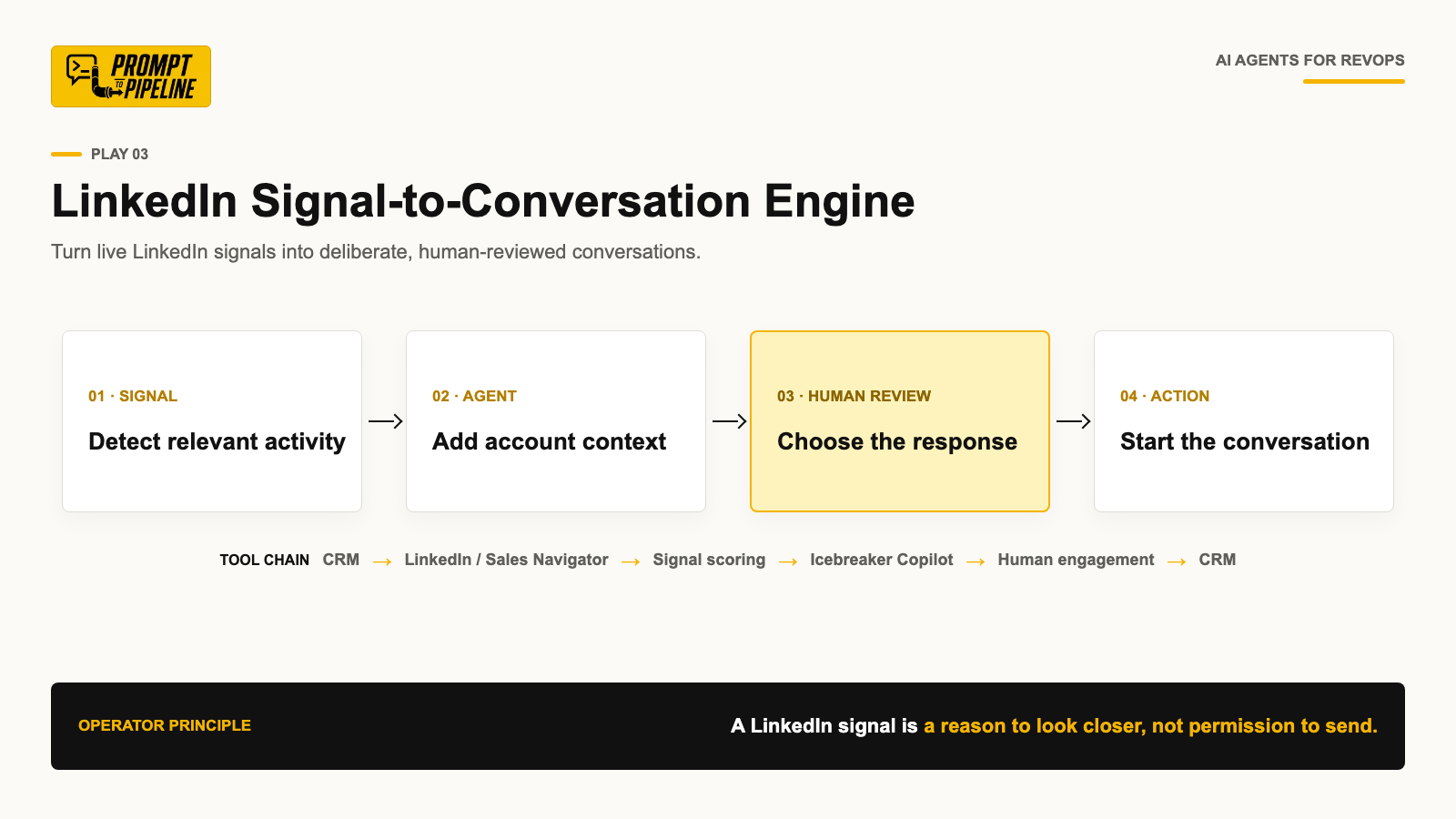
LinkedIn contains live commercial signals across job changes, posts, comments, company announcements, shared relationships, and profile updates, yet most teams use it as either a content channel or a place for sellers to browse without recording what they find.
Main purpose: An agent turns relevant LinkedIn activity into prioritized engagement and relationship-building actions.
The trigger can be a champion starting a new role, a target buyer posting about a relevant problem, an ICP account announcing a strategic change, a prospect engaging with company content, or a mutual relationship creating a warmer path. The agent compares that activity with CRM history, account fit, relationship strength, and opportunity context before recommending an action.
Depending on the signal, the next step might be a thoughtful comment, a connection request, a direct message, a founder note, a referral request, or quiet monitoring. The human decides whether the relationship and timing justify engagement because not every LinkedIn notification needs to become an outbound event.
For the connection-request step, I built the Signal-Led LinkedIn Icebreaker Copilot. The Chrome extension scans visible profile signals and produces a draft icebreaker in a few seconds. The seller adds the context the profile cannot provide, edits the note, and decides whether to send it.
Use case: A former prospect moves into an ICP-fit company and begins posting about rebuilding its revenue workflows. The agent connects the job change and LinkedIn activity with the previous CRM relationship, then alerts the original account owner. The owner reviews the profile, decides that a connection request is appropriate, and uses the Copilot to prepare the first draft.
The key shift: LinkedIn becomes a relationship and buying-signal layer connected to CRM context and deliberate next actions, rather than an isolated feed where useful commercial information disappears by lunchtime.
Tool chain: CRM or relationship tracker → LinkedIn or Sales Navigator (profile and activity signals) → signal scoring and action recommendation → Signal-Led LinkedIn Icebreaker Copilot (connection-note drafting) → human engagement or outreach → CRM writeback.
Play 4: Signal-to-Segment Campaign Engine
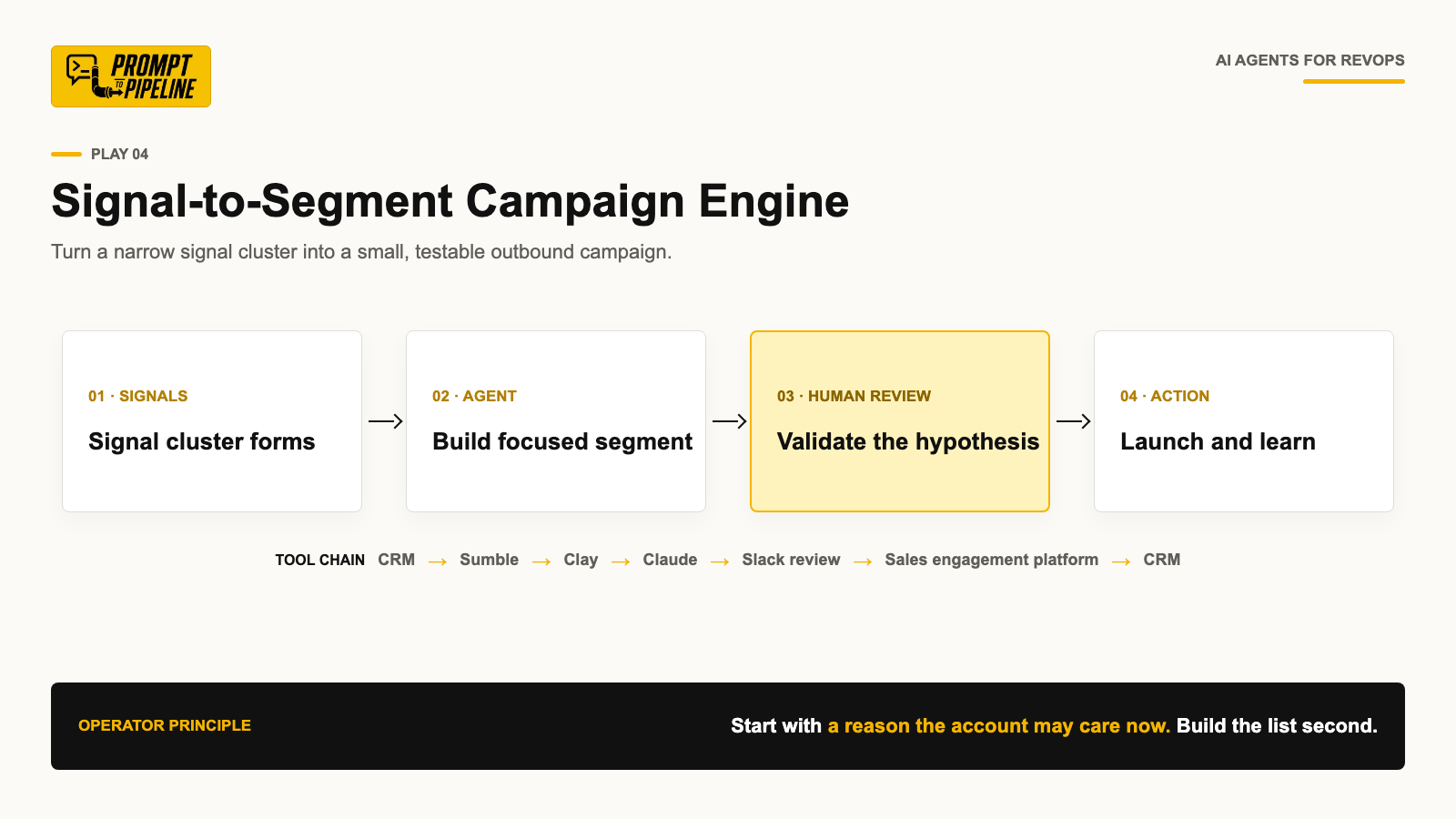
Most outbound campaigns begin with a list and search for a reason to contact it later. Signal-triggered micro-campaigns reverse that sequence by starting with a specific change in the account.
Main purpose: An agent turns a narrow cluster of buying signals into a small, testable outbound campaign.
The trigger might combine a relevant hiring pattern, technology change, funding event, competitor complaint, website activity, or engagement with category content. The agent waits until enough evidence supports a clear timing hypothesis rather than treating every isolated signal as an invitation to launch another sequence.
When the threshold is reached, the agent identifies matching accounts, enriches the relevant contacts, retrieves existing CRM context, and prepares account briefs and message drafts. A human reviews the hypothesis, audience, and messaging before activation, while responses and opportunity outcomes return to the CRM for comparison by signal type.
Use case: A B2B company identifies accounts hiring RevOps and GTM engineering roles while adopting tools associated with revenue workflow redesign. The agent builds a small account list, finds the relevant operations leaders, and prepares outreach connected to the hiring and technology signals. The campaign launches only after RevOps confirms that the segment and timing hypothesis are commercially credible.
The key shift: Outbound begins with a testable reason the account may care now, rather than a large contact list waiting to be seasoned with generic personalization.
Tool chain: CRM → Sumble (company and market signals) → Clay (enrichment and orchestration) → Claude (account briefs and message drafts) → Slack (human review) → existing sales engagement platform → CRM writeback.
Play 5: Website Intent Routing Engine
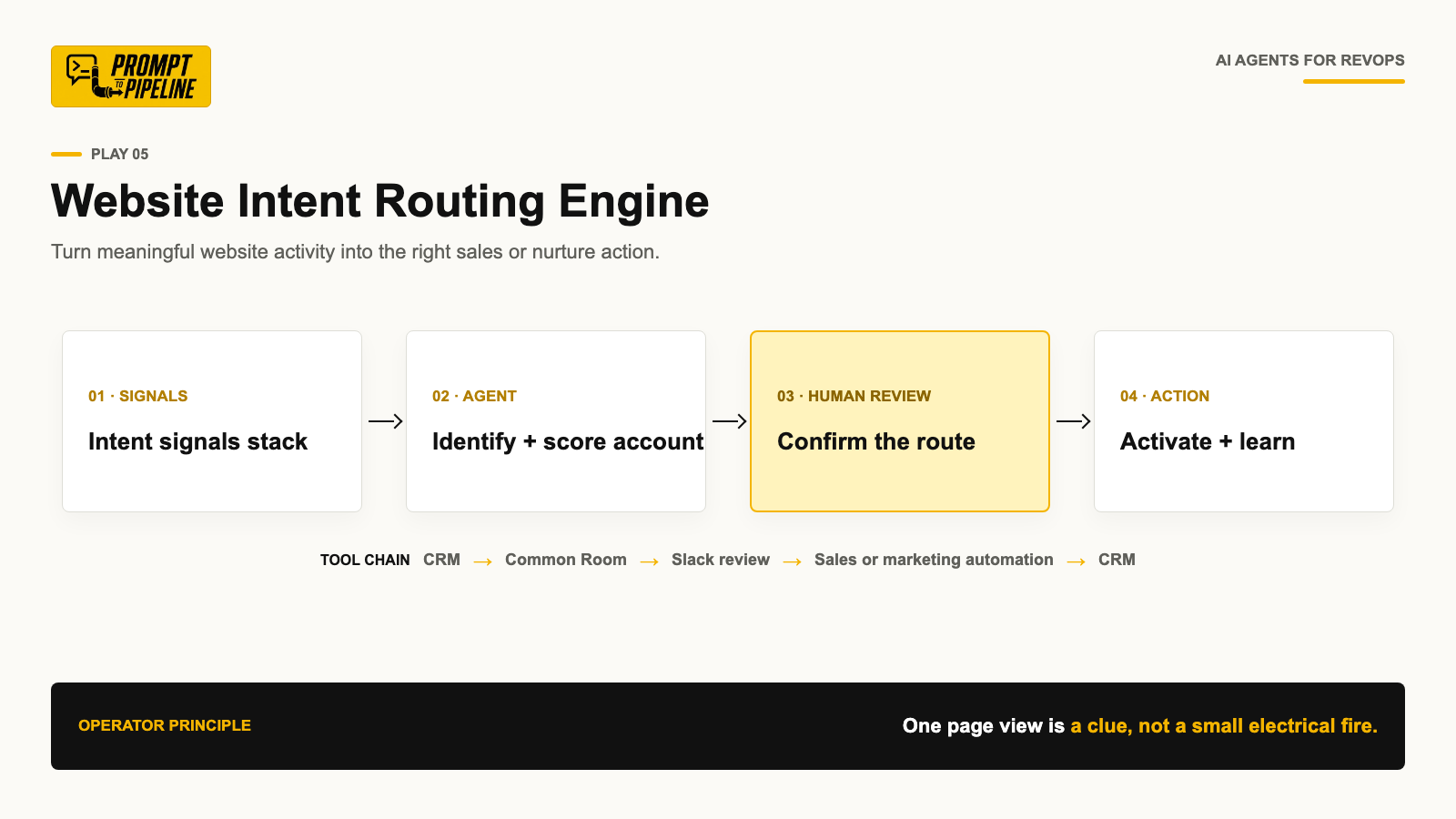
Website intent becomes alert theater when every visitor is treated as a lead and every pricing-page view is delivered to sales with the urgency of a small electrical fire.
Main purpose: An agent determines which website activity deserves sales action, marketing nurture, customer follow-up, or no response.
The trigger combines account fit with meaningful behavior: repeat visits, pricing or comparison-page activity, content engagement, an existing CRM relationship, product usage, or multiple people from the same company appearing within a short period. A single blog visit should rarely be enough.
When the threshold is reached, the agent identifies the account, retrieves its CRM history and ownership, evaluates the pages and signals involved, and recommends the appropriate route. High-value accounts can trigger a brief and Slack review for the account owner, while lower-intent visitors enter nurture or remain unassigned.
Use case: An ICP-fit company visits the pricing and implementation pages several times while a known contact engages with an integration guide. The agent confirms that there is no active opportunity, prepares a short account brief, and routes it to the appropriate seller. The human decides whether the combined activity supports direct outreach or whether marketing should continue nurturing the account.
The key shift: Website activity becomes an input for account-level routing rather than a stream of isolated alerts that sales eventually learns to ignore.
Tool chain: CRM → Common Room (visitor identification, signal aggregation, and account scoring) → Slack (human review and routing) → existing sales engagement or marketing automation platform → CRM writeback.
Play 6: Account Context Briefing Engine
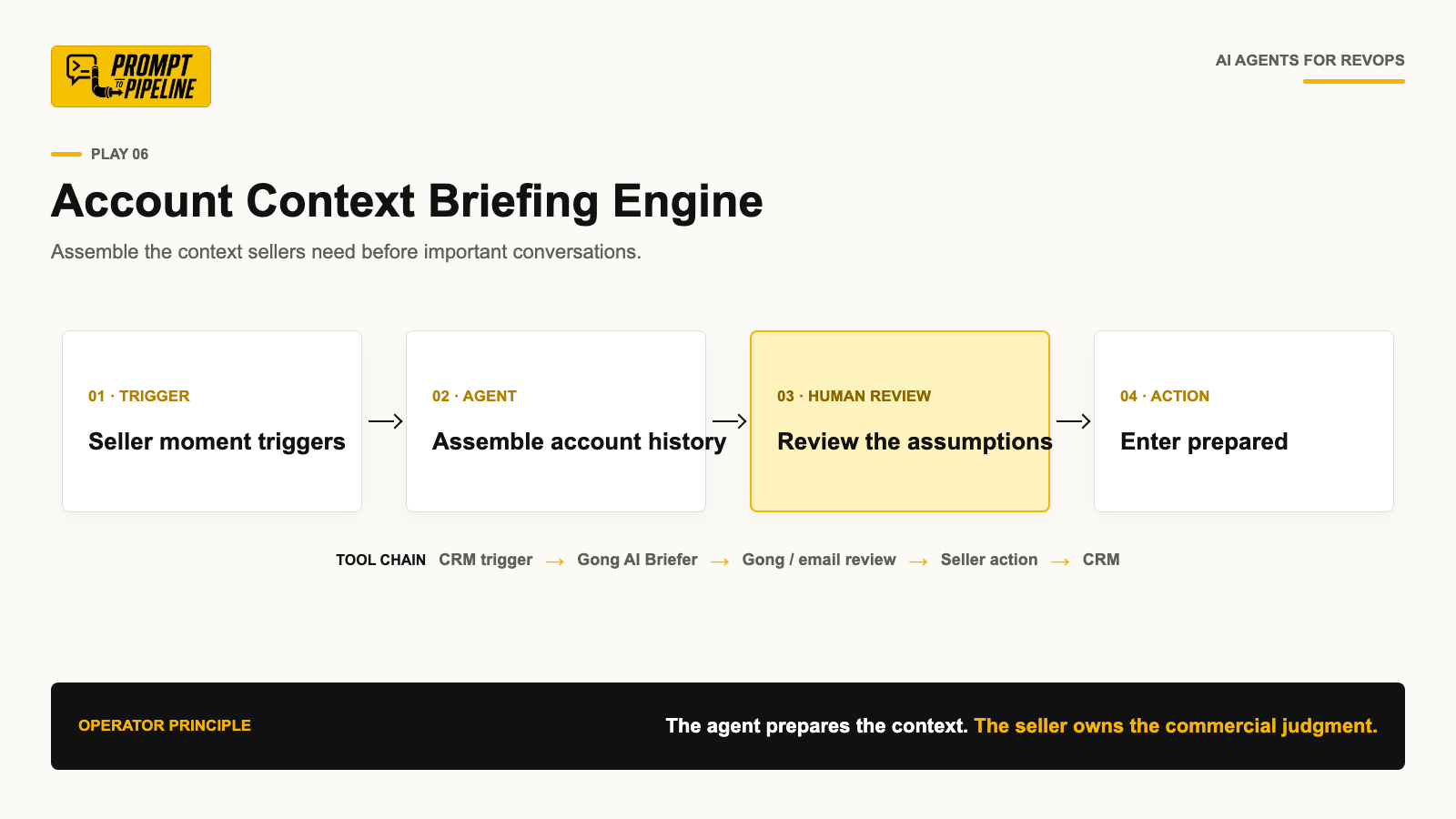
Account research becomes expensive when every seller reconstructs the same company history across CRM records, call transcripts, emails, and browser tabs before an important conversation.
Main purpose: An agent assembles the account history and current context required for a useful commercial conversation.
The trigger can be an upcoming executive meeting, account handoff, deal-stage change, renewal review, or new activity from a Tier 1 account. The agent retrieves previous calls and emails, CRM notes, stakeholders, objections, commitments, deal risks, and relevant company developments.
It turns that context into a concise brief covering why the account matters, what has changed, which priorities and objections have already surfaced, which proof points are relevant, and what the seller should ask next. The account owner reviews the brief before relying on its recommendations because a polished summary can still reach the wrong conclusion with excellent formatting.
Use case: A sales leader is joining an executive meeting with an account that has already completed several discovery calls. The agent summarizes the previous conversations, identifies an unresolved implementation concern, highlights a recent leadership change, and recommends questions for the meeting. The original account owner reviews the brief and corrects any assumptions before it is shared.
The key shift: Account research becomes cumulative and event-triggered rather than being rebuilt manually before every important interaction.
Tool chain: CRM trigger → Gong AI Briefer (conversation, email, CRM, and web context) → email or Gong workspace (delivery and human review) → CRM next-step writeback.
Play 7: Re-Engagement Signal Engine
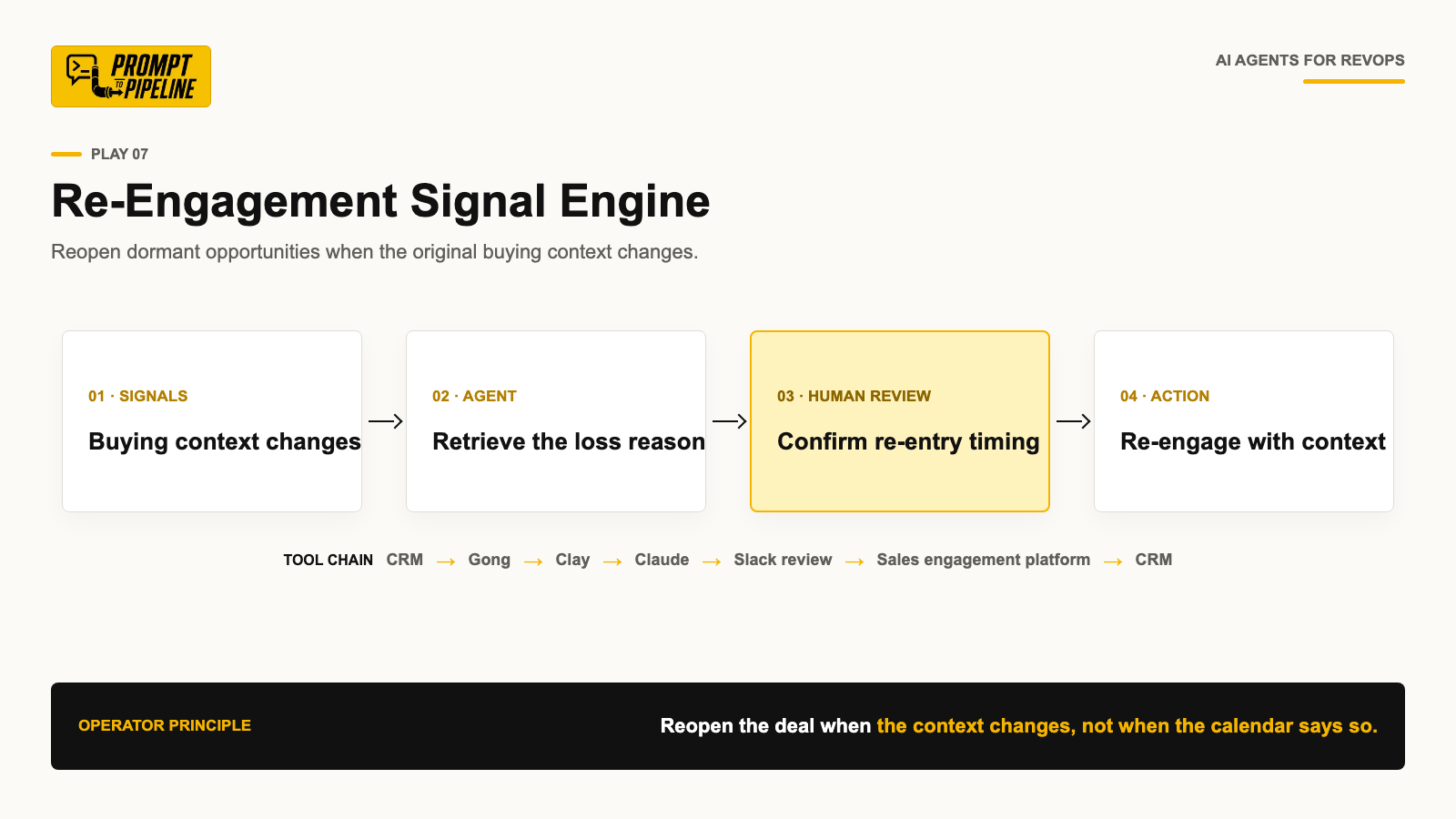
Closed-lost opportunities often become CRM archaeology, even though the reason a deal died is one of the strongest signals for knowing when to reopen it.
Main purpose: An agent monitors dormant opportunities and identifies when the original buying context has changed enough to justify another conversation.
The trigger is a cluster of re-engagement signals: new leadership, funding, hiring around the relevant problem, renewed website activity, competitor dissatisfaction, a product launch, or an integration that resolves the original objection.
When enough signals stack, the agent retrieves the closed-lost reason, CRM notes, previous emails, and the relevant Gong transcript. It identifies the objection that stopped the deal, compares it with what has changed, and prepares outreach grounded in the previous conversation. Tier 1 accounts route to the original rep or an executive for review, while lower-risk opportunities can enter an approved re-engagement sequence.
Example: An account selected a competitor because your product lacked a required integration. The agent monitors product releases, competitor reviews, leadership changes, and website activity. When the integration becomes available and the account returns to the pricing page, it drafts a message that references the original concern and explains what has changed.
The key shift: Re-engagement timing becomes signal-based rather than calendar-based, and the message addresses the actual reason the deal was lost instead of offering a generic “checking in.”
Tool chain: CRM closed-lost pipeline → Gong (previous conversations and objections) → Clay (external signals, enrichment, and orchestration) → Claude (context comparison and draft preparation) → Slack (human review) → existing sales engagement platform or CRM sequence → CRM writeback.
Related reading: These seven plays show what agentic GTM workflows look like in practice. For the broader operating model behind them, read AI GTM in 2026: What High-Performing Teams Do Differently, which explains how signals, context, decisioning, execution, and learning work as one system. If you are deciding who should build and own these workflows, the 2026 State of GTM Engineering maps the roles, skills, tools, and operating mandates emerging around this work.
How To Decide Which Play To Build First
The first play should be the one your team can operate with the least guesswork. Look for a signal that already exists, a person responsible for acting on it, and a next step that can be approved or rejected without opening six tabs and convening a small parliament.
Use four checks:
Signal: Is the underlying data reliable and frequent enough to support action?
Owner: Who reviews the recommendation and owns the next step?
Action: What should happen when the signal crosses the agreed threshold?
Learning: Will the response, meeting, rejection, or opportunity outcome return to the CRM?
If all four are clear, run the play manually with a small group of accounts before automating it. A champion job change connected to a known CRM relationship and account owner may be ready immediately; anonymous website activity with no scoring threshold or routing rule probably needs more design.
Build the workflow after the manual version produces useful conversations or better commercial decisions. Automation should follow a working operating rule, not volunteer to discover one on the company’s behalf.
Three Things To Do This Week
If the seven plays feel like a large menu, use this week to identify one signal, test one workflow, and decide where automation stops.
1. Build a Signal Inventory
Review the signals already available across your CRM, customer records, closed-lost opportunities, LinkedIn network, website activity, event lists, and previous conversations.
For each signal, capture: location · frequency · reliability · current owner · action it can support.
The output is one ranked list of usable signals, with the strongest candidate at the top.
2. Run One Play Manually
Choose the signal with the clearest owner and commercial action. Process a small batch of around 20 accounts or contacts before connecting additional tools.
Good starting points: former champions · closed-lost accounts · ICP-fit website visitors · relevant LinkedIn relationships.
Record the result: useful action · conversation · meeting · monitor · no action.
If the manual workflow produces no useful decisions, automation will only help it reach the same conclusion faster.
3. Set Permissions and CRM Writeback
Map the workflow as a simple sequence:
Enrich → score → stage → route → draft → send
For each step, choose one permission: automatic · human approval required · prohibited. Sensitive relationship outreach and important accounts should remain human-reviewed before anything is sent.
Define the CRM writeback in one line:
Signal · owner · recommendation · decision · response · commercial outcome
By the end of the week, you should have one prioritized signal, one manually tested workflow, one accountable owner, and clear evidence about whether the play is ready for automation.
Operator Note
Across all seven plays, teams already have plenty of signals and an increasingly crowded shelf of tools. What remains scarce is operational clarity: which signal matters, when it deserves action, who owns the decision, and what the system should learn from the outcome.
RevOps should be able to describe any agent workflow in one sentence:
When this signal appears, this owner reviews the recommendation, this action follows, and this outcome returns to the CRM.
Start with one signal and one accountable owner. Choose one primary tool for each function, run the workflow manually with a small group of accounts, and keep human review wherever timing, relationships, or reputation are involved. Automate only after the operating rule produces useful decisions consistently.
Once that logic is clear, agents can remove a meaningful amount of research, routing, and administrative work. Before then, another platform mostly gives the existing confusion a more expensive interface.
Question Worth Sitting With
If your RevOps team added agents this quarter, would they help the company notice warmer buying signals sooner, or would they mostly help the team send more messages to people who were never warm in the first place?
About me
I help founders and GTM teams build or upgrade towards AI-native GTM engines that turn signals, customer context, and AI workflows.
Request GTM Audit
→ 360° assessment + 6-month action plan: Your GTM blindspots revealed
or