
AI can write. (Yes, Captain Obvious has entered the chat.) The more interesting problem is why so much AI-assisted work arrives polished, correct and somehow anonymous.
As production speeds up, brand voice has to move upstream, from the final edit into the brief, the evidence and the judgment behind the draft. Otherwise, AI scales a company’s output while sanding away the parts that make it recognisable.
I asked some industry experts what becomes more valuable when everyone has access to the same tools. Sean Weisbrot, Founder of SparkVox, put the problem bluntly:
“The biggest problem I see everywhere (including LinkedIn), is that everyone’s voice has been replaced by AI’s and become clones of each other because they’re directly pasting something written by AI.”
That sameness has a commercial cost. Buyers have less to remember, sales inherits fewer distinctive claims to carry into conversations, and outbound becomes even easier to ignore.
This article brings together five expert perspectives on the human advantage, shows where brand-voice tools genuinely help, and gives GTM leaders five practical ways to make AI-assisted content sound like their company.
So, what do the experts say?
Sean identified the symptom: AI-assisted content can erase the voice it is supposed to scale. The other experts pointed to the human inputs that keep a brand recognisable.
Nick Rajadurai, Head of GTM at Expertise AI, sees self-awareness as the starting point:
“I think what matters more now is self-awareness. The edge isn’t the AI generating the message. It’s the person behind it, their style, their thought process, their judgment, even the little quirky jokes that make something feel real. AI can help you produce faster, but it still needs to be fed the right taste and perspective. When everyone has access to the same tools, the advantage goes to the people who bring something distinct into them.”
Andrew Royal, Founder and Principal of Full Stack RevOps, focused on the judgment required when production speeds up:
“While AI has improved workflows, speed of execution, and the ability to get more done in less time, there is one skill that has become increasingly important: critical thinking and an eye to catch mistakes. Getting the perfect response from an AI requires you to balance the speed of delivery with a meticulous, intentional critical eye. Not only is it about prompting the right things, but it also requires questioning the machine.”
Justyna Waciega, B2B marketing strategist, content creator and ghostwriter, brought that judgment back to the brand:
“AI can’t make objective decisions (at least not yet) and it can’t say which option is better or what angle doesn’t work for a specific brand. You need a human expert on the other end that has the final say and that can make a decision based on insights from years in the industry.”
Ina Toncheva, creator of The Irreplaceable Marketer newsletter and a speaker on content marketing in the AI era, adds the ability to make instinctive expertise explicit:
“One skill that becomes super valuable because of AI is the ability to make your instinctive knowledge explicit. To take something you do on autopilot and break it down precisely enough that a machine can follow it. What’s different now is that AI gives you an immediate test: if your breakdown is right, the result will show it. This skill will help people do things that weren’t possible before instead of just doing more of the same.”
Taken together, the experts point to the same division of labour: tools can apply a voice; people have to decide what the brand believes and what deserves to be said.
The experts’ views have a commercial edge. In LinkedIn and Edelman’s 2024 study of nearly 3,500 managers, 75% said thought leadership had led them to research a product or service they had not previously considered, and nine in ten were more receptive to outreach from companies producing consistently strong thought leadership. Yet only 15% rated the thought leadership they consume as very good. Buyers respond to useful thinking; the market simply produces too little of it.
Five tools promise to protect your brand voice. Where do they actually help?
Choose the tool according to where the voice breaks down. Five subscriptions will not give the company five times the personality.
1. Notion and Notion Agent: shared company context
Notion Agent can query a database of approved positioning, customer language, proof and claims before drafting. Use it when the main problem is scattered or outdated context.
2. HubSpot Brand Voice: content produced inside HubSpot
HubSpot’s Brand Voice learns from writing samples and applies the voice to content created in HubSpot. Use it when the website, blogs and marketing emails already live in that ecosystem.
3. Writer: rules across teams and channels
Writer can enforce terminology, style and restricted language across different workflows. Use it when marketing, sales, support and compliance need the same rules.
4. Jasper IQ: brand-grounded marketing generation
Jasper IQ combines brand voice, audience definitions, company knowledge and style rules across Jasper’s content tools and agents. Use it when Jasper is the main marketing-production workspace.
5. Grammarly Brand Tones: guidance wherever people write
Grammarly Brand Tones gives writers real-time feedback against an organisation’s tone profile. Use it when the team needs a lighter editing layer rather than another content-production system.
Opinion: HubSpot, Writer and Jasper overlap. Most B2B teams need one context source, one application or governance layer, and one human-in-the-loop owner. That person approves the source material, new claims and proposed changes to the voice. The five-tool tasting menu is optional.
Five things GTM leaders can do today to make AI content sound like their company
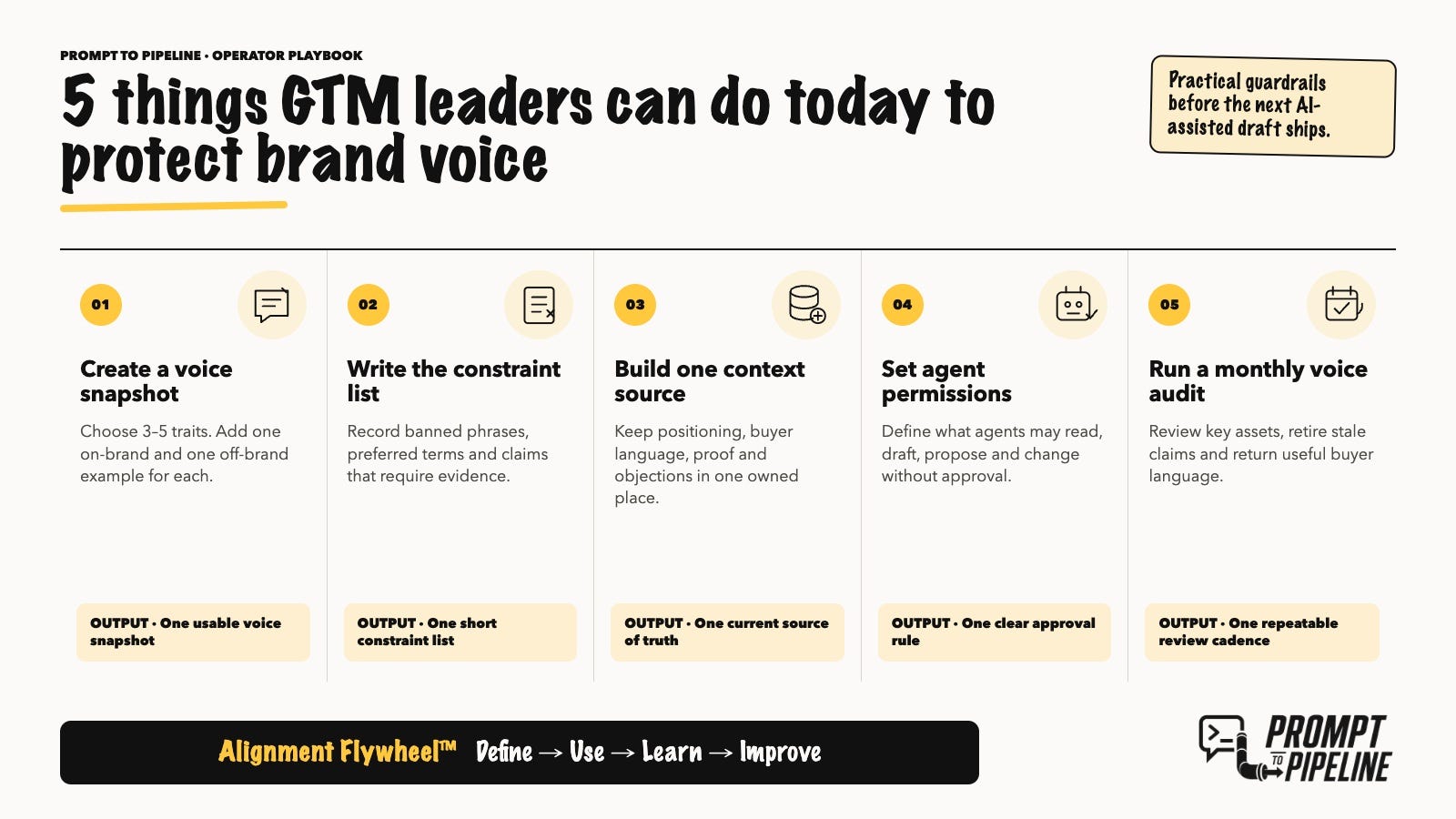
Create a voice snapshot. Choose three to five traits and add one approved and one off-brand example for each.
Write the constraint list. Record banned phrases, preferred terminology and claims that require evidence.
Build one approved context source. Store current positioning, customer language, proof, differentiators and common objections with an owner and review date.
Set agent permissions. Decide what agents may read, draft and propose, and which changes require human approval.
Run a monthly voice audit. Compare the website, sales deck, outbound and recent content; retire stale claims and return useful buyer language to the context source.
The output is one voice snapshot, one constraint list, one current context source, one permission rule and one review cadence. Together, they create the Alignment Flywheel™ for brand voice: define the context, use it, learn from the market and improve it.
What else to read on this topic
If this raised questions about what AI systems learn from your company’s content, read How to Make ChatGPT Recommend Your Product: A Practical AEO Guide for AI Search Visibility. It covers the other side of the same problem: making your positioning, proof and customer context clear enough for answer engines to understand and recommend the product accurately.
About me
I help founders and GTM teams build or upgrade AI-native GTM engines that turn signals, customer context and AI workflows into pipeline.
Want to work with me?