
At some point, “What are we doing with AI?” becomes a question you’re expected to answer in a leadership meeting. You’re still responsible for pipeline, positioning, and a team with a full workload, while also deciding which capabilities to build and which experiments deserve investment.
The expectation is to move quickly, with enough judgment to avoid spending the quarter on something nobody uses.
When I talk to teams about adopting AI, I usually look at how the leader is learning, whether people have time to experiment, and who will help useful ideas become part of everyday work. The tool budget is often easier to agree on than what comes off the calendar or who takes responsibility after the first demo. Those decisions tell me more about how ready the team is to move forward.
What you will learn
How to build your own AI fluency so you can give the team direction and assess where it needs support.
What your team needs to adopt AI: paid tools, time to experiment, practical training, and permission to learn through failed attempts.
How to turn individual experiments into shared capabilities through hackathons, onboarding, and a regular GTM review cadence.
How to assess your team’s AI readiness, identify the gap holding adoption back, and decide which initiatives deserve further investment.
Where is your AI adoption getting stuck?
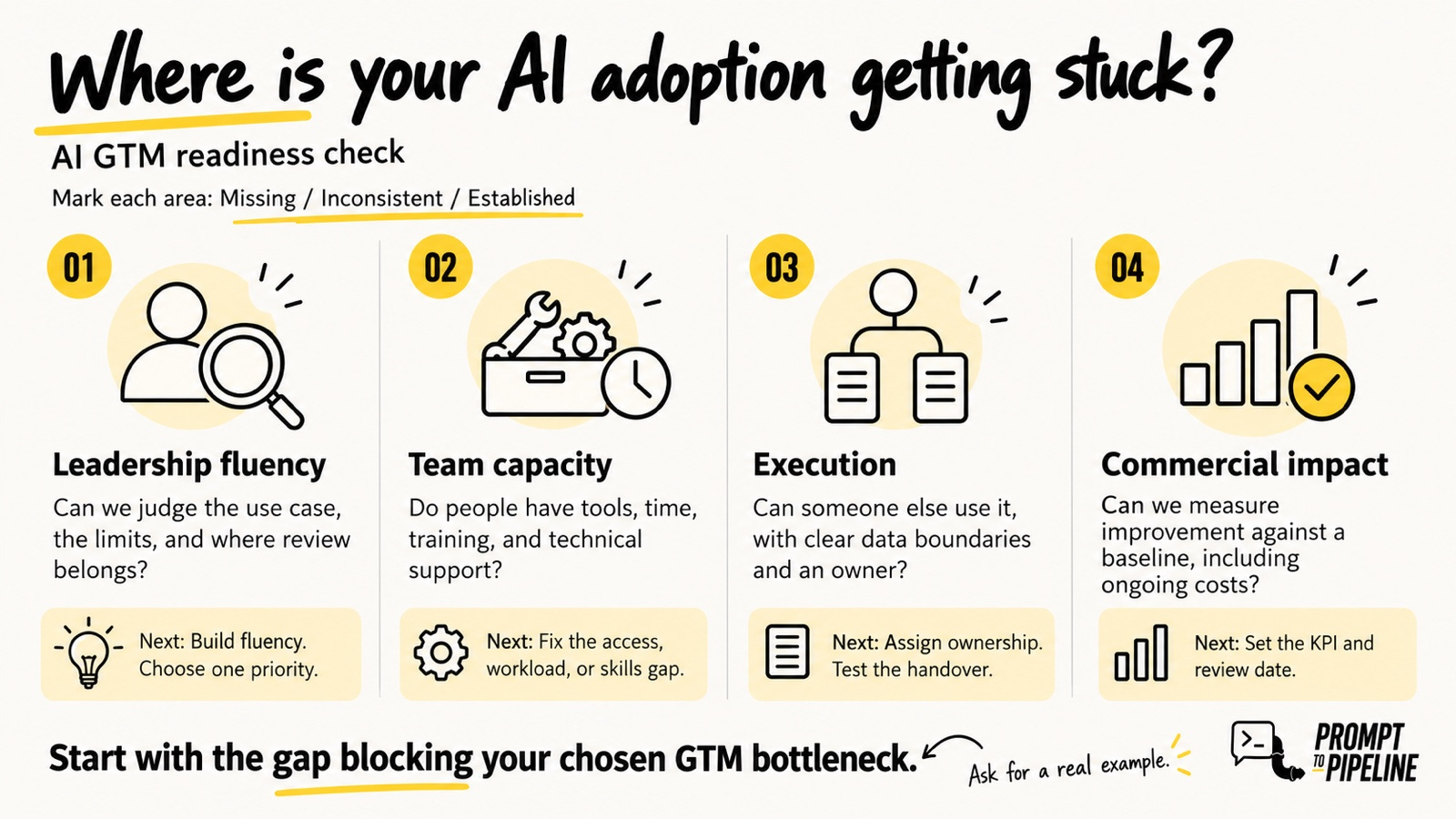
Before deciding what to buy or build next, I would check four things: leadership fluency, team capacity, execution, and commercial impact. Use the questions below with marketing, sales, and RevOps, and mark each area as missing, inconsistent, or established. Ask for a recent example behind each answer; “we have access to ChatGPT” leaves quite a lot unanswered.
Leadership fluency
Question: Can we judge what AI can do, where it needs review, and which GTM problem deserves attention?
Next: Build practical fluency and agree on one priority.Team capacity
Question: Do people have the tools, time, training, and technical support to apply AI in their roles?
Next: Fix the specific access, workload, or skills gap.Execution
Question: Can colleagues use a promising workflow, with clear data boundaries and someone responsible for maintaining it?
Next: Assign ownership and test whether someone else can use it.Commercial impact
Question: Can we compare results with a baseline, including review effort and ongoing costs?
Next: Define the KPI and review date before investing further.
Keep the four answers separate. Strong personal usage can coexist with weak team adoption, and a good prototype can still lack an owner. Start with the gap preventing progress on your chosen GTM bottleneck, give it an owner, and agree on what would demonstrate improvement. That gives you a concrete next decision without pretending the whole team fits neatly into one maturity score.
Waiting makes it harder to know where to start
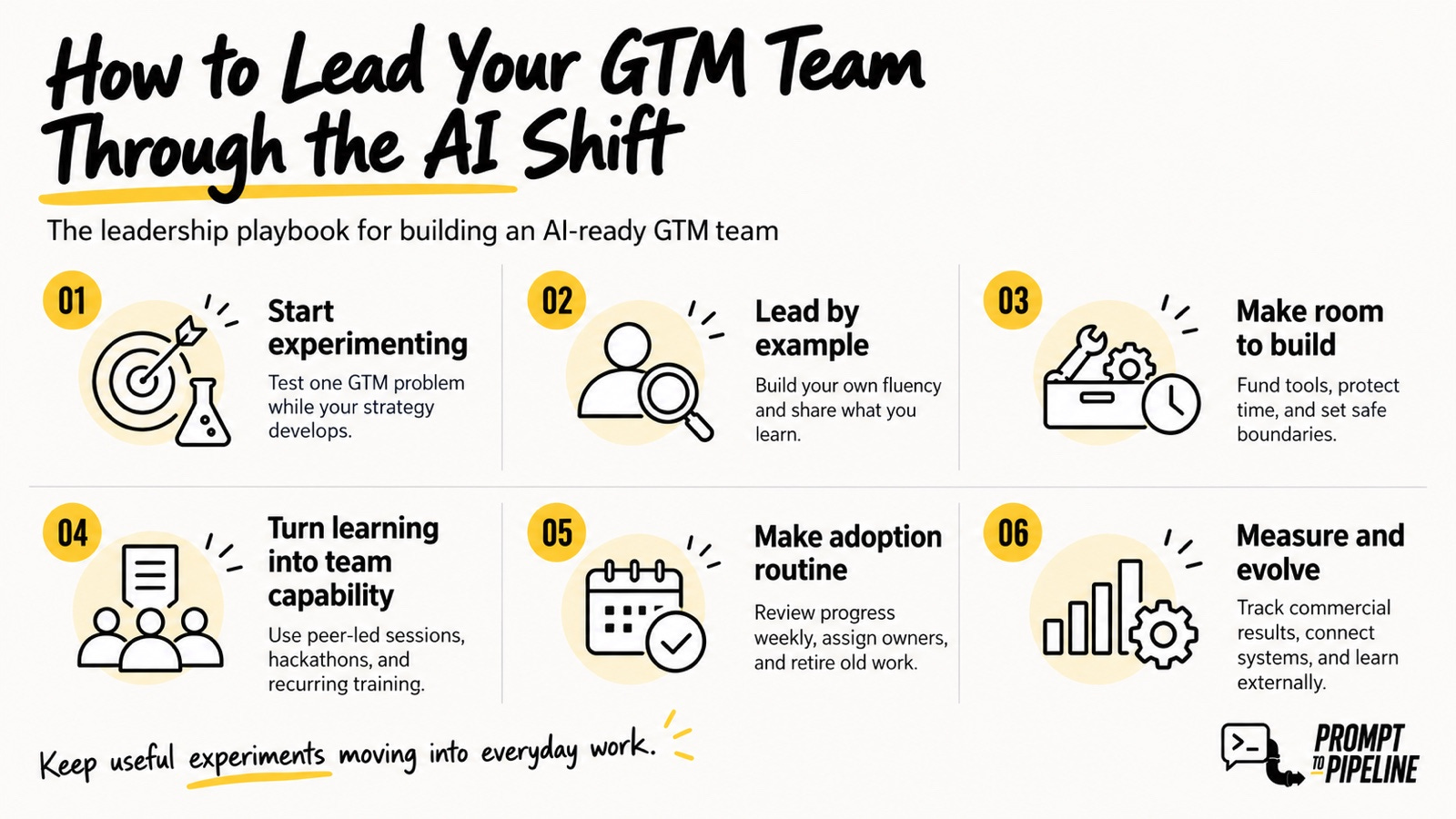
AI is already being used in account research, customer analysis, campaign production, and recurring GTM work. My advice is to start learning through practical use while you develop the strategy. Spending six months planning before testing anything leaves the budget, priorities, and hiring decisions resting on assumptions you could already be examining. By then, the strategy may be beautifully presented and overdue for an update.
Keep the first experiment manageable enough to learn from before expanding the scope:
Choose one problem. Pick recurring GTM work where you can observe whether the approach helps.
Give someone ownership. Make clear who will test it and record what happens.
Review before expanding. Use the findings about your data, team skills, and implementation effort to shape the strategy.
Your team is watching how you use AI
I would treat your own AI fluency as part of the leadership job. If every proposal requires someone else to explain what is possible, you will struggle to judge the investment or give the team direction. Make time for practical training, videos, podcasts, and conversations with experienced operators, then use the tools yourself. Choose a starting point that matches your current fluency:
Google AI Essentials offers a beginner foundation in everyday AI use, prompting, and responsible use, with hands-on workplace activities.
Anthropic’s AI Fluency: Framework & Foundations covers delegating work, giving instructions, evaluating outputs, and responsible use.
OpenAI Academy’s AI Leadership course covers business priorities, ownership, governance, and adoption. Look for AI Leadership under Lead AI Adoption.
Apply the learning to a GTM problem your team actually faces, then share what you are trying, what needed correction, and what proved less useful than expected. Becoming AI-native involves knowing enough about the capabilities and limitations to judge a proposal, ask useful questions, and recognize where human review belongs. Your own participation also makes it easier to set reasonable expectations for a team that is learning alongside you. When I help teams work through these decisions, the priorities, workload, and ownership shape what is worth implementing.
Give your team the time, tools, and confidence to experiment
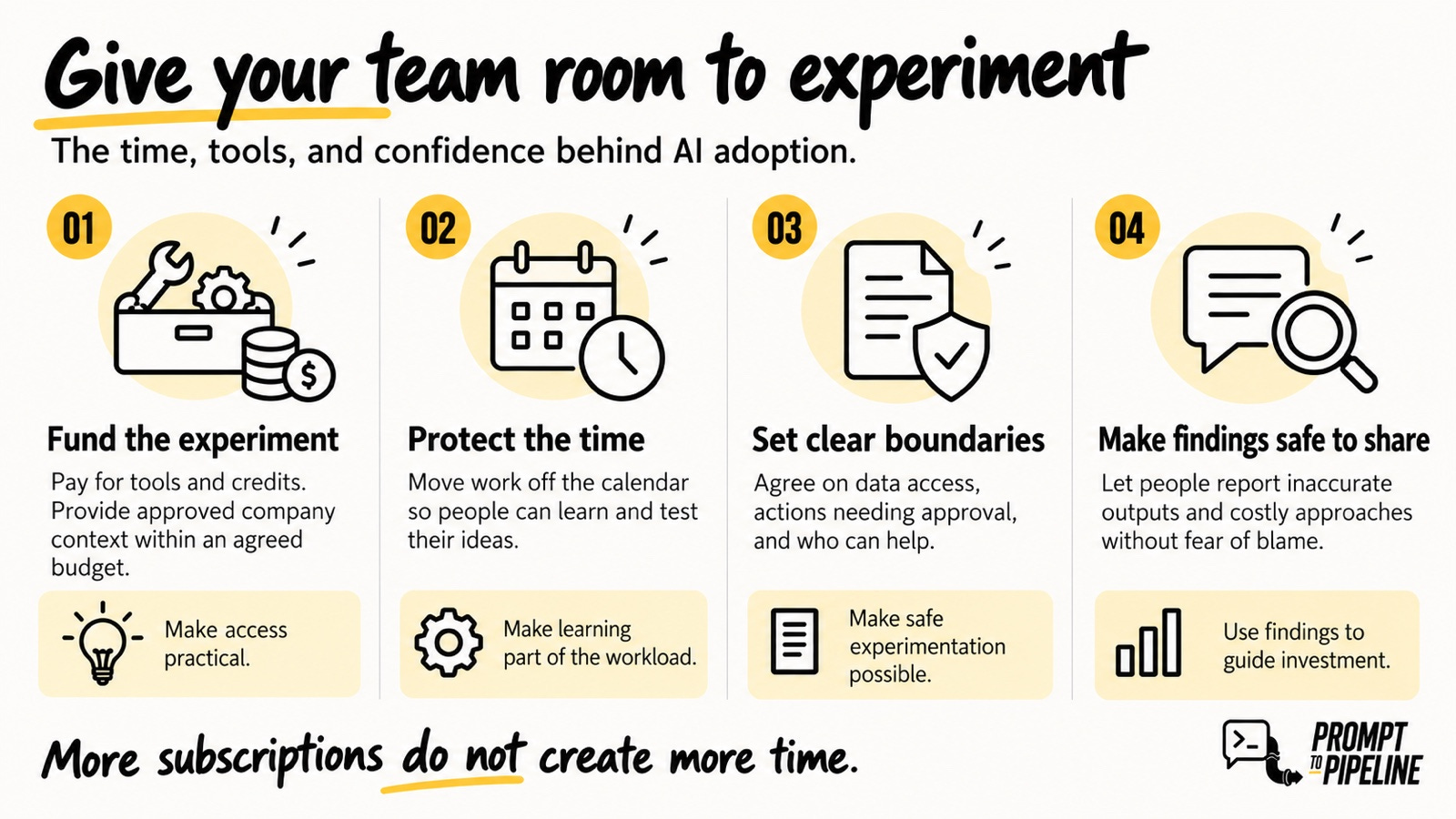
If you expect your team to adopt AI, pay for the tools they need and make learning part of their workload. Adding subscriptions while leaving everyone’s workload untouched is rather like handing out ingredients and expecting dinner to arrive. The practical decisions sit with you:
Fund the experiment. Arrange paid tools, credits, and access to relevant company information within an agreed budget.
Protect the time. Decide what moves off the calendar so people can learn and test their ideas.
Set clear boundaries. Agree on which data people can use, which actions need approval, and who can help when they get stuck.
Make disappointing results safe to share. Finding inaccurate outputs or an approach that costs too much to maintain should inform the next decision, rather than count against the person who tested it.
You need those findings to make investment decisions, and people need to know they can bring them to you.
Help good AI ideas spread across the team
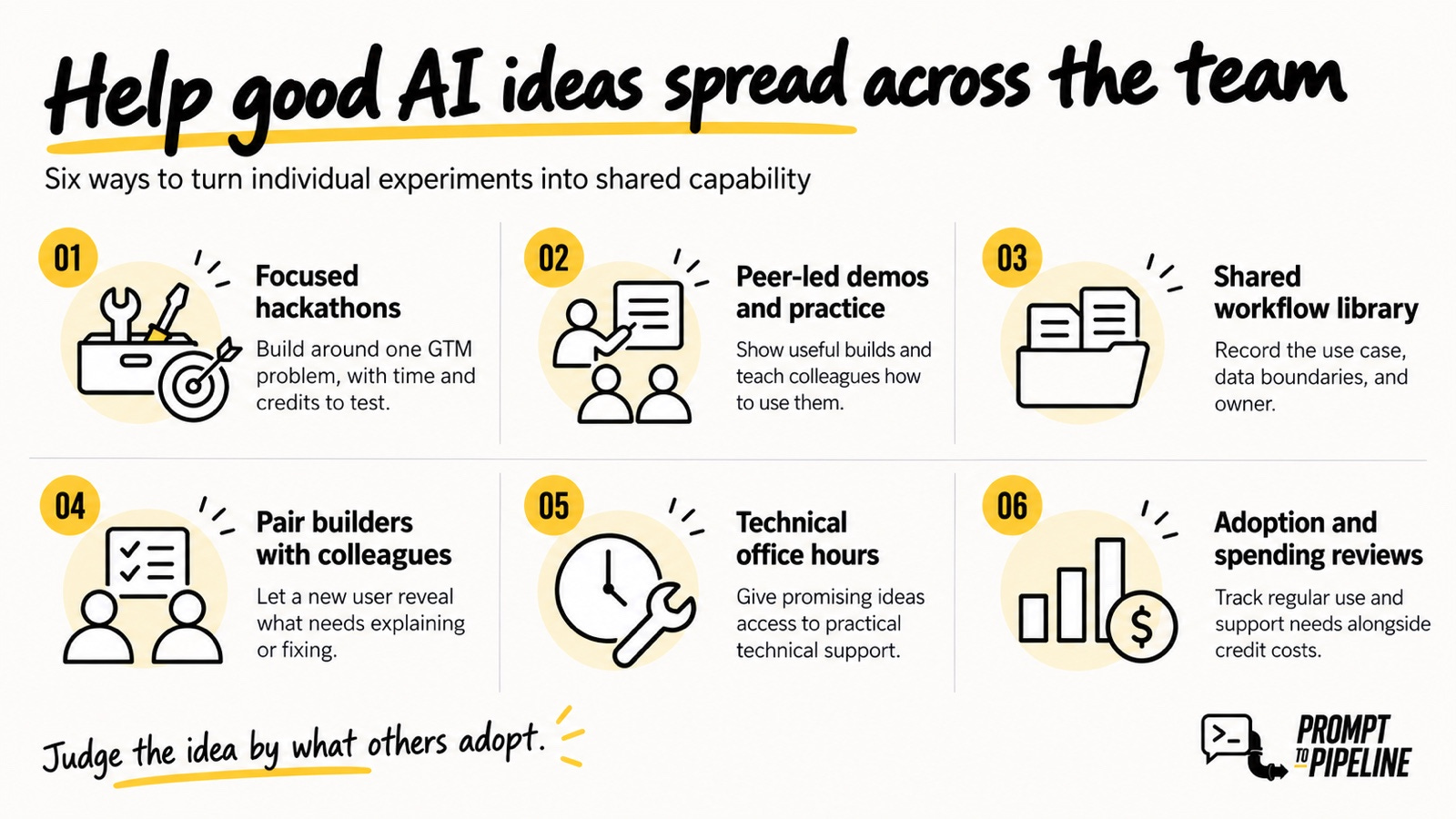
Give people a way to learn from each other’s experiments, especially across marketing, sales, and RevOps. I would look at whether a useful idea can travel beyond the person who built it: can a colleague try it, understand its limits, and get help when something breaks? A few practical ways to make that happen:
Run focused hackathons. Bring people together around one GTM problem, with protected time and enough tool credits to build and test an approach.
Hold short show-and-tell sessions. Ask people to share what they built, what went wrong, and where a colleague could use it.
Run peer-led practice sessions. Ask colleagues with more experience to teach the tools and approaches they already use. Someone working in an environment that coordinates multiple agents could walk the team through how they divide tasks, review results, and keep control of the work, then help others try it themselves.
Keep a shared workflow library. Record useful builds, the problem each solves, approved data boundaries, and who to contact for help.
Pair builders with colleagues. Have someone outside the original experiment try the workflow; their questions will reveal what needs explaining or fixing.
Offer technical office hours. Give people access to a technical marketer, RevOps specialist, GTM engineer, or external advisor who can help promising ideas move forward.
Review adoption and spending together. A simple dashboard can show which builds enter regular use and where people need support. Ranking colleagues by credit consumption gives them a rather expensive incentive.
Choose the formats your team can sustain, and make someone responsible for taking useful experiments into everyday work. I would judge these activities by what colleagues adopt afterward and what improves as a result. A popular prototype still needs someone willing to maintain it.
Closing the AI skills gap in your GTM team
New hires and established colleagues need a shared foundation, with opportunities to update it as AI capabilities change. I would make practical training a recurring part of how the team works, with clear expectations about what people should be able to do afterward:
Include AI in onboarding. Give newcomers the same foundation as the rest of the team, including approved tools, data boundaries, and workflows already in use.
Set a regular training cadence. Schedule hands-on sessions at a pace you can sustain, such as monthly, led by an internal expert or external advisor who understands your GTM priorities.
Build something relevant to the role. Have participants create or improve an agent or workflow for their own work, with time to test it and get feedback.
Share the learning. Let people explain their approach, compare results, and discuss what needed correction so colleagues can learn from the same exercise.
Measure what happens afterward. Track completed builds, then check which enter regular use and whether people can explain and maintain them. I would use those as training KPIs; attendance tells you very little about whether someone can apply the learning without help.
From AI pilots to everyday GTM execution
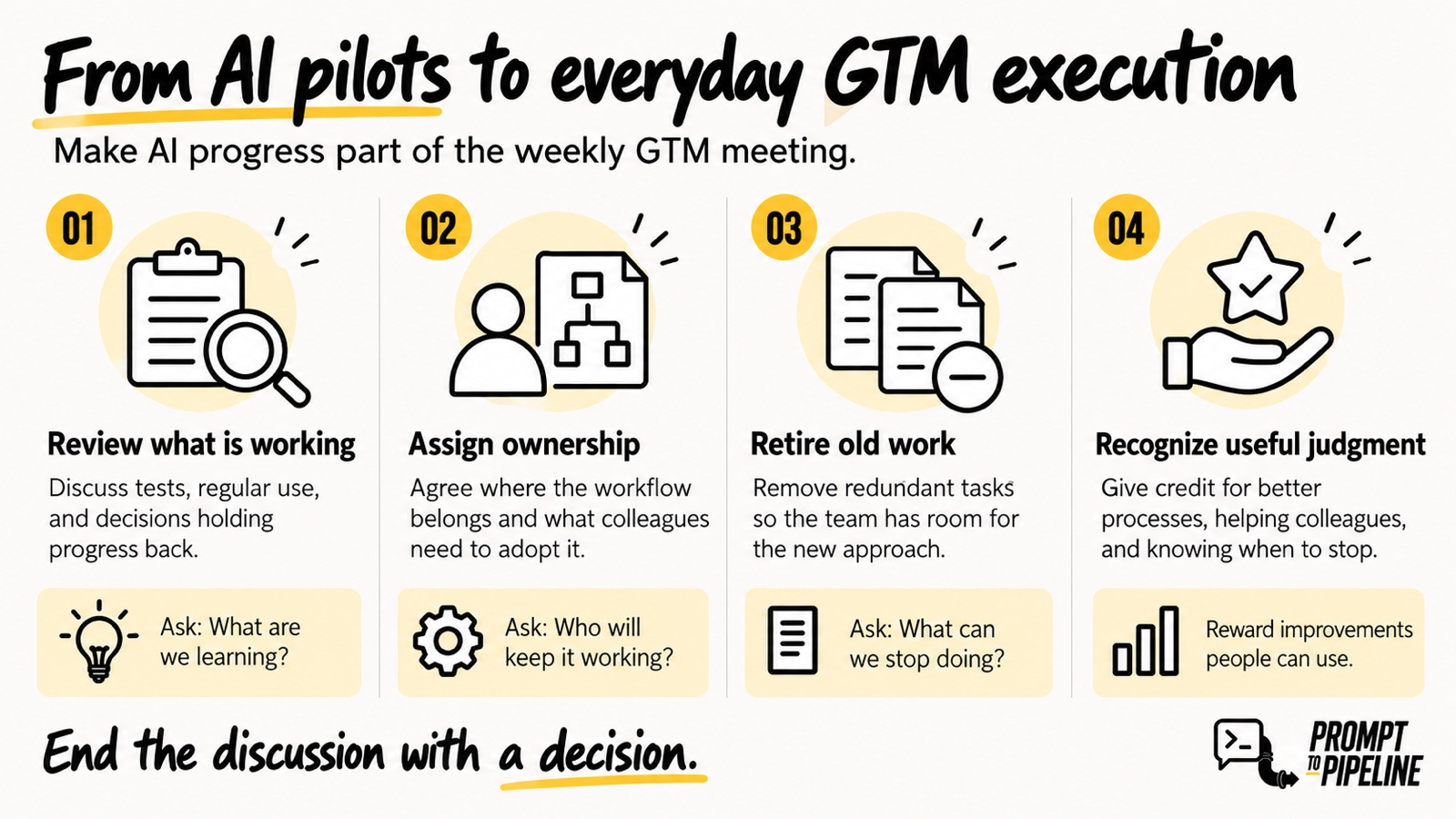
Bring AI progress into the existing weekly GTM meeting, with a few recurring questions that lead to decisions:
What are we learning? Review what is being tested, what has entered regular use, and which decisions are holding it up.
Who will make it part of the process? Agree on an owner, where the workflow belongs, and what colleagues need to adopt it.
What can we retire? Decide which old tasks or process steps can disappear so people have room for the new approach without maintaining both versions indefinitely.
Reinforce that routine through regular feedback and recognition. Give credit to people who improve a process, help colleagues adopt it, or provide evidence that an experiment should stop. Set expectations around examining how AI could improve work in their roles, with room for justified decisions to keep a task human. Rewarding useful judgment makes the standard clearer than rewarding the volume of AI activity.
Keep your GTM thinking ahead of your current playbook
As AI adoption grows, agree with marketing, sales, and RevOps on the commercial result that would justify further investment. I would keep reviewing four things as the tools and your team’s capabilities develop:
The result you are measuring. Choose a primary KPI, such as pipeline conversion, sales velocity, or production cost, and establish the baseline. Keep it close to the work you are changing, allowing time for commercial outcomes to emerge.
The full cost of improvement. Include subscriptions, reviewing outputs, correcting mistakes, and maintenance in your view of AI ROI; faster production can still carry substantial costs.
The infrastructure behind useful work. Connect the data, company knowledge, and systems needed to repeat proven approaches reliably, with an owner who can review performance and adapt the workflow.
What other operators are learning. Compare what they have put into regular use, what it costs to maintain, and what they have stopped. Those conversations are more useful for your next decision than another impressive demonstration.
Three things to do this week
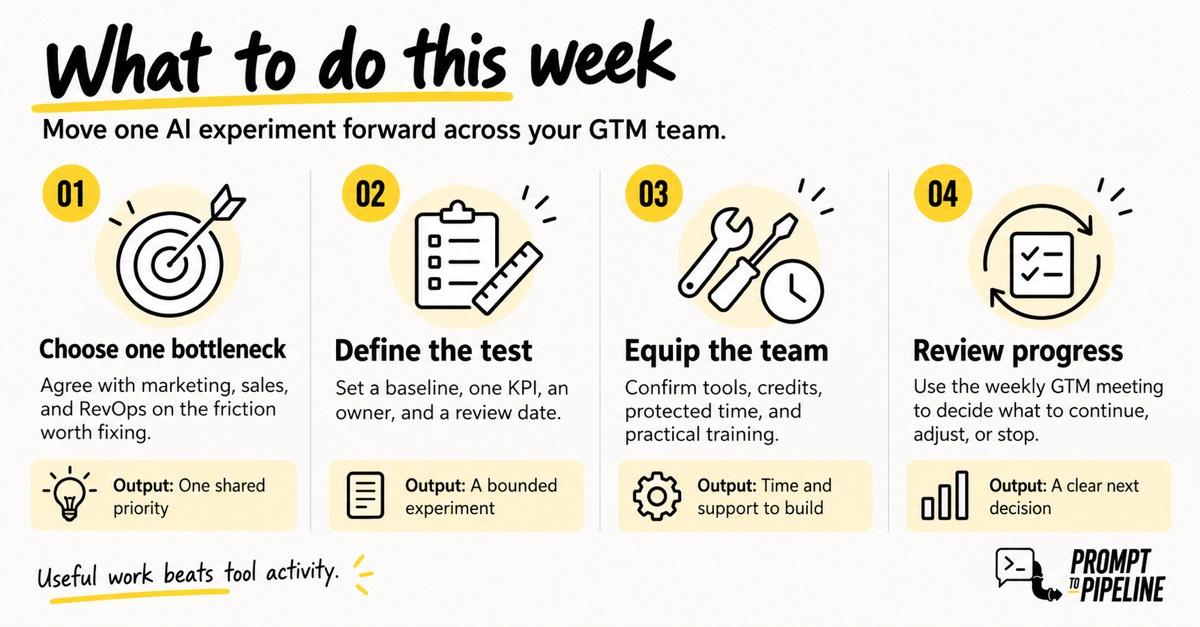
Choose one commercial bottleneck. Bring marketing, sales, and RevOps together to identify a recurring friction point, agree on a primary KPI, and record the current baseline. Assign an owner to a bounded experiment and set a date to review the result.
Check whether the team has what it needs. Confirm access to paid tools and credits, time to learn, and someone who can provide technical support. Schedule a practical training session that includes both new hires and established colleagues.
Add AI progress to the weekly GTM meeting. Review what people have tried, what they are using, and where they need help. End with a decision about what to continue, adjust, or stop, and recognize contributions that help colleagues improve their work.
Operator note
Before giving an experiment more budget, I would ask three questions. An unanswered one gives you a specific gap to resolve before scaling and a clearer brief for whoever helps you resolve it:
Value: Has it improved the work?
Adoption: Can someone else use it?
Ownership: Who will keep it working?
If the readiness check leaves you unsure which gap to address first, my AI GTM Maturity Snapshot is a useful next step. Answer 10 focused questions about your GTM setup, and I review the pattern behind the friction to give you a practical view of your current stage, the constraint holding adoption back, and one next move. It is designed for leaders in companies with 200+ people, where adoption has to work across teams.