


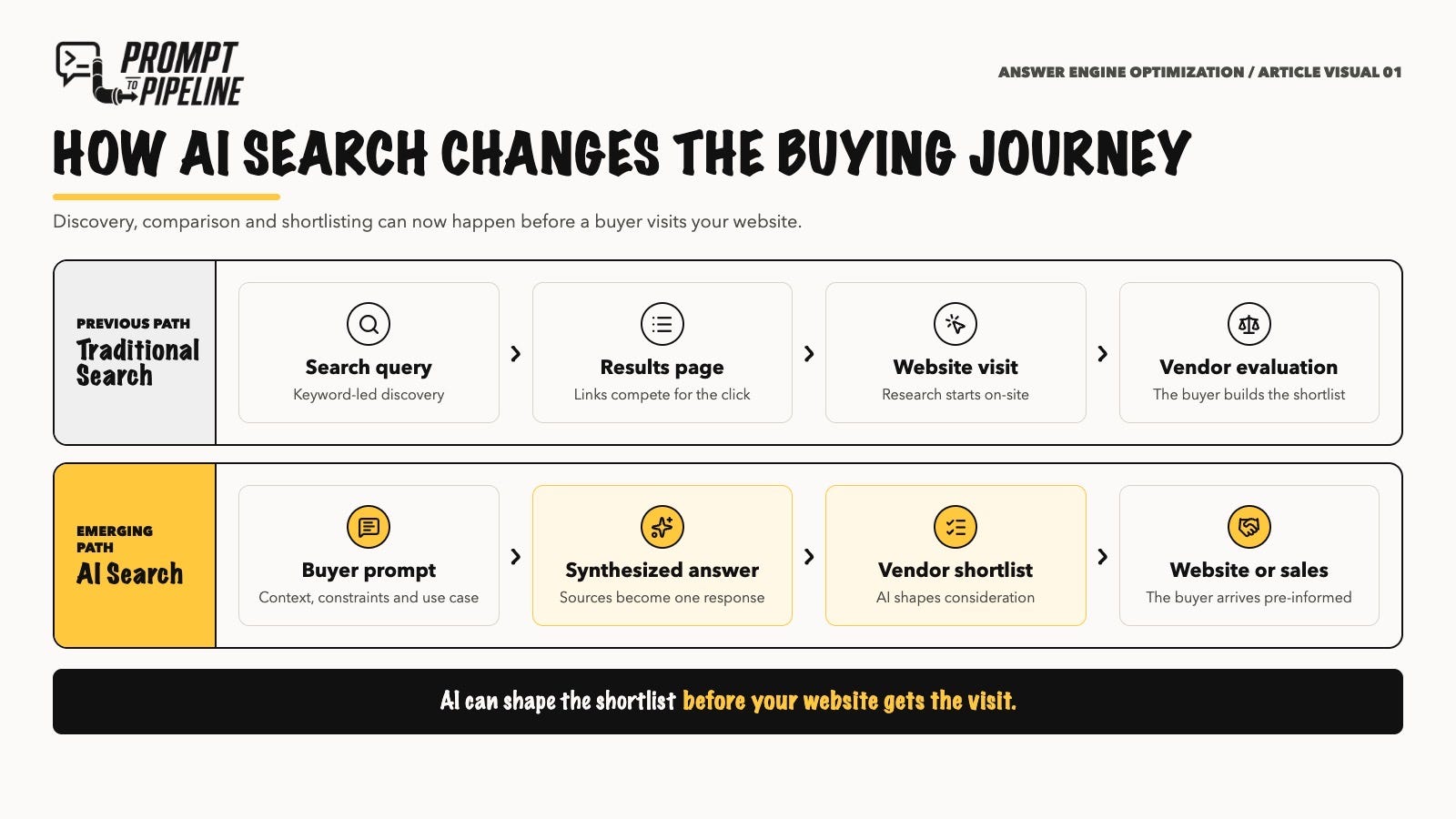
These days buyers get in touch with your sales team once they’ve already read the website, compared three competitors, skimmed a few reviews, and asked ChatGPT whether your category is just five vendors wearing the same jacket.
The question is whether ChatGPT mentioned your product while your buyer was researching, or sent them to the competitor your team still describes as “not really in our space.”
With that in mind, AI is now a serious part of the conversation before the website visit: it helps buyers form a category, assemble a shortlist and decide which claims sound credible enough to investigate.
(Your product page and sales team do matter, but they enter the picture after the first version of your company has already been created.)
What is Answer Engine Optimization (AEO)? It’s a practice of making it easy for AI assistants to understand, trust, and recommend your company and product.
It involves creating clear positioning, direct answers to common questions, credible third-party evidence, and technically accessible content so AI models have reliable information to draw from. Instead of improvising your story, answer engines can accurately explain why your product fits a buyer’s specific situation.
Does website remain important? Yes, but it is only one input. Answer engines assemble their “view” from a variety of sources: product content, customer stories, reviews, partner pages, industry coverage and the old category description someone published three years ago and never corrected.
That’s why AEO sits across product marketing, SEO, customer marketing, PR and RevOps.
A 2025 generative-search study found that source selection changed by engine, language and prompt. In its US consumer-electronics sample, earned media represented 92.1% of cited sources. It is not a B2B study, but the underlying lesson travels: the market needs more evidence than a well-optimized product page before it can confidently repeat your story.
What you’ll learn
How to assess how ChatGPT, Perplexity and Gemini currently describe and recommend your product
How to find the positioning, evidence, content and technical gaps behind weak AI visibility
How to turn that diagnosis into an agent-assisted AEO workflow with clear owners and measurable GTM outcomes
How to track your visibility in ChatGPT and AI search
Before building your AEO strategy, you need to see the version of your company AI is already giving buyers.
This section is a practical starting playbook: the questions to test, the signals to track and the tools to use when a spreadsheet stops being enough. It helps you turn “we are not visible in ChatGPT” into a specific problem with a clear owner and next step.
Start with buyer questions
Start with 20 buyer questions from sales calls, CRM notes and competitive deals. Run the same questions across ChatGPT, Perplexity and Gemini every month. (You’re looking for recurring patterns in how AI describes and recommends you.)
Track four signals:
Mention coverage: how often your product appears
Positioning accuracy: whether AI describes your category, customers and capabilities correctly
Competitor context: which alternatives appear beside you
Citation sources: which websites support the recommendation
Use a tool if you want to automate or scale
Add a monitoring platform when the volume of prompts, competitors and cited sources makes a manual review unreliable.
I’d recommend:
Semrush One or Ahrefs Brand Radar - if your team already uses that SEO suite and wants AI visibility alongside existing search data
Peec AI for focused tracking of prompts, mentions, positioning, sentiment and citations
Profound for enterprise programs that need prompt-volume research, source analysis and broader AI-agent monitoring
Tip: these platforms overlap, so choose one based on your current stack and reporting requirements.
Turn the results into a prioritized list of buyer questions, claims to prove and sources to fix. That list becomes the starting point for the AEO strategy in the next section.
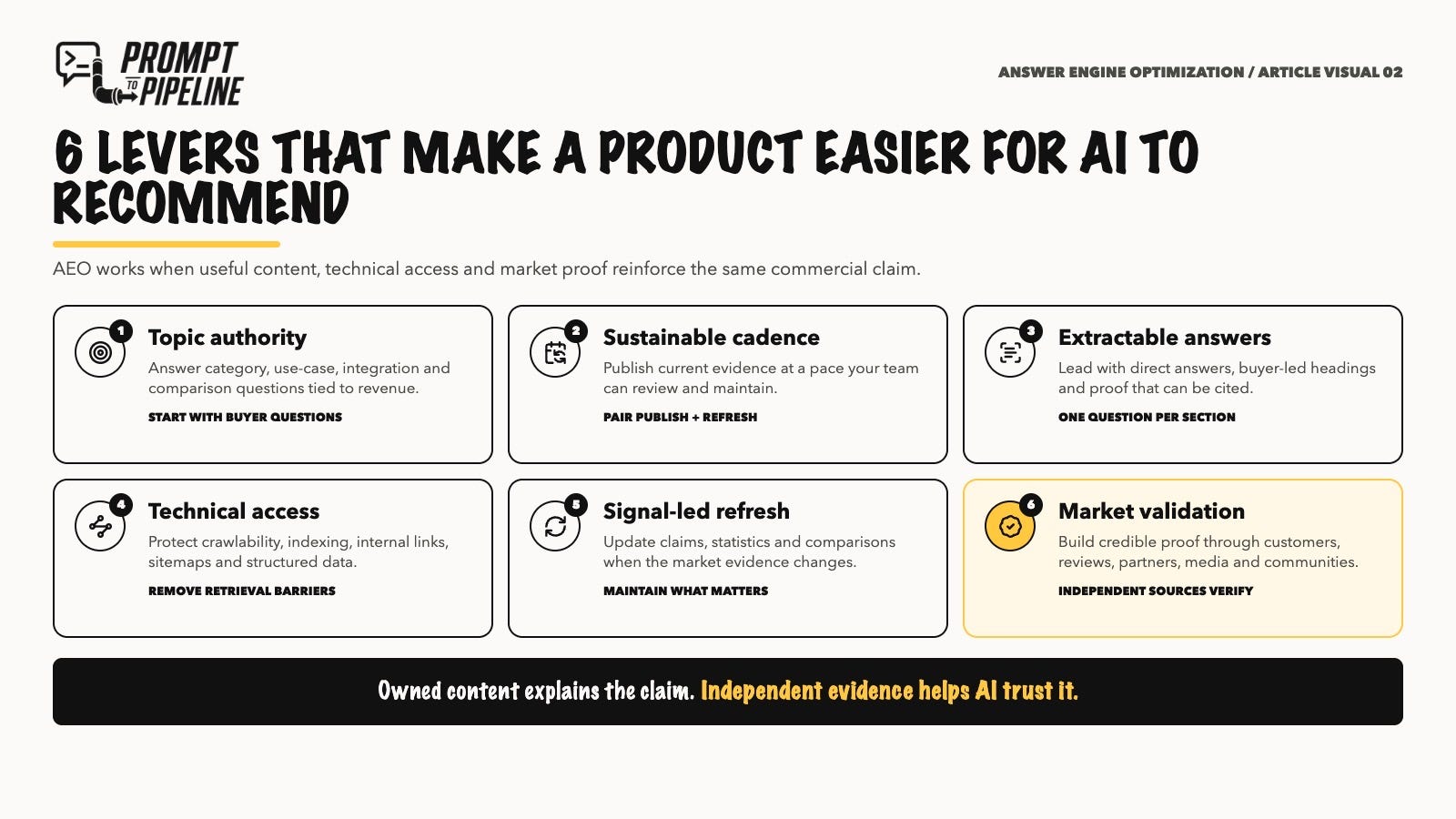
Six practical ways to increase AI search visibility
Once you know how AI describes your product, which competitors it places beside you and what sources it cites, you have the shopping list.
Now you can stop throwing more content into the pot and fix what is actually missing: clearer pages, stronger evidence and market proof that makes your positioning easier to repeat.
1. Build authority around topics connected to revenue
Cover the category, problems, use cases, integrations, implementation questions and alternatives that influence real buying decisions. Then go deeper by answering the follow-up questions buyers ask during evaluation.
Unrelated traffic content creates inventory faster than authority. Start with questions from sales calls, competitive deals and customer interviews before expanding the topic map with keyword data.
2. Publish at a pace you can maintain
Consistent publishing gives answer engines more current evidence, but every new page creates a maintenance obligation.
Set a publishing cadence alongside a refresh cadence. A smaller collection of accurate, commercially relevant pages will usually be more useful than a large library of generic comparisons and AI-generated listicles. Publishing velocity without maintenance becomes content debt with better reporting.
3. Make important pages easy to extract and cite
Give the direct answer early. Use headings that reflect real buyer questions, focused sections, comparison tables where they help and links to supporting evidence.
Length alone does not create more citations. Each section should answer one clear question and remain understandable when an answer engine retrieves it without the surrounding article.
That is a useful AEO rule: machine-readable content helps when it carries distinct positioning and credible proof. If every company publishes the same AI-smoothed explanation, answer engines get more content and very little reason to recommend one brand over another.
4. Remove technical barriers
(A bit of good old SEO, I know)
Check whether important pages are crawlable, indexed, internally linked and represented correctly in your sitemap. Review robots.txt, canonical tags, URL structure and structured data.
Treat llms.txt and AI information pages as optional experiments, not substitutes for basic technical hygiene. A beautifully formatted AI information file will have limited value when the useful product evidence remains blocked, duplicated or buried.
5. Refresh content based on signals
Monitor product changes, outdated statistics, declining citations, changing competitors and pages that no longer match buyer intent.
Classify each page as requiring a light refresh, a substantial update or a complete rewrite. An agent can flag likely candidates and draft changes, but a human owner should verify the claims and decide whether the page still deserves to exist.
6. Manage how the market describes your brand
Your website is only one source (The market, inconveniently, has its own version of your company.)
Reviews, customer stories, partner pages, credible media, communities and comparison content all influence how AI understands your category and reputation.
Owned channels explain your positioning, while independent sources verify it. Track both, respond to inaccurate market descriptions transparently and avoid manufactured community promotion. AI systems are quite capable of indexing bad judgment at scale.
These six approaches should produce a prioritized list of evidence gaps, each connected to a buyer question, source, owner and measurable signal.
Pro tip: build your AEO strategy around buyer questions
Why start AEO research from a blank prompt when buyers have been telling your sales team exactly what they need to understand before they shortlist you?
Sales calls, CRM notes and lost-deal reviews already contain the homework; the market has done its part, which is more than we can say for most content calendars. Start with one question: Which commercially important claims can the market verify about us today?
E.g. your buyer asks:
Which AI sales assistant works for a 50-person B2B SaaS company using HubSpot and requiring EU data compliance?
To recommend your product, an answer engine needs evidence that it fits the company size, integrates with HubSpot, supports the required use case and meets the compliance requirement. A generic page describing it as an “AI sales assistant” will not provide enough proof.
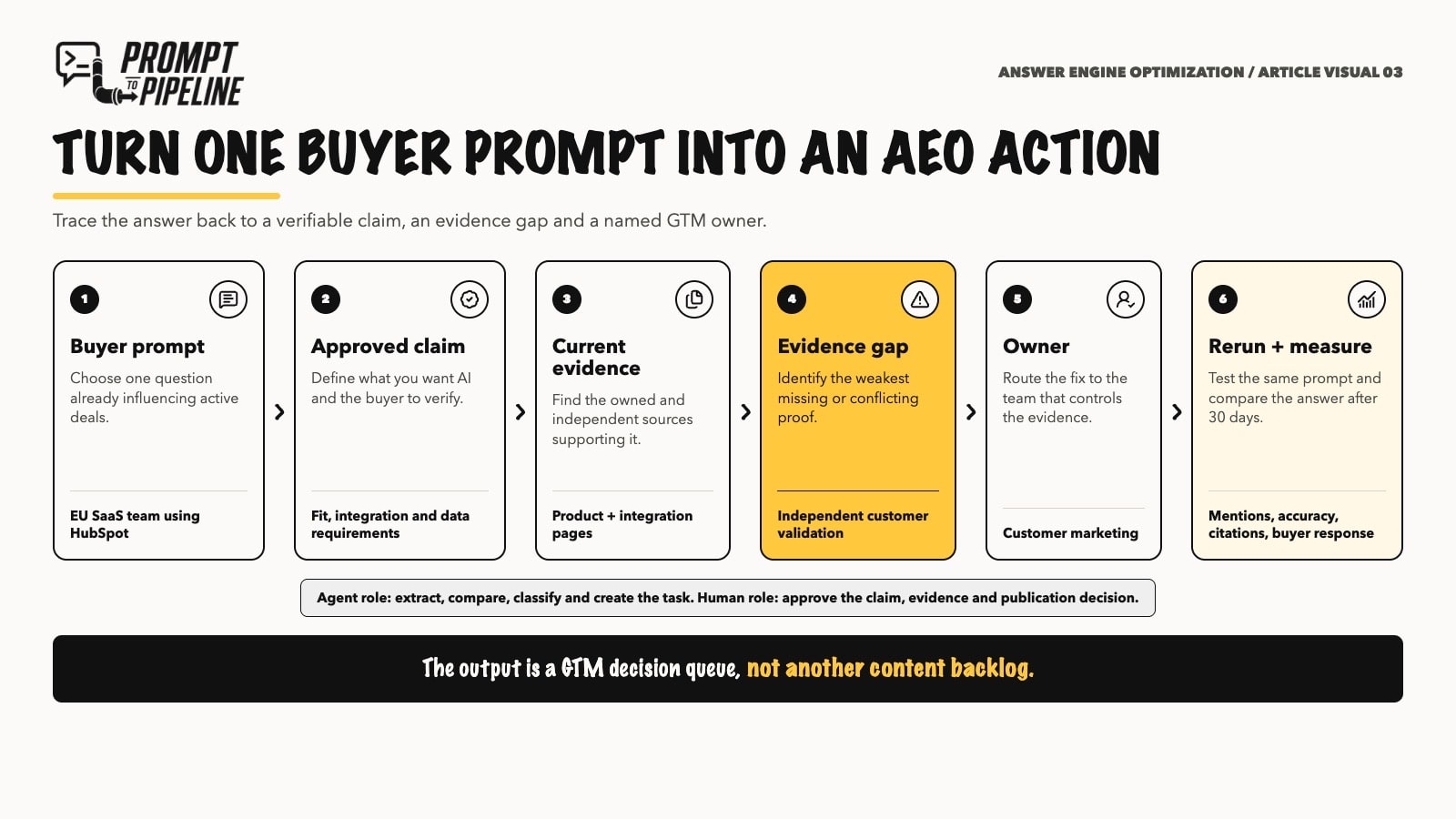
Turn each priority buyer question into one working record:
Buyer prompt: AI sales assistant for a 50-person EU SaaS company using HubSpot
Approved claim: Fits the team size, integrates with HubSpot and supports EU data requirements
Current evidence: Product page and integration page
Evidence gap: Independent customer proof
Owner: Customer marketing
Commercial signal: Qualified AI referral or self-reported discovery
The record forces the team to decide what it wants AI to understand, where that claim can be verified and who can close the gap. It also prevents a visibility problem from automatically becoming a content request.
An agent can compare the monitored answer with approved positioning and evidence. Keep the prompt constrained:
Compare the AI response with our approved positioning and verified claims.
Return:
1. Any inaccurate or missing claim
2. The evidence currently available for that claim
3. The gap type: positioning, content, proof, technical or distribution
4. The recommended owner and next action
Do not invent claims, customer evidence or sources.
Product marketing should review the output and route each gap to content and SEO, customer marketing, PR, partnerships, engineering or RevOps. The agent can extract, compare, classify and create the task. A human owner remains responsible for the claim, evidence and publication decision.
Rerun the same prompt after the fix and record whether the description, recommendation and cited sources changed. The output should be a decision queue for the monthly GTM review, not another content-idea backlog.
Give AEO one owner and measure business impact
Once you have done the research, mapped the citations and set the workflow in motion, somebody needs to own the whole thing. (Otherwise it becomes one of those cross-functional projects everyone agrees is important, right up to the point someone has to update a page or ask a customer for proof.)
My view: product marketing should run the cadence. SEO makes the evidence discoverable, Sales brings the real buyer questions, customer marketing and PR add independent proof, and RevOps connects the work to pipeline.
Product marketing owns whether those pieces produce one accurate market story rather than five departments each describing a slightly different company.
Then keep the reporting practical. Are the priority buyer prompts more accurate? Are credible sources supporting the answer? Are AI-discovered buyers becoming qualified opportunities? Raw referral traffic is useful context, but it has a habit of arriving at the meeting dressed as proof.
Your first 30 days of AEO
Choose one revenue-relevant prompt cluster. Focus on a category, use case, integration, migration or compliance question that already appears in active deals.
Capture the baseline. Record how AI describes your product, which competitors it recommends and which sources it cites.
Fix one evidence gap. Improve the positioning, product content, customer proof, technical access or third-party validation behind the answer.
Rerun the same prompts after 30 days. Compare the description, recommendation coverage, citations and qualified buyer response.
At the end of the first cycle, your team should know whether AI understands the product more accurately, whether stronger sources are shaping the answer and whether qualified buyers are finding you through AI search.
Dashboard growth only matters when it leads to a concrete GTM decision. That is the standard I would use for AEO: clearer market understanding, stronger evidence and a measurable path from AI visibility to qualified demand.
About me
I help founders and GTM teams build or upgrade towards AI-native GTM engines that turn signals, customer context, and AI workflows.
Request GTM Audit
→ 360° assessment + 6-month action plan: Your GTM blindspots revealed
Or