
If you work in GTM right now, you have probably heard MCP mentioned in the same conversation as APIs, Claude, RAG, gateways, agents, and possibly a Python script someone assures you is “very simple.”
The problem is that these terms describe different parts of the system, but they are often presented as if they are competing products. An API is not an MCP. RAG is not an integration. A gateway is not another version of either. And a CLI is sometimes the most sensible option in the room, which is inconvenient if you were hoping for one tidy acronym to solve the whole thing.
So what the heck is MCP actually? Where does it fit if your team already uses APIs, automation tools, or a CRM with AI features? And when does an agent need MCP, a script, a direct API connection, or simply better context?
In this article, I will explain the practical difference in plain English, show how each layer appears in a real GTM workflow, and give you a way to decide what your team should use without needing to become the person who maintains the Python script.
What you will learn
What MCP, APIs, SDKs, CLIs, RAG, and gateways actually do in an agentic GTM workflow - without the engineering theatre.
How to choose the right interface for exploratory research, repeatable batches, and deployed production workflows.
Which security and human-approval decisions need to exist before an agent can take action in a CRM, outreach system, or data environment.
Where direct APIs win on cost, volume, reliability, and repeatability.
What is what: MCP, APIs, SDKs, CLIs, RAG, and gateways
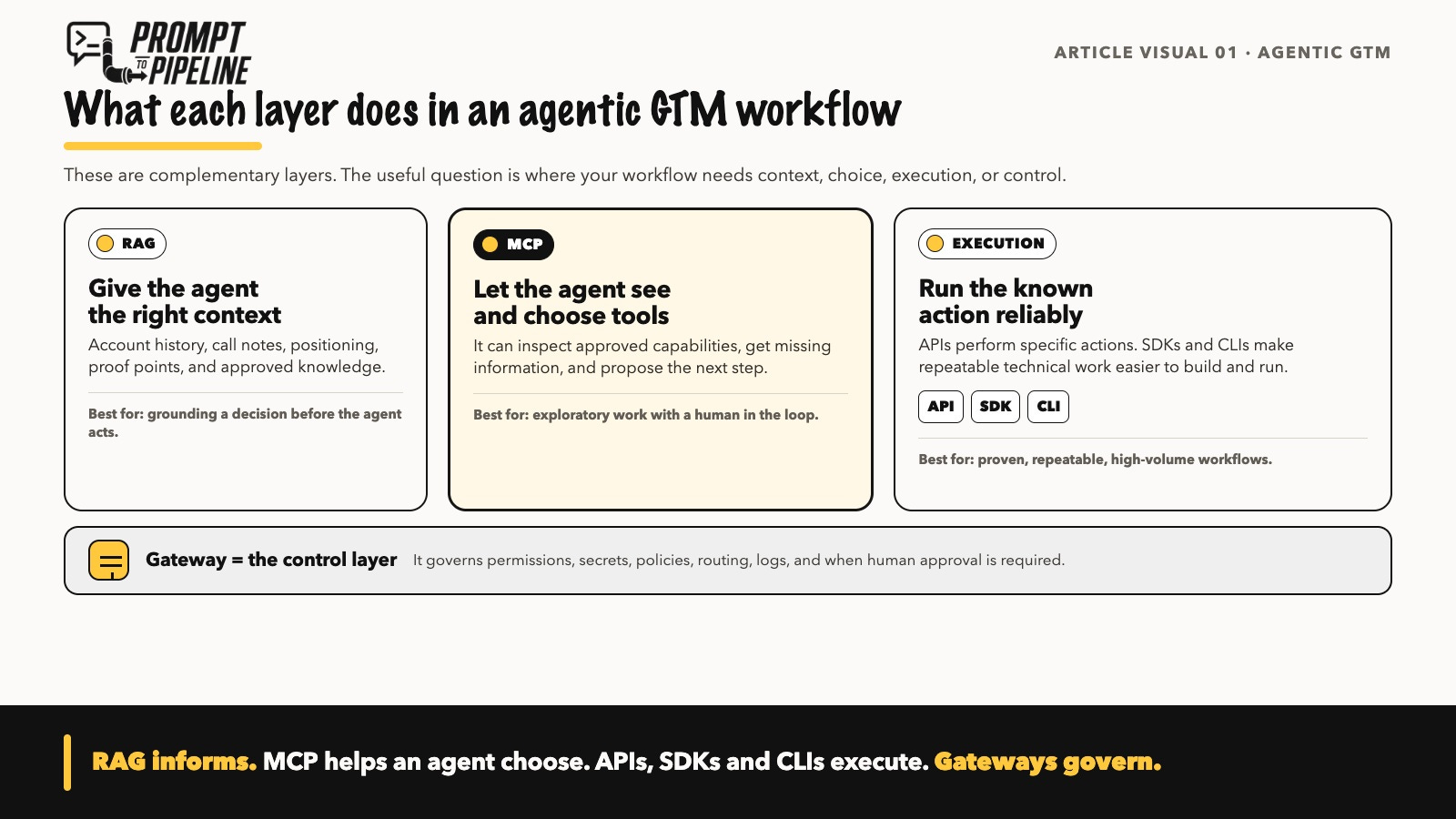
They are complementary layers that serve different jobs in the same workflow. A single GTM workflow might use RAG to provide approved account context, MCP to help an agent find the relevant tools, an API to execute a known CRM update, an SDK or CLI to run a recurring batch, and a gateway to control the whole route.
Here is what each one actually does.
What is an API?
An API, or application programming interface, is a defined way for one piece of software to request data or trigger an action in another. It can fetch an account record from Salesforce, create a contact in HubSpot, send an email through a sequencing platform, or pull campaign performance from an ad platform.
Use an API when the job is already clear. The workflow knows which action to take, what information to send, and which permissions it has. APIs are the reliable execution layer beneath many SDKs, workflow automations, and MCP servers. They leave the choice of what to do next to a developer, a rules-based workflow, or an agent.
What is MCP?
MCP, or Model Context Protocol, gives an AI application a standard way to connect to tools, data, and instructions. It helps the agent see the capabilities it has access to, understand what they can do, and use an approved one while it works through a task.
Use MCP when the agent needs to investigate, weigh up options, and choose its next step with a human still in the loop. Account research, CRM-quality checks, enrichment-source selection, and campaign preparation all fit that shape. MCP commonly connects an agent to APIs, databases, and command-line tools. The quality of the agent’s decisions still depends on the context it receives, the permissions it has, and the approval rules around it.
What is an SDK?
An SDK, or software development kit, is a package of ready-made code for working with a service. Instead of writing every API request from scratch, a developer can use the SDK’s functions to authenticate, send data, handle errors, and get a result in Python, JavaScript, or another language.
An SDK earns its keep once a GTM task has stopped being an experiment. Think weekly enrichment, product-signal syncs, or scheduled lead scoring. The workflow is known, needs to run the same way every time, and needs someone to own the code when it breaks. MCP is more useful earlier, when an agent still needs to explore the context and decide which tool to use.
What is a CLI?
A CLI, or command-line interface, lets a person or script interact with a system by running commands in a terminal. It is a direct, practical way to test an operation, manage files, run a data job, or automate a task that has clear inputs and outputs.
Use a CLI when the command is known and the team needs the same thing to happen predictably every time. It is often a good fit for local scripts, scheduled jobs, and operational tasks that can be written, reviewed, and rerun. A CLI can sit behind an approved agent tool or an MCP server, but it relies on the person, script, or agent having already chosen the right command.
What is RAG?
RAG, or retrieval-augmented generation, is a way to give an AI model the relevant information it needs at the moment of work. It pulls from approved documents, product information, account notes, call transcripts, or playbooks and adds the most useful material to the model’s context.
Use RAG when an agent needs current, grounded knowledge to write a brief, explain positioning, or understand account history. It works alongside MCP, APIs, and CLIs: RAG helps the agent understand the situation, while the other layers can help it find more information or take an approved action. Its quality depends on the source material, retrieval logic, and permission model, so a neglected knowledge base will still produce a neglected answer.
What is an AI or MCP gateway?
An AI or MCP gateway is the control layer between an AI application and the systems it can access. It can route requests, manage authentication and secrets, enforce policies, limit usage, create logs, and require read-only access or human approval before a write.
Use a gateway when several agents, services, teams, or sensitive systems share the same environment. It works across the other layers: an API still performs the action, an MCP server can still expose the tool, and RAG can still supply the context. The gateway sets the guardrails and records what happened; it does not replace the underlying systems or make a weak workflow sensible.
The shortest useful version: APIs and CLIs carry out specific operations; SDKs make APIs easier to build with; RAG provides relevant context; MCP helps an AI application discover and use capabilities; and gateways govern access along the way.
If you lead sales, remember this: use MCP when an agent needs to explore and help a rep decide. Use RAG to give it the right customer and company context. Use an API or workflow once the job is known and needs to happen reliably at scale. Keep a human involved whenever the action affects a prospect, customer, forecast, or revenue record.
That distinction turns “we need MCP” into an operating question: where does this GTM workflow need context, tool discovery, repeatable execution, or tighter control?
What does MCP add beyond an API or OpenAPI specification?
The question is who knows the next step. With a direct API integration, the developer or rules-based workflow already knows. It sends a precise instruction such as “create this contact in the CRM” or “pull activity from this account.”
MCP earns its place when the agent needs to work through the task first. It can look at the tools available to it, read relevant context, ask for missing information, and choose an approved action. The underlying API may still do the actual work; MCP gives the agent a more usable way to find and use that capability.
OpenAPI documentation is useful when a developer is building an integration because it describes the available API calls. MCP brings a similar map into an agent environment, where the model needs to discover and use approved tools as part of its work. For technical readers: the host, client, and server are the plumbing that makes this discovery and tool use happen.
When APIs win - and what MCP can cost
When a direct API wins
MCP is useful when an agent needs to investigate, interpret context, and work out the next step. A direct API wins once the team already knows exactly what should happen.
Use a direct API when the workflow runs at high volume, needs predictable speed, has fixed business logic, or creates a consequential change in a system. Syncing product usage every hour, routing leads with defined rules, updating approved CRM fields, and running recurring enrichment across thousands of accounts all fit this shape.
At that point, asking an agent to reason through every step is expensive theatre. Put the proven logic into a workflow with ownership, logs, retries, and a clear failure path.
Does MCP use more credits than a direct API?
Usually, an agent using MCP will consume more model tokens than a direct API workflow completing the same known task. The model needs to understand the available tools, decide which one to use, send a call, read the result, and sometimes take another step. Anthropic’s token-counting documentation includes tool definitions in the input it counts.
That does not make MCP inefficient. It means you are paying for exploration and judgment. A direct API workflow is cheaper when the judgment has already happened and the task is ready to execute repeatedly.
One nuance matters: an API called by an agent still uses model tokens for the agent’s reasoning and tool calls. The real comparison is not “MCP versus API cost.” It is “agent-led exploration versus a known workflow running reliably in production.”
Practical GTM use cases: where each layer earns its place
These examples matter more than a taxonomy. Notice the job first, then the layer that makes the job reliable.
Practical use case: turn a territory list into targeted micro-campaigns
A Zendesk SMB AE showed this Sumble-and-Claude workflow. He uploaded a territory list and asked the agent to identify accounts using call-centre technology, then locate senior contacts and prepare small, tailored campaign batches.
MCP made the enrichment capability available inside the agent’s working context. The rep could investigate a narrow segment, decide whether the signal mattered, and use the resulting context to shape outreach. This is where MCP earns its place: exploratory work with incomplete information and a human still making the commercial judgment.
Practical use case: turn a prospect screenshot into a usable CRM record
Clarify demonstrated a workflow that takes a screenshot of a prospect conversation, extracts the deal details, and creates the company, person, and deal records in the CRM.
The CRM actions are still conventional system operations, likely exposed through APIs. MCP brings the interpretation and the action together in one agent workflow, so the rep does not have to manually move information from an unstructured conversation into a dozen fields.
Practical use case: move a recurring data request out of chat
A GTM Systems Engineer at Nooks documented this progression: Claude first matched two CSVs for an ad hoc Finance request. Once the same question kept returning, the team moved the data into a warehouse, set scheduled ETL jobs, and exposed repeatable queries.
The first step was exploratory; the later system needed reliable data refreshes, known logic, and a home outside a chat session. This is where an SDK, CLI, or direct API workflow becomes the better fit than an agent-led task.
Practical use case: keep the context behind account plans current
WorkSpan’s operator example started with product, persona, competitor, and proof-point context scattered across AI experiments, then found it went stale quickly. The team used an MCP-connected context layer to update those shared objects after product and positioning changes, so the same current information could inform account plans, onboarding, reporting, and prospecting.
RAG or a comparable retrieval layer supplies the right material at the moment of work. MCP gives the agent a consistent route to the systems that hold and update that context.
What I have learned from using MCPs and APIs every day
I use both MCPs and direct APIs almost every day, and I choose based on the job rather than the acronym. MCP is better when the task starts with ambiguity: look across a few systems, work out what matters, and help me decide the next step. A direct API or repeatable workflow is faster when I already know the action, need it to run reliably, or do not want an agent burning credits while it rediscovers the same answer.
The connector quality matters too. Some MCPs are genuinely useful; others are slow, token-heavy, or weaker than using the underlying tool another way. Canva’s MCP, for example, has not been reliable enough for my own workflow.
My practical workaround is to keep secure API access in macOS Keychain and save the reliable MCP and API routes in local skills: what the agent can use, when each route is cheaper or faster, and when it needs to ask for approval. That way, the agent can choose the useful path without turning every task into a fresh technical experiment.
The MCPs getting the most GTM attention - and where they actually help
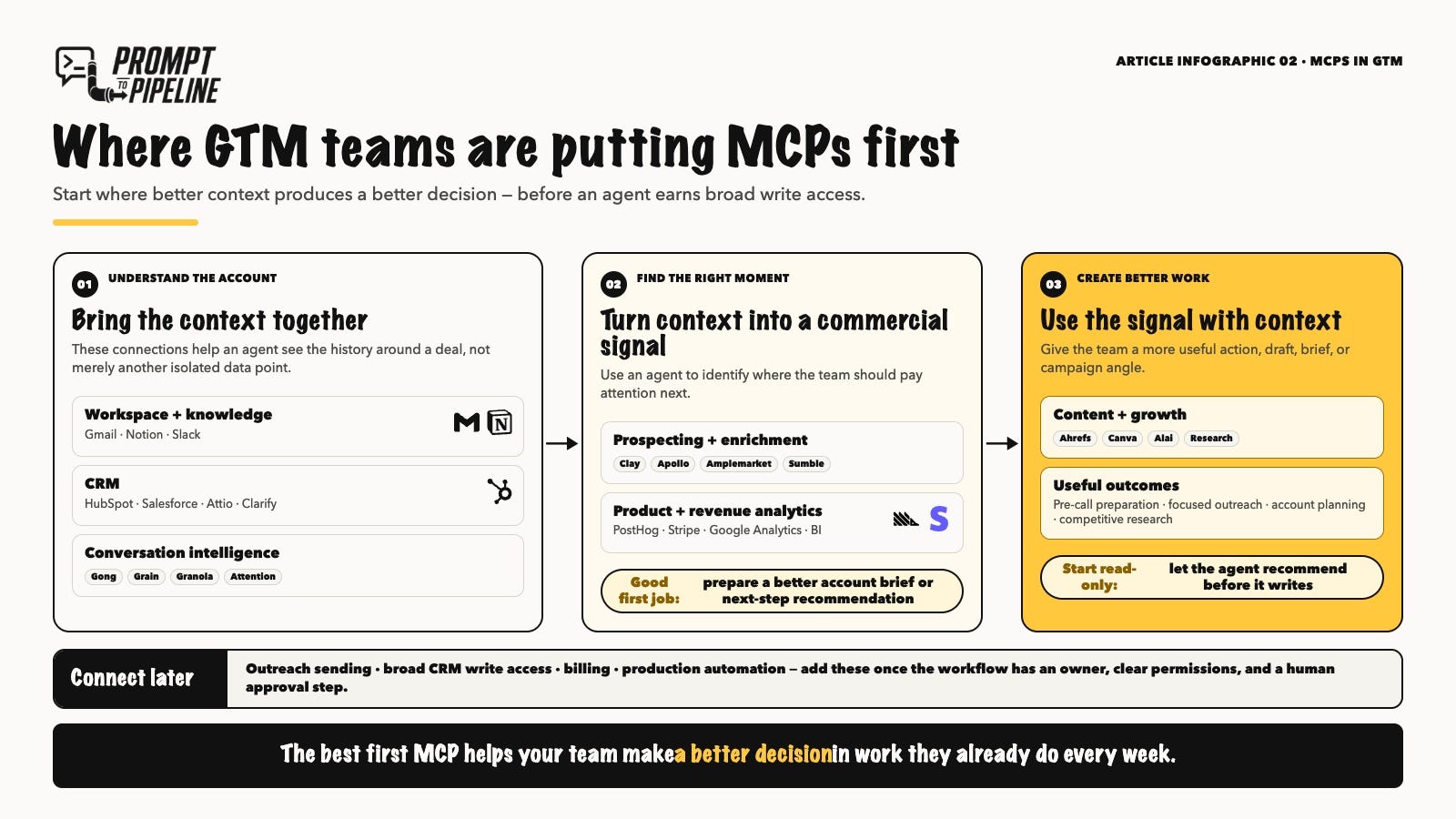
The market is producing a lot of MCP announcements, which is lovely for conference slides and less helpful when you are trying to decide what to connect first. Recent GTM-focused roundups cluster around the categories below, although they are vendor perspectives rather than an independent ranking: Databar’s overview and Amplemarket’s sales comparison.
This is a July 2026 market snapshot. Connector support, pricing, permissions, and maturity change quickly.
Start with the work your team does often, where the context is already valuable, and where a wrong action will not create a small crisis in your CRM.
1. Workspace and knowledge MCPs
Examples: Gmail, Google Calendar, Notion, Google Drive, and Slack.
These are becoming the default starting point because they help an agent understand the day-to-day work around a deal: meeting history, open threads, account notes, positioning documents, and next commitments. For a sales leader, that can mean better pre-call preparation, more useful follow-up drafts, and fewer “I did not see that Slack thread” moments.
2. CRM MCPs
Examples: HubSpot, Salesforce, Attio, and Clarify.
CRM MCPs give an agent access to account history, contacts, pipeline stages, activity, and deal context. Start with read-only access. Let the agent find gaps, summarise context, and recommend an update before it earns permission to change a record.
3. Prospecting and enrichment MCPs
Examples: Clay, Apollo, Amplemarket, Sumble, and Explorium.
This category turns an agent into a more useful research partner. It can identify accounts that match a signal, find relevant contacts, enrich a list, and prepare a small campaign around the reason the account matters now.
The practical use is finding a narrow, commercially useful segment and giving a rep a better reason to start a conversation. Enriching the entire database because the connector exists is an expensive hobby.
4. Product, revenue, and web-analytics MCPs
Examples: PostHog, Google Analytics, Stripe, and data-warehouse or BI connectors.
These matter most for PLG, hybrid, and usage-led GTM teams. They help a seller or customer-success leader connect account activity to product usage, marketing performance, expansion signals, or churn risk without waiting for someone to build a report.
The caveat is definition quality. An agent can retrieve data quickly; it still needs agreed definitions of an activated account, a meaningful usage signal, or a qualified opportunity.
5. Conversation-intelligence MCPs
Examples: Gong, Grain, Granola, and Attention.
Call recordings become more useful when the agent can connect them to the CRM, email history, calendar, and approved messaging. The goal is not another meeting summary. It is a better follow-up, a clearer next step, and a view of which objections or buying signals are showing up across the pipeline.
6. Content and growth MCPs
Examples: Ahrefs, Canva, Alai, research, and web-search connectors.
Marketing teams are using these for keyword research, content briefs, competitive analysis, reporting, and repeatable sales or marketing assets from existing company context. They become especially useful once the team has a maintained positioning and proof-point library for the agent to work from.
What to connect later
Outreach sending, broad CRM write access, billing, and production automation can create value, but they also create consequences. Connect them once the team has a proven workflow, an owner, clear permissions, and a human approval step where it matters.
The best first MCP is rarely the flashiest one. It is the one that helps your team make a better decision in work they already do every week.
How to choose the right layer: explore → repeat → deploy
Use this as the practical decision model:
Explore with MCP: Interactive, context-dependent work with a human present, such as account research, data-source evaluation, or a one-off CRM audit.
Repeat with an SDK or CLI: A known workflow that needs consistent inputs, retries, logs, and reproducible outputs, such as enrichment or account scoring for a campaign.
Deploy with a direct API: A continuous, high-consequence, or business-critical workflow that runs outside an agent session.
Use RAG across each stage: Supply approved positioning, customer evidence, and exclusions before the agent reasons or acts.
Use a gateway across each stage: Apply routing, permissions, policy, and logs.
The useful pattern is to let a workflow earn its way into production. MCP helps an operator test whether the data and decision rule are genuinely useful. Once both are clear, the repeatable portion usually belongs in a controlled batch or direct integration.
Is MCP security the same as API security?
The starting controls are familiar: authentication, authorization, encrypted transport, input validation, rate limits, least-privilege access, and logs. Those matter whether the caller is a conventional application, a workflow, or an agent.
MCP introduces an additional decision and context boundary. An agent may encounter instructions in retrieved content, choose between several tools, carry delegated credentials, or act on incomplete context. Teams therefore need to consider prompt injection, misleading tool descriptions, excessive scope, and the consequences of a wrong but technically valid action.
The practical security question is whether the agent has been given more freedom than the workflow can safely tolerate. Start read-only. Separate the ability to research from the ability to write. Require explicit approval before external-facing actions, and make sure the team can reconstruct which tool was called, with what inputs, and why.
Practical use case: let an agent inspect pipeline without edit access
MintMCP described an Attio connector configured for read-only deal access. An agent could inspect pipeline data but could not update records.
That is a useful starting boundary: give the team evidence that an agent can reason over the right data before granting it permission to change that data.
What GTM leaders should do next
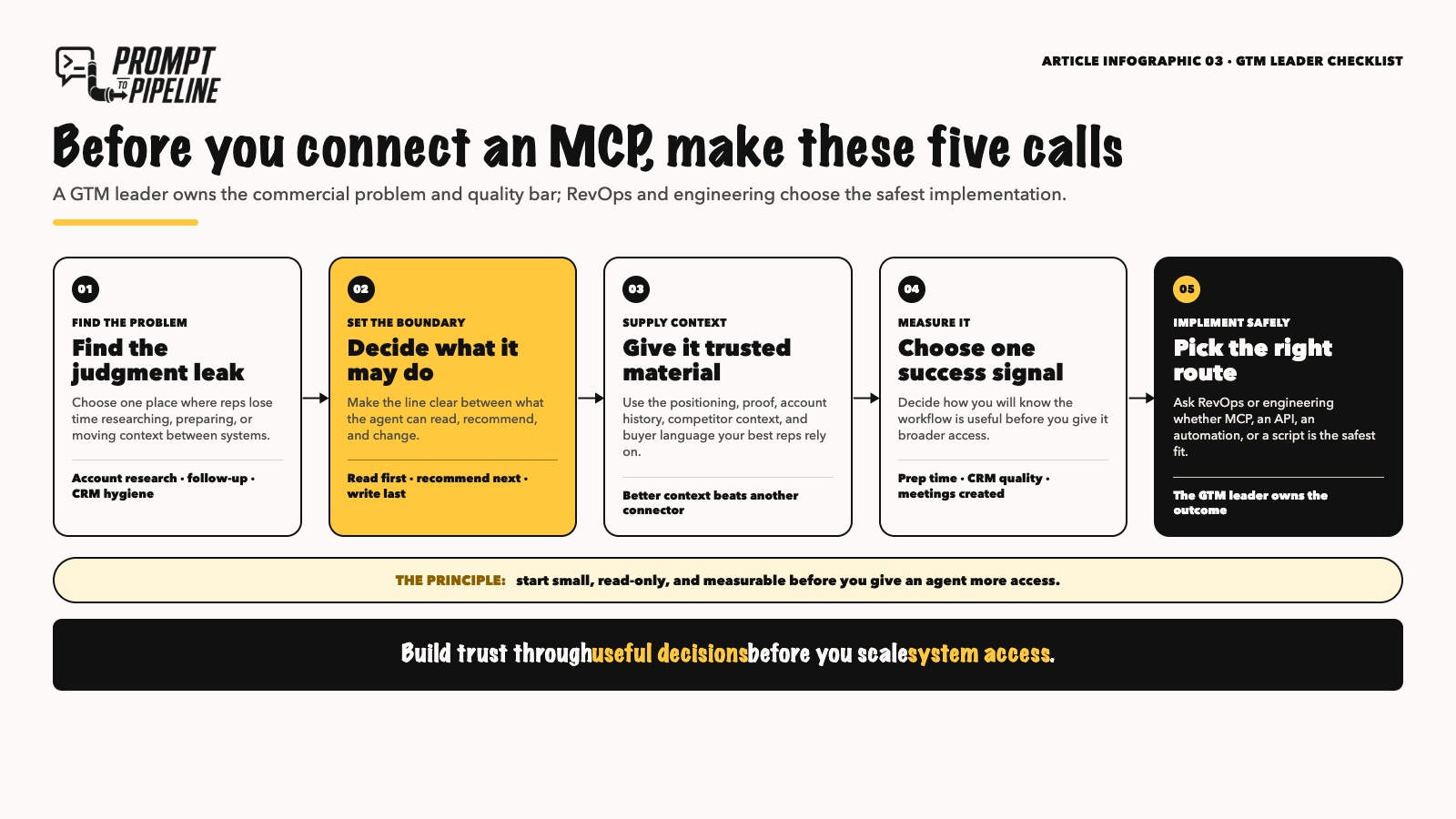
1. Find one place where reps lose judgment time
Start with account research, post-call follow-up, CRM hygiene, or planning a first outreach angle. These are good places to begin because the agent can help a rep prepare better before it is trusted to change a record or send a message.
2. Decide what the agent may read, recommend, and do
Make the boundary explicit. An agent may read CRM history and call notes, recommend next steps, and prepare a draft, while a rep approves anything that reaches a prospect or changes a forecast.
3. Give the agent the context your best reps already use
Current positioning, customer proof, competitor context, account history, and the language buyers actually use will improve output more than another connector. The goal is to give the agent the same starting material a good rep would ask for before a meeting.
4. Choose one success signal before expanding
Measure preparation time, CRM completeness, follow-up quality, or meetings created. If the workflow does not improve one of these, wider access will only make the existing mess move faster.
5. Ask RevOps or engineering for the safest implementation path
The GTM leader owns the commercial problem, quality bar, and approval boundary. RevOps and engineering can decide whether the safest path uses MCP, an API, an automation, or a script.
Common questions from GTM teams
Does MCP replace APIs?
MCP usually sits on top of existing APIs, databases, or command-line actions. It gives an AI application a standard way to discover and invoke those capabilities.
The underlying system still needs an API, query, or command that actually reads or changes data. MCP makes that capability easier for an agent to find and use in the right moment.
MCP vs CLI: when is a command-line workflow better?
A CLI wins when the job is known, repeatable, and needs predictable execution: run a data export, validate a file, refresh a table, or trigger a scheduled script. It is especially useful when a person or workflow already knows the exact command to run.
MCP is more useful when an agent needs to inspect context and choose from several possible tools before acting. A CLI may still sit behind that agent workflow once the right command has been chosen.
MCP vs RAG: what is the difference between context and action?
RAG retrieves relevant knowledge so the model can reason from current positioning, account history, product details, or approved proof. MCP exposes tools and resources so the model can look up more information or act on the conclusion.
A solid GTM agent often needs both: RAG to understand what it should say, MCP to find or use the relevant system capability.
What is an MCP gateway?
An MCP gateway is a control point for access to MCP servers and other agent connections. It can centralise authentication, secrets, policies, rate limits, logs, and approval rules.
It does not provide the CRM action or the agent’s reasoning. It decides which routes are permitted and gives the team visibility into how those routes were used.
MCP vs API in Python: does the language decide the architecture?
Python is an implementation choice, not the architecture decision. A Python script can call a direct API, use an SDK, run a CLI command, host an MCP server, or support a retrieval workflow.
The right option depends on who or what is consuming the workflow, how repeatable it is, the consequence of failure, and the required controls.
Before you connect the next tool
The useful question is not whether your team has adopted MCP. It is whether the workflow needs exploration, reliable execution, better context, or a decision that should remain human. Once that is clear, the connector choice becomes far less mystical and much more useful.
About me
I help founders and GTM teams build or upgrade AI-native GTM engines that turn signals, customer context, and AI workflows into pipeline.
Want to work with me?