


That is the clearest pattern I saw while building The AI GTM Stack Report: modern revenue teams are adding AI around CRM, RevOps, orchestration, workflow automation, and customer systems, but the real question is whether those systems can turn better context into better commercial action.
Everyone is talking about AI agents, AI SDRs, autonomous workflows, and agentic GTM.
But after spending the last couple of months studying how B2B companies are modernizing their go-to-market systems, the clearest pattern is more practical: AI GTM readiness is not about whether AI appears somewhere in the workflow. It is about whether the GTM stack can use better context to make better commercial decisions and turn those decisions into repeatable action.
That is why I built The AI GTM Stack Report 2026.
The report looks at how AI is entering internal GTM systems: sales, marketing, RevOps, customer success, growth, data, GTM engineering, workflow automation, revenue intelligence, and the commercial operating model around them. It is not a vendor ranking. It is not a claim that every visible tool is being used deeply. It is a market benchmark for leaders trying to understand where AI-enabled GTM is actually taking shape.
This is also the work I do with established companies: helping teams understand where AI should enter the GTM system, what needs to be fixed first, and how to move from scattered pilots to a practical AI-enabled operating model.
In other words, it is for the teams having a very specific conversation right now:
Are we behind on AI in GTM, or are we missing the operating system that would make AI useful?
What You Will Learn
In this article, I will cover:
what AI GTM readiness means for established revenue teams;
why the AI GTM stack is forming around existing commercial systems, not replacing them wholesale;
where GTM orchestration, decision intelligence, RevOps AI, agentic workflows, and controlled automation are starting to matter;
how the report separates tool visibility from operating-model maturity;
why company size changes the complexity of AI GTM modernization;
how to diagnose whether the next constraint sits in foundation, context, activation, or control.
Table Of Contents
Why AI GTM Readiness Needs A Market BenchmarkWhat The AI GTM Stack Report StudiedThe Main Pattern: GTM Stacks Are Becoming Systems Of IntelligenceThe Four Layers Of A Modern AI GTM StackHow AI GTM Modernization Changes By Company SizeWhat This Means For Established Revenue TeamsDownload The Complete AI GTM Stack Report 2026Applying The Framework To Your GTM StackA Question For Your GTM Operating Model
1. Why AI GTM Readiness Needs A Market Benchmark
AI GTM readiness has become a commercial systems question.
Not just a tooling question. Not just an experimentation question. Not just whether somebody in sales is using ChatGPT to write a better email before lunch.
For established B2B companies, AI has to work inside a revenue system that already has dependencies: CRM data, lifecycle definitions, routing logic, enrichment, sales engagement, marketing automation, customer workflows, forecasting, governance, and ownership across several teams.
That makes the market harder to read.
One company may have a long AI vendor list but still run most GTM decisions manually. Another may use fewer tools but connect account research, routing, and follow-up into one reliable commercial workflow. From the outside, those two companies can look similar. Operationally, they are very different.
That distinction matters because the next stage of AI go-to-market strategy will not be won by activity volume alone. It will be shaped by whether teams can connect intelligence to a decision, a workflow, an owner, and a measurable commercial outcome.
The useful question is not whether AI is present somewhere in GTM. It is whether the commercial system can turn better context into better action.
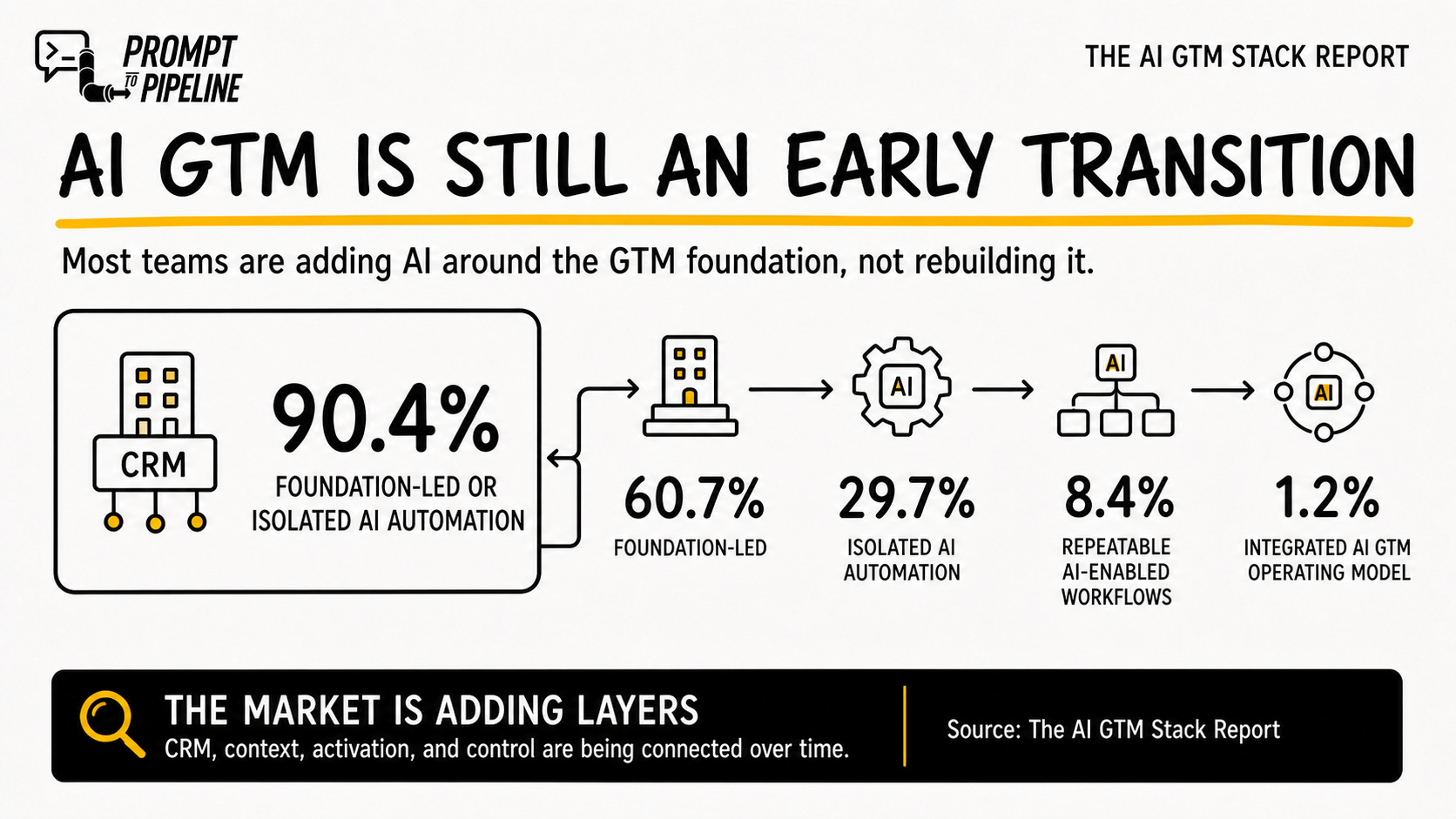
This is why I wanted a market benchmark.
The report gives revenue leaders a way to compare their own starting point with what is visible across the market. It shows which parts of the GTM stack remain durable, which AI-enabled layers are forming around them, and where the operating model starts to matter more than the tool list.
When I work with companies on GTM stack modernization, this is usually where the conversation becomes useful: not “which AI tool is best,” but which commercial decision, handoff, workflow, or control point is ready to improve.
For mature teams, that benchmark is useful because the question is rarely “Should we use AI?” anymore.
The question is usually:
Where should AI enter next without making the GTM system harder to run?
2. What The AI GTM Stack Report Studied
The AI GTM Stack Report studies how AI is entering internal go-to-market systems.
The emphasis is important: internal GTM systems, not customer-facing AI product features.
A company can sell an AI product and still operate a conventional sales and marketing system. Another company can sell a non-AI product and have a sophisticated AI-enabled GTM motion behind the scenes. The report is interested in the second question: how commercial work is actually supported by tools, data, orchestration, workflows, ownership, and repeatable processes.
Methodology note:
I analyzed a large cohort of B2B companies across North America and Europe, focusing on internal GTM signals: technology visibility, stack layers, company size, workflow patterns, and evidence of AI-enabled commercial operations.
The report studies how AI is entering sales, marketing, RevOps, customer success, growth, and GTM engineering work. It does not treat customer-facing product AI features as proof of internal AI GTM maturity.
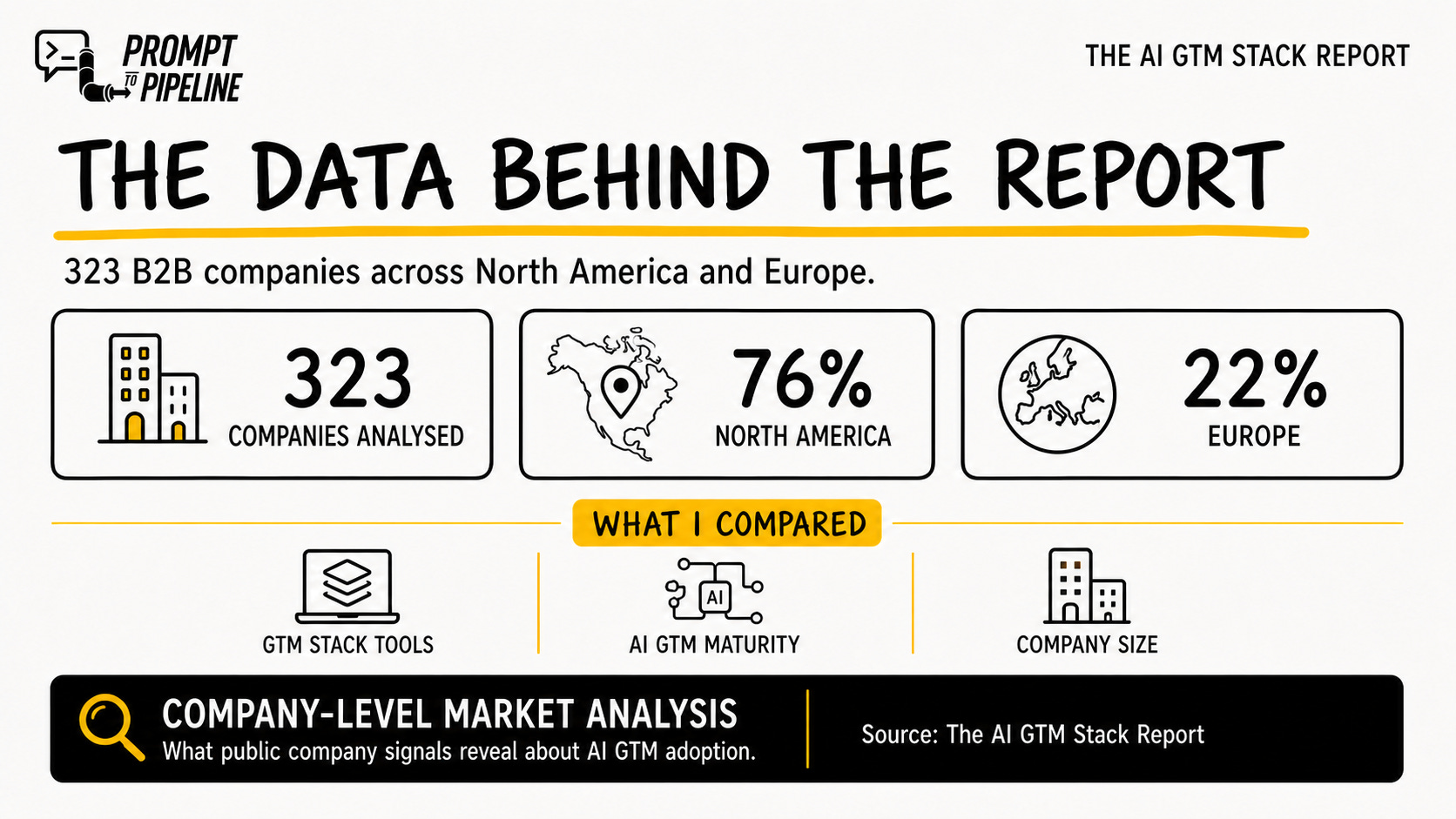
The report uses public and visible market signals, so it is careful about what the evidence can and cannot prove.
Tool visibility is a signal. It can show that a category or capability is present around the GTM stack. It does not prove contract value, usage depth, workflow quality, or commercial impact.
That is why the report separates several questions that often get collapsed into one conversation:
Does the company have a durable GTM foundation?
Are new data, research, orchestration, or model layers visible around it?
Is there evidence that AI supports one contained use case?
Is there evidence that AI has become part of a repeatable workflow?
Does the operating model show ownership, measurement, governance, and control?
This distinction keeps the report vendor-neutral and more useful for operators.
Buying a tool is a procurement event. Changing how a commercial decision gets made is an operating change. The report is about the second one.
3. The Main Pattern: GTM Stacks Are Becoming Systems Of Intelligence
The strongest pattern in the report is that AI GTM is mostly an augmentation and integration story.
The commercial foundation remains central. CRM, engagement, enrichment, revenue intelligence, customer workflows, and data infrastructure are still doing real work. AI-enabled layers are forming around that foundation rather than replacing it wholesale.
This is where a lot of public AI GTM conversation becomes too dramatic for its own good.
The market is not simply moving from “old GTM stack” to “new AI stack.” It is moving toward a more intelligent commercial system: better context, better prioritization, better routing, better workflow activation, better follow-up, and more explicit control over where automation should and should not scale.
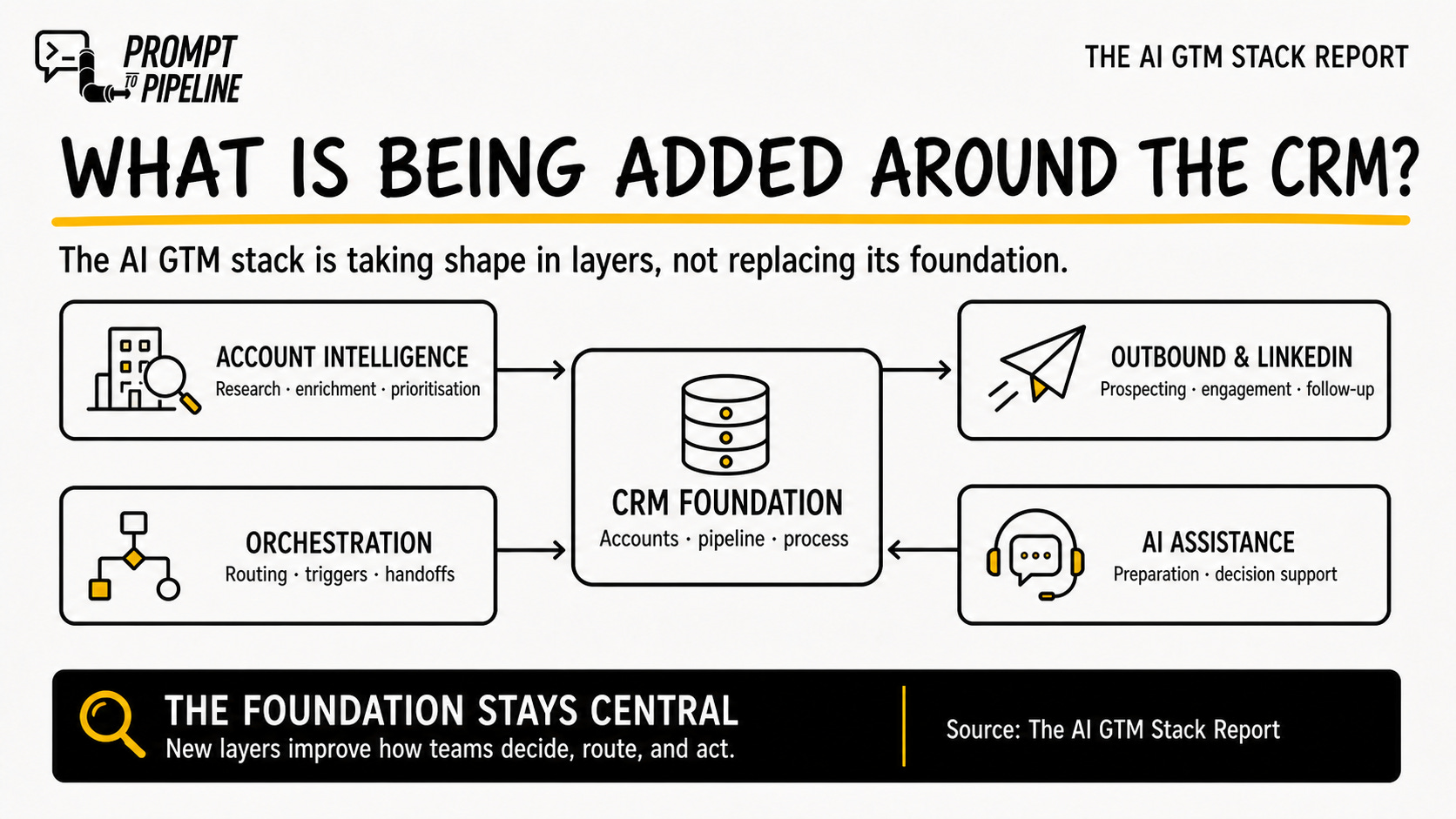
The companies that look more mature are not just “using AI.”
They are connecting AI to the parts of GTM where better context can change what the team does next.
For a RevOps leader, that might mean better routing, enrichment, lead-to-account matching, territory logic, or handoff design.
For a sales leader, it might mean account prioritization, call preparation, follow-up, mutual action plans, or opportunity review.
For a marketing or growth leader, it might mean segment intelligence, audience selection, campaign orchestration, personalized journeys, or signal-based activation.
For a customer success leader, it might mean health context, expansion signals, renewal preparation, customer risk workflows, or account planning.
For an AI transformation leader, it means something broader: how does experimentation become an operating model?
That is the practical shift behind phrases like AI revenue operations, GTM orchestration, decision intelligence, agentic workflows, and controlled automation. They matter only when they connect to the commercial system. Otherwise, they become impressive vocabulary parked next to the same old handoffs.
The direction of travel is clear: GTM stacks are becoming systems of intelligence.
The unresolved question is how much of that intelligence changes the way revenue work is actually done.
4. The Four Layers Of A Modern AI GTM Stack
To make the report practical, I use a four-layer framework:
Foundation
Context
Activation
Control
The framework is intentionally simple because the real GTM stack is usually not.
It helps leaders avoid a common mistake: starting the AI conversation with “Which tool should we buy?” before asking where the current system is constrained.
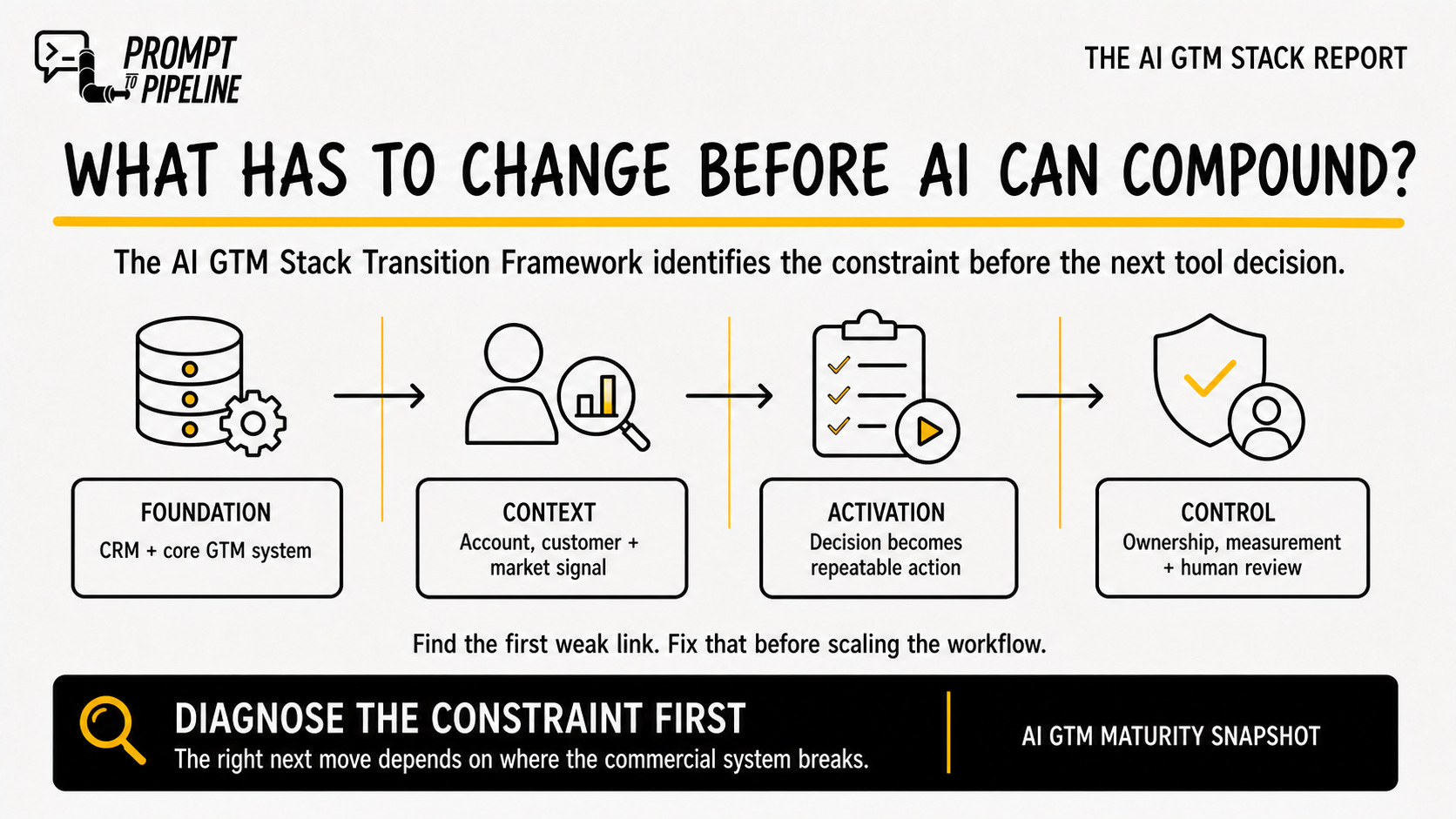
Foundation: can the commercial system be trusted?
The foundation is the commercial system teams already depend on: CRM, account and contact records, lifecycle stages, ownership rules, pipeline definitions, routing logic, permissions, and the basic operating discipline that keeps GTM work coherent.
AI does not remove the need for this foundation. In many companies, it makes the foundation more visible.
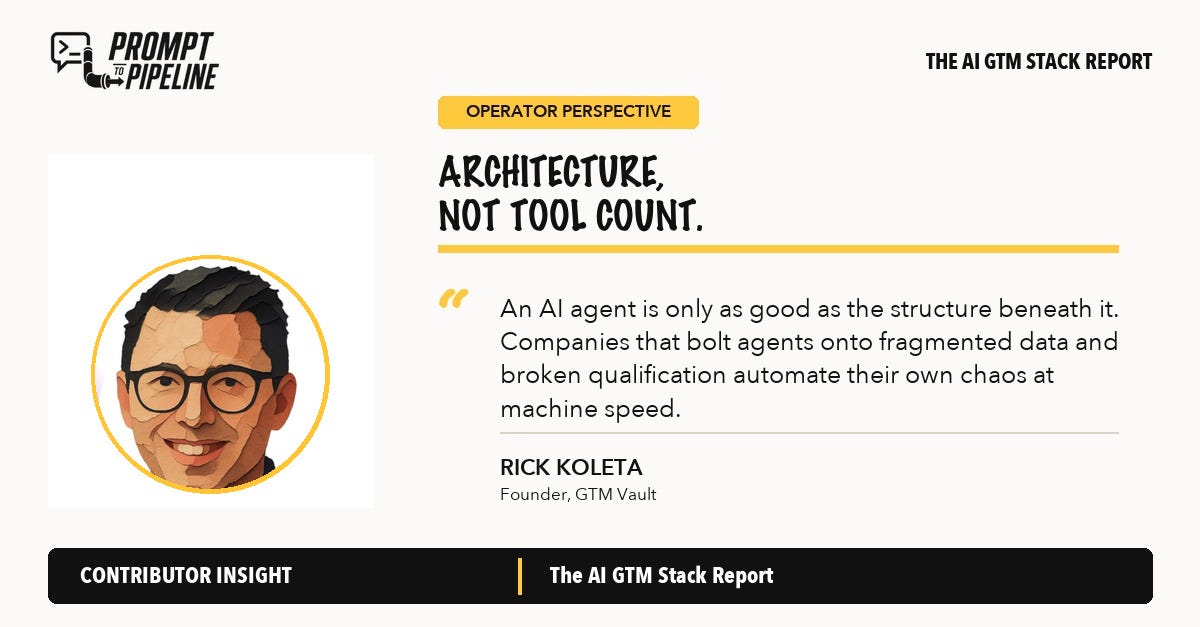
If CRM data is unreliable, if lifecycle stages mean different things across teams, or if handoffs are negotiated informally in Slack, AI will not magically turn that into a clean operating model. It may simply make the mess faster and more confident, which is a very modern way to create work for next quarter.
The first AI GTM readiness question is therefore not “Do we have AI?” It is:
Can the system be trusted enough for AI-assisted workflows to use it?
Context: does the team have useful commercial intelligence?
Context is the intelligence layer around the foundation.
This includes account research, enrichment, intent and fit signals, customer health context, conversation intelligence, market signals, buyer context, and the information a team needs before deciding what to do next.
Most companies already have more data than they can use well. The modernization opportunity is not only to collect more information. It is to make the right context available at the moment of commercial action.
That is where AI can be useful: turning scattered inputs into a better view of an account, customer, buying group, opportunity, or risk.
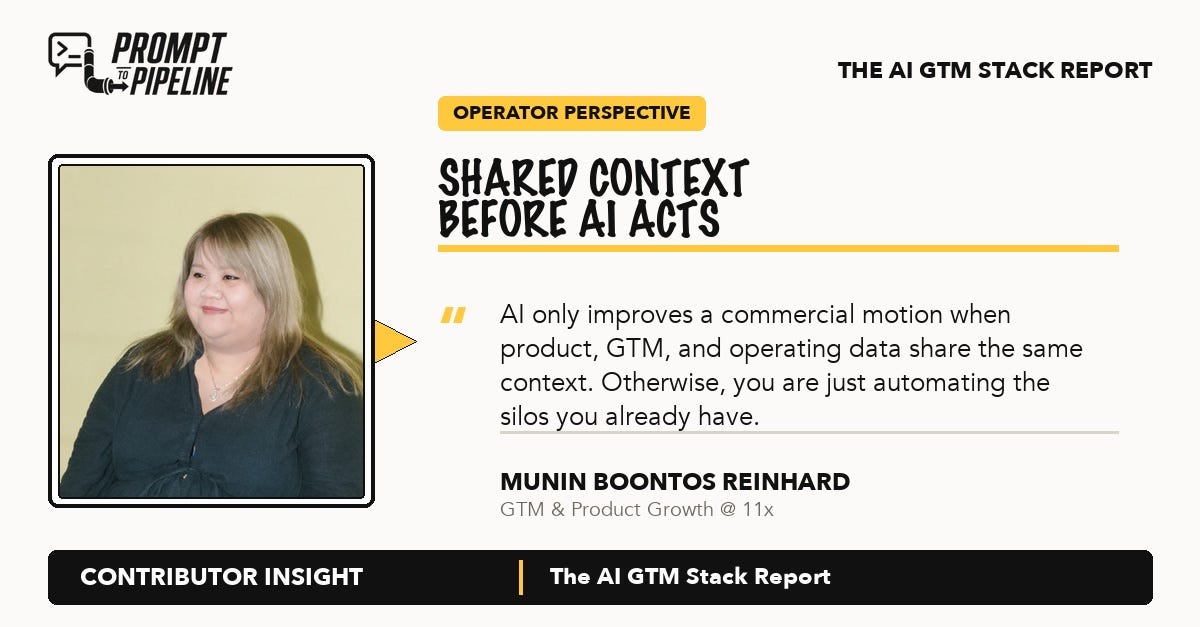
https://www.linkedin.com/in/murei/
But context is still only half the story.
A better insight that stays in a dashboard is not yet GTM transformation. It is a nicer waiting room.
Activation: can better insight become repeatable action?
Activation is where AI GTM starts to become operational.
This layer includes workflow automation, routing, sequencing, playbooks, handoffs, next-best-action logic, sales and marketing execution, customer success workflows, and agentic workflows where the system can safely prepare or trigger action.
The important word is repeatable.
An AI pilot can be useful for one person or one team. A repeatable workflow has clearer inputs, ownership, review points, handoffs, and success measures. It does not depend on one unusually motivated operator holding the process together with browser tabs and optimism.
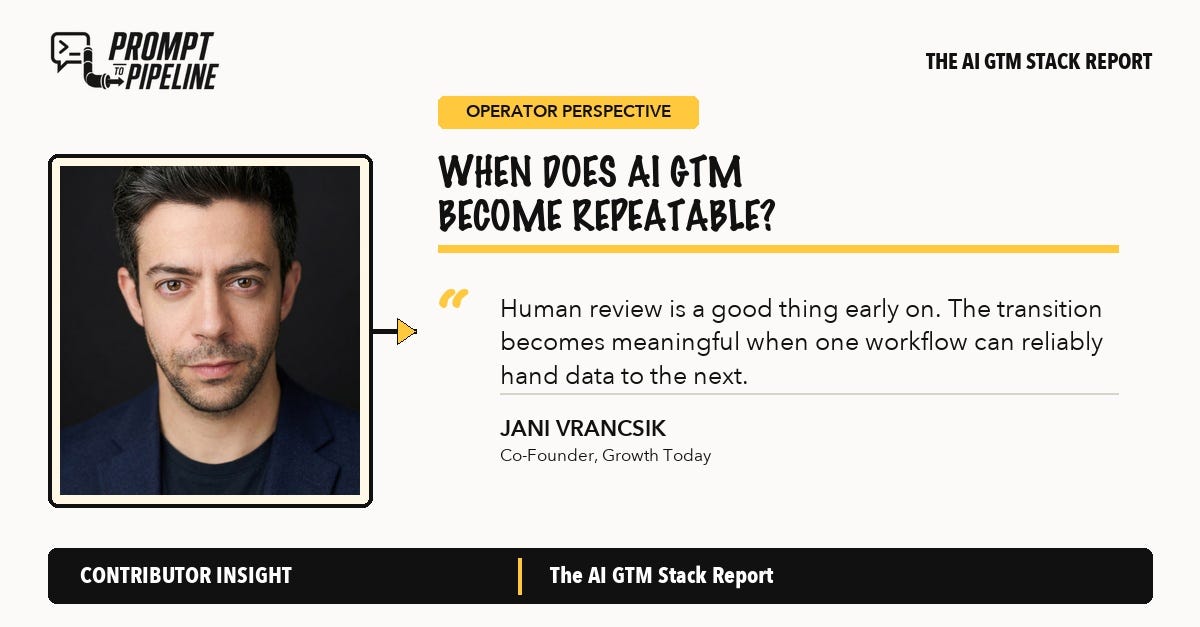
This is where the AI GTM stack starts to matter as an operating system rather than a collection of tools.
Control: can the system scale without losing trust?
Control is the layer that makes AI-enabled GTM workable at scale.
It includes governance, auditability, permissions, human review, data access, measurement, escalation rules, AI policy, and the operating cadence for improving the system over time.
Control is sometimes treated as the boring part of AI adoption. In established companies, it is often the part that decides whether the work can expand beyond a pilot.
Once AI affects account prioritization, pipeline movement, customer communication, or sales execution, the company needs to know who owns the workflow, what the system is allowed to do, where human judgment is required, and how performance will be measured.
That is not bureaucracy. That is how the organization keeps trust while increasing automation.
5. How AI GTM Modernization Changes By Company Size
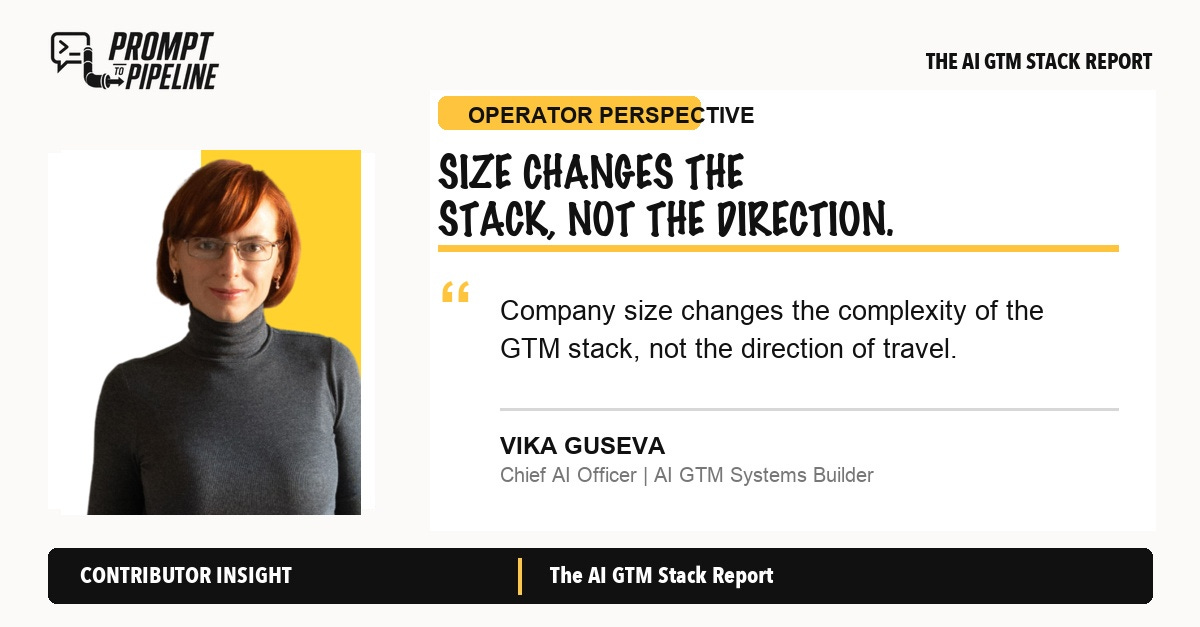
Company size does not change the direction of AI GTM modernization. It changes the coordination cost.
Smaller teams can often add research, automation, and agentic workflows faster because the system is lighter. There are fewer approval layers, fewer data boundaries, fewer regional exceptions, and fewer teams required to agree on a handoff.
That speed is useful. It also creates its own risk: a compact workflow can become fragile if it depends too much on one person, one spreadsheet, or one tool configuration nobody else understands.
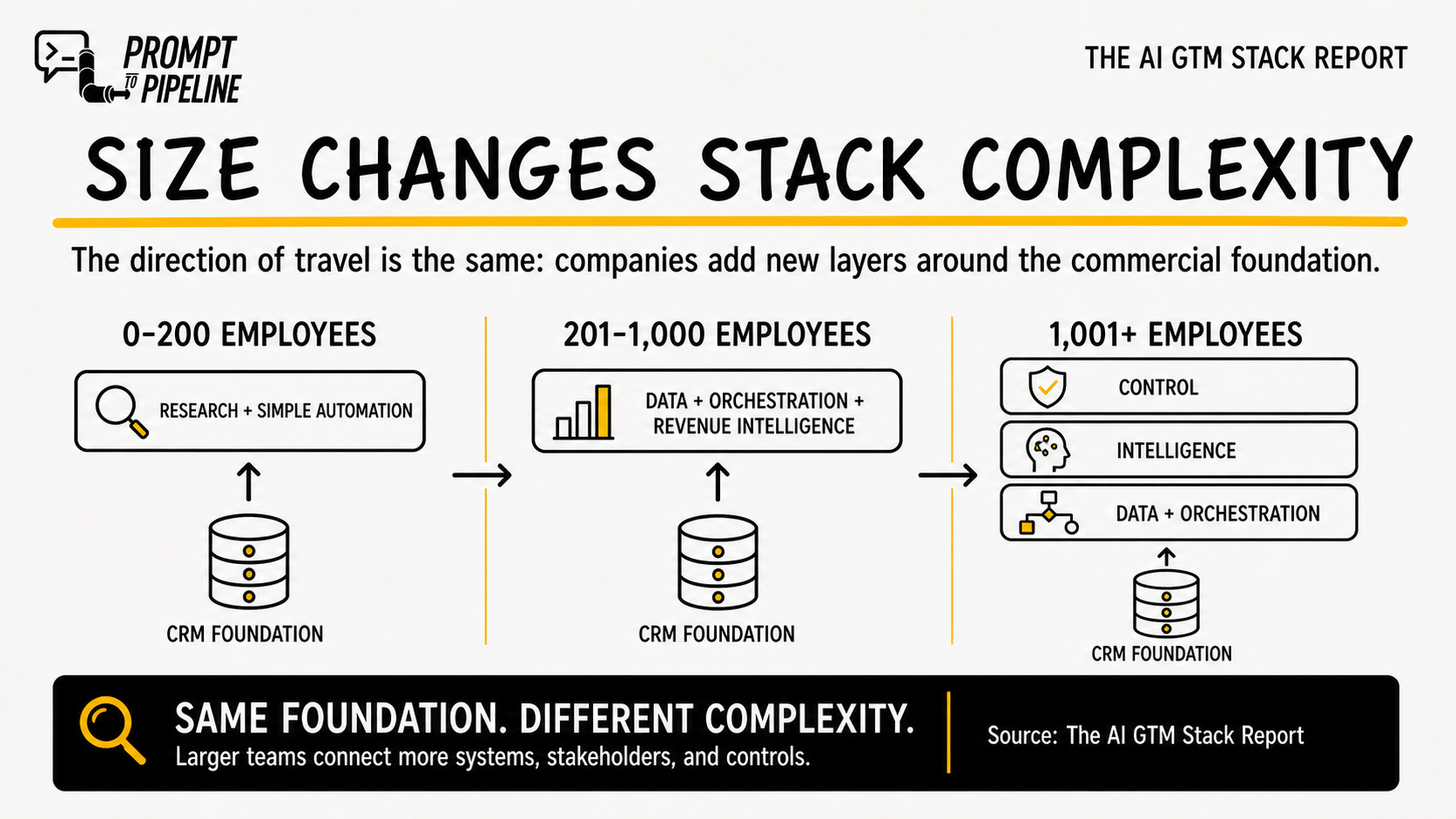
Larger teams usually have more durable systems. They also have more complexity.
The CRM is more embedded. Data ownership is more distributed. Permissions matter more. Revenue workflows cross regions, segments, business units, and customer motions. A change in routing or account prioritization can affect sales, marketing, customer success, finance, operations, and leadership reporting
This is why established companies should avoid copying AI GTM playbooks from much smaller teams without translating the operating model.
The idea may be right. The implementation path will be different.
A smaller company may be able to connect account research, enrichment, and outbound activation quickly around a lightweight CRM. An enterprise team may need to solve data quality, ownership, consent, governance, CRM handoffs, regional process differences, and measurement before the same workflow can scale responsibly.
The direction is similar across company sizes: AI is forming around the GTM stack.
The work required to make it reliable is not.
6. What This Means For Established Revenue Teams
For established revenue teams, the report points to a practical conclusion: AI GTM maturity should be evaluated through system readiness, not only visible tool adoption.
That does not mean tools are unimportant.
Tools matter when they improve a commercial decision, connect to a repeatable workflow, clarify ownership, and help the team measure what happened next. They matter less when they create another disconnected surface area for GTM work to happen in parallel.
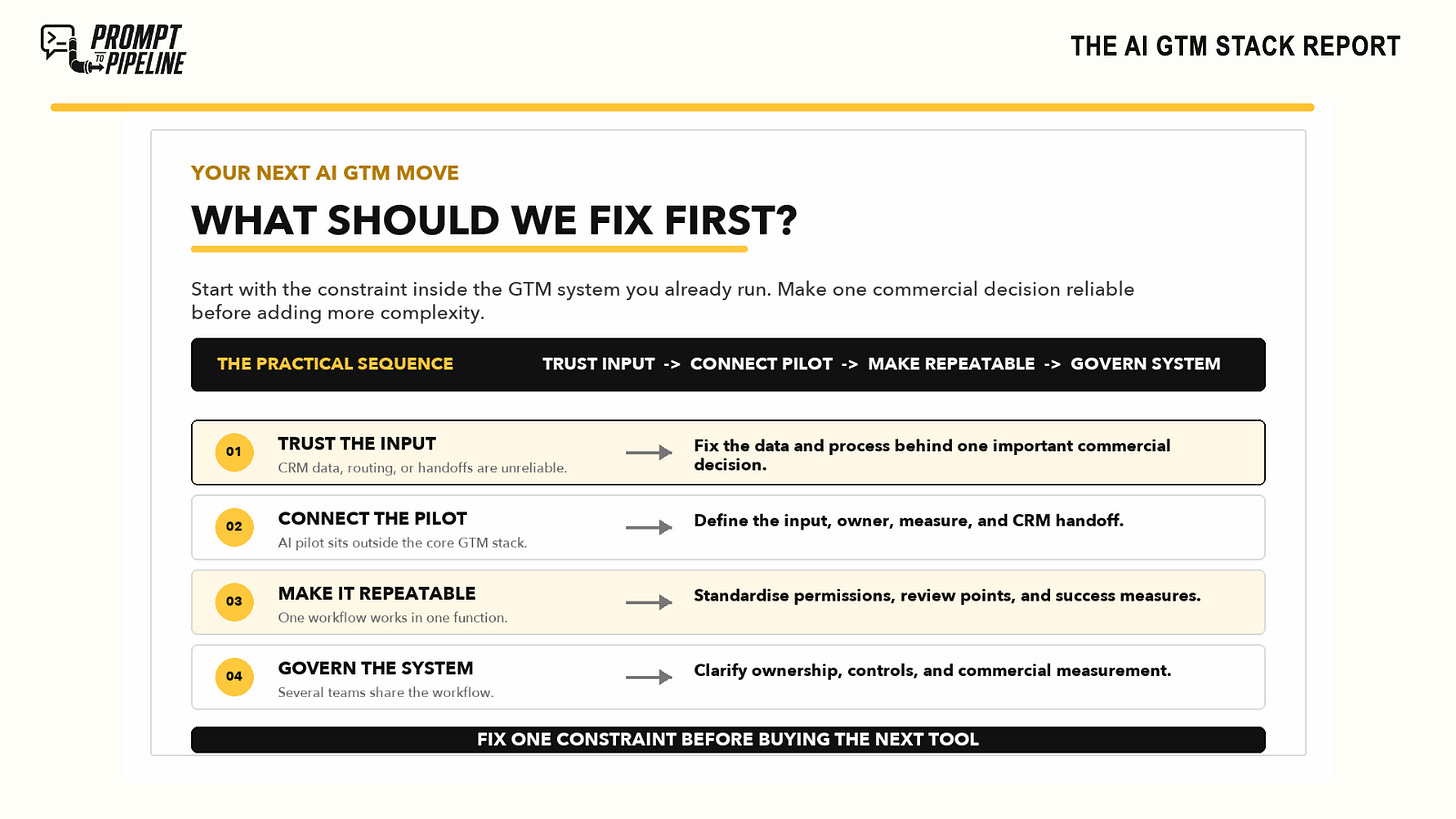
The better diagnostic is to ask where the current constraint sits:
Is the foundation trusted enough for AI-assisted workflows?
Does the team have useful context at the moment of action?
Can insights trigger repeatable workflows, or do they stay trapped in dashboards?
Who owns the AI-enabled GTM operating model?
Where do we need control, governance, or human review before scaling automation?
For established companies, the AI GTM opportunity is not to add another disconnected layer of activity. It is to modernize the commercial system so better intelligence changes the next best action.
That usually starts with one constraint, not a grand transformation deck.
Fix the data and process behind one important commercial decision. Connect one useful pilot back into the GTM system. Make one workflow repeatable across inputs, owners, review points, and success measures. Clarify governance before automation expands into customer-facing or pipeline-sensitive work.
The goal is not to slow AI adoption down.
The goal is to make the adoption more useful.
This is the advisory work behind Prompt to Pipeline: helping established B2B teams map their GTM stack, identify where AI can improve revenue operations, and build a modernization path that connects data, workflows, ownership, and commercial outcomes.
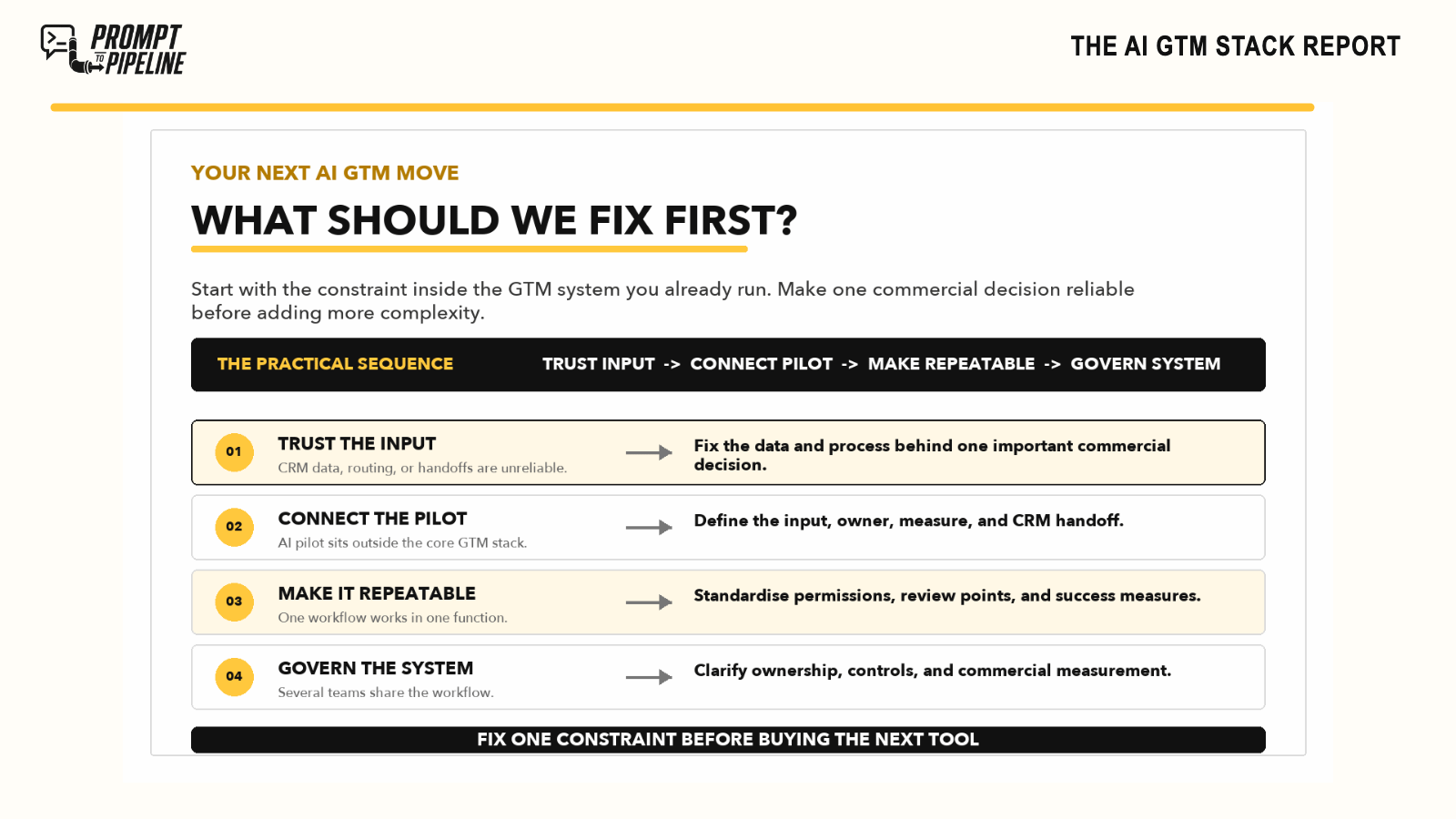
Want to see how this transition map applies to your own team? The AI GTM Maturity Snapshot is a short diagnostic for GTM, RevOps, Sales, Marketing, Customer Success, Growth, and AI transformation leaders. Ten focused questions produce a human-reviewed maturity stage, the bottleneck most likely slowing adoption, and one practical next move, rather than another generic score.
