
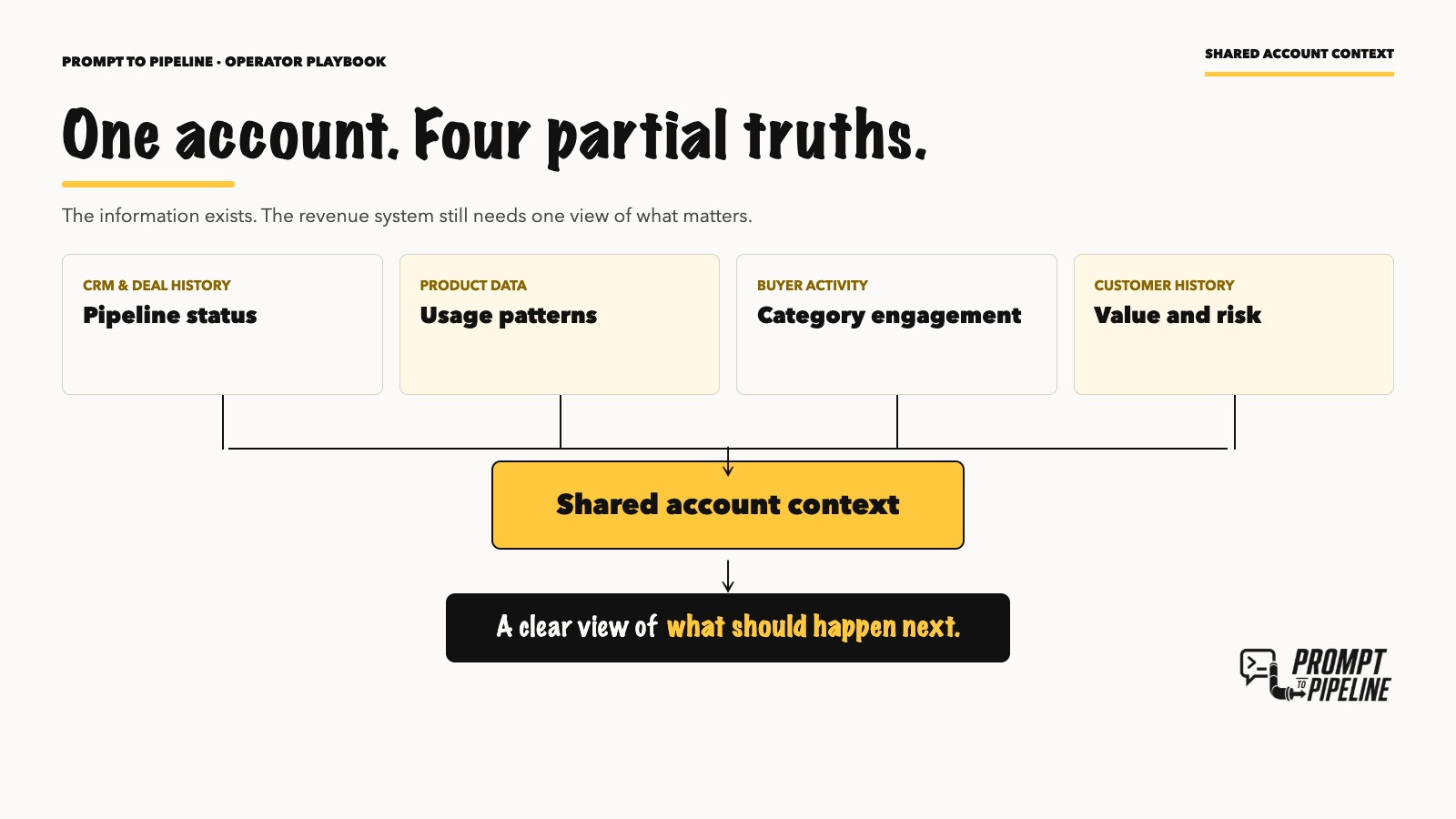
By 2026, B2B companies have more account data than they can use coherently. A strategic account can look entirely different depending on which tab you have open: product sees three active users, sales sees a stalled opportunity, marketing sees a buyer debating the category on LinkedIn, and customer success sees renewal risk. Every view is valid. The account is simply leading four separate lives inside the same company.
That fragmentation becomes more expensive as more of the buyer journey happens before sales is invited in. Deloitte describes B2B buyers using LLMs to configure solutions and compare vendors, while Forrester points to the need to align qualification, buying-group engagement and value creation across the customer lifecycle.
What You Will Learn
This article looks at how GTM leaders are moving from isolated AI use cases toward revenue architecture: a system that connects context, signals, routing and accountability, actions and learning around an account. You will see what the operator examples reveal about product signals, signal-based outbound, sales coaching and human review, and where founders, sales leaders and RevOps teams need different operating choices. I will close with the changes worth watching over the next six months as AI becomes part of the GTM operating model.
The Revenue Architecture Shift
The account-level coordination problem is why AI adoption alone tells a limited story. A team can have useful tools and active workflows while account prioritisation, handoffs and seller decisions still run on fragmented information.
McKinsey’s 2026 B2B sales research and its analysis of the new economics of B2B growth point to the same commercial change: the advantage comes from rewiring workflows around sellers, customers and measurable impact, rather than adding isolated AI use cases.
By revenue architecture, I mean the structure that turns scattered information about a market, account or customer into a consistent commercial response. It defines what the business knows, which signals matter, who can make which decisions, where work goes next and how the result improves the next decision.
Hassan Mahmood, a GTM Strategist & Revenue Architect, describes what that looks like in the revenue system:
The biggest leverage is making the revenue system more intelligent and measurable end-to-end. AI can evaluate account and intent signals, prioritize who should be worked, enrich and maintain CRM data, and trigger the right outreach or handoff in real time. The opportunity isn’t just using AI to write better emails or automate individual tasks. It’s using AI to connect research, prioritization, outbound, routing, and pipeline management so reps spend more time in high-value conversations and less time figuring out what to do next.
This example puts a commercial outcome behind an abstract term: better account prioritisation and routing, cleaner revenue data, and more seller time for live conversations. That outcome relies on five connected layers: context, signals, routing and accountability, actions and learning.
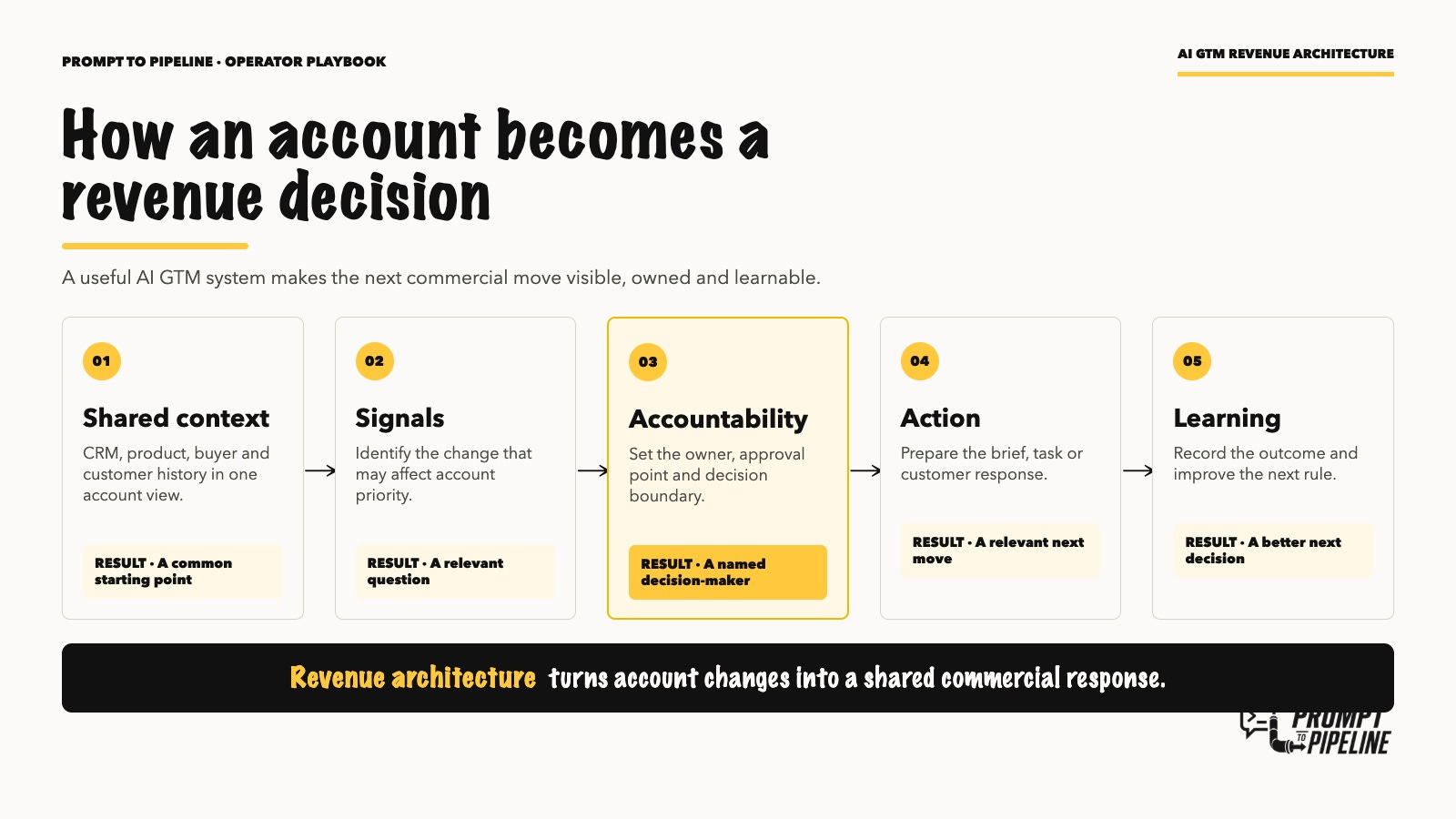
Taken together, these layers are a practical way to diagnose where an AI-enabled revenue system will hold or fail. A company can have excellent signals but no shared account context, identify the right account without routing a response, or produce useful work that never becomes organisational learning.
Context: From Fragmented Knowledge to Shared Account Context
Most companies already have an ICP (the more interesting question is whether marketing, sales and the CRM are using the same one?)
Across companies, the information needed to make a better account decision sits with different teams, in different systems, and is applied for different purposes: Marketing has an ICP definition. Sales has qualification criteria. Product sees usage. Customer success has the history of what the customer actually values. RevOps owns the fields that are meant to connect some of it.
As AI becomes part of research, prioritisation and customer work, that fragmented context becomes more visible. An SDR can research an account without seeing product usage. A sales manager can coach a rep without the agreed qualification standard. Marketing can build a campaign from an ICP definition that does not match the one used in the CRM. The adjustment is to establish a shared commercial reference before asking AI to act on it.
That reference rarely centralises every document in the business. Instead, it gives the revenue system a consistent answer to a smaller set of recurring questions: who is a good-fit account, what evidence supports the positioning, what counts as meaningful engagement, how an opportunity is qualified, and which team owns the next step.
Across companies building this shared reference, the material being connected tends to be familiar:
ICP and disqualification rules;
product positioning and proof points;
account research and qualification standards;
sales-process definitions and CRM field ownership;
approved claim language, tone expectations and examples of good and bad output.
The same principle applies to the workflows teams are now turning into reusable AI skills. The pattern can govern account research, qualification briefs, handoff preparation and CRM enrichment as easily as it can govern content work. The useful versions carry a clear brief, relevant reference material, boundaries and a defined output; without those, each use recreates the same interpretation work.
Norbert Bezzina, a Creative Content Strategist, names the asset correctly:
The system that works best for me is building reusable AI skills rather than one-off prompts. Each skill is a documented process for one task: brand design, content ideation, writing, research, infographics, and carousels. Each holds its own reference files, tone rules, and output format, so the output hits the same standard every time. A prompt gets forgotten. A skill becomes part of how the work runs.
Tahnee Perry, an AI-led founder and educator, shows why clear boundaries matter:
The workflow that worked was breaking my content process into standalone Claude skills, each owning a single job: brand context, audience context, writing style, and campaign execution. They stack instead of overlap. What made it effective was the boundary-setting. When one skill tried to handle strategy and copy at once, it blended the two and produced generic output. Splitting them forced every part of the system to do one thing well.
Their examples come from content work, but the operating implication is broader. Reusable context lets marketing, sales and RevOps apply the same commercial standards across different workflows. In practice, the teams moving first are making the few rules that should travel with the work available where decisions are made.
What Teams Are Building Now
Reusable operating skills: Anthropic’s Agent Skills repository shows the pattern gaining traction: a self-contained package of instructions, scripts and reference material for a specialised task. In GTM, the same format can hold the commercial rules and approved inputs a workflow needs to apply consistently.
Signals: From Static Lists to Live Commercial Relevance
Once the business has a shared way to assess an account, it can make better use of live behaviour. Most GTM plans still begin with a target list based on firmographic fit, then ask sellers to work through it. AI gives teams a practical way to update that priority when a person, team or account does something that suggests genuine relevance.
This is particularly visible in product-led and self-serve businesses, where product usage and sales pipeline often remain separate. A user can sign up with a personal email, invite colleagues or start paying while sales continues cold-prospecting into the same market. The emerging pattern is to connect that behaviour to an account, interpret it in context and let it change the next commercial move when the evidence warrants it.
The distinction between useful and noisy signals is increasingly being set at leadership level: which combinations of behaviour change account priority, and which response they trigger. A product signup, for example, is one data point. Several users from the same company, a paid upgrade and a relevant hiring pattern tell a more useful commercial story.
Konrad Kucharski, CRO & Co-Founder at Aviato, connects product behavior to account-level GTM:
The workflow I keep coming back to is treating existing self-serve users as your warmest pipeline, not just your user base. Many people sign up or buy with personal emails, but inside that data is a map of who those users are at work. Enrich those emails, connect them to companies, and anonymous signups can become account-level buying signals: which teams are already using the product, where usage is clustering, and where the next enterprise conversation should start. What makes it effective is that you stop guessing. You build outreach on behavior that already happened, from people who have already chosen to spend money or time with you.
Ariel Levin, GTM Automation Consultant for B2B Tech, applies the same logic upstream in signal-based outbound:
The one that’s actually worked for us isn’t an AI copywriter. It’s an AI qualifier. For a cybersecurity client, we monitor about 175 LinkedIn accounts in their category: analysts, practitioner voices, and competitor pages. When one of them posts something relevant, the system pulls everyone who liked or commented. That engagement list is the real asset, because people debating SSE rollouts in a comment thread are far more interesting than anyone sitting on a static list. From there, AI makes two judgment calls: is the post actually about the category, and after enrichment, does the engager match the ICP on title, company size, geography, and industry. Only matches land in Clay for human review. What makes it useful is where AI sits. It is not writing messages. It is making the thousands of small relevance decisions an SDR would otherwise make by eyeballing profiles, and doing that before we spend money on enrichment rather than after.
Together, these examples show the same shift: operators begin with evidence of behaviour, then assess whether it is commercially meaningful for a specific account. Konrad uses product behaviour to reveal warm enterprise potential. Ariel uses category engagement to decide which people merit enrichment and human review.
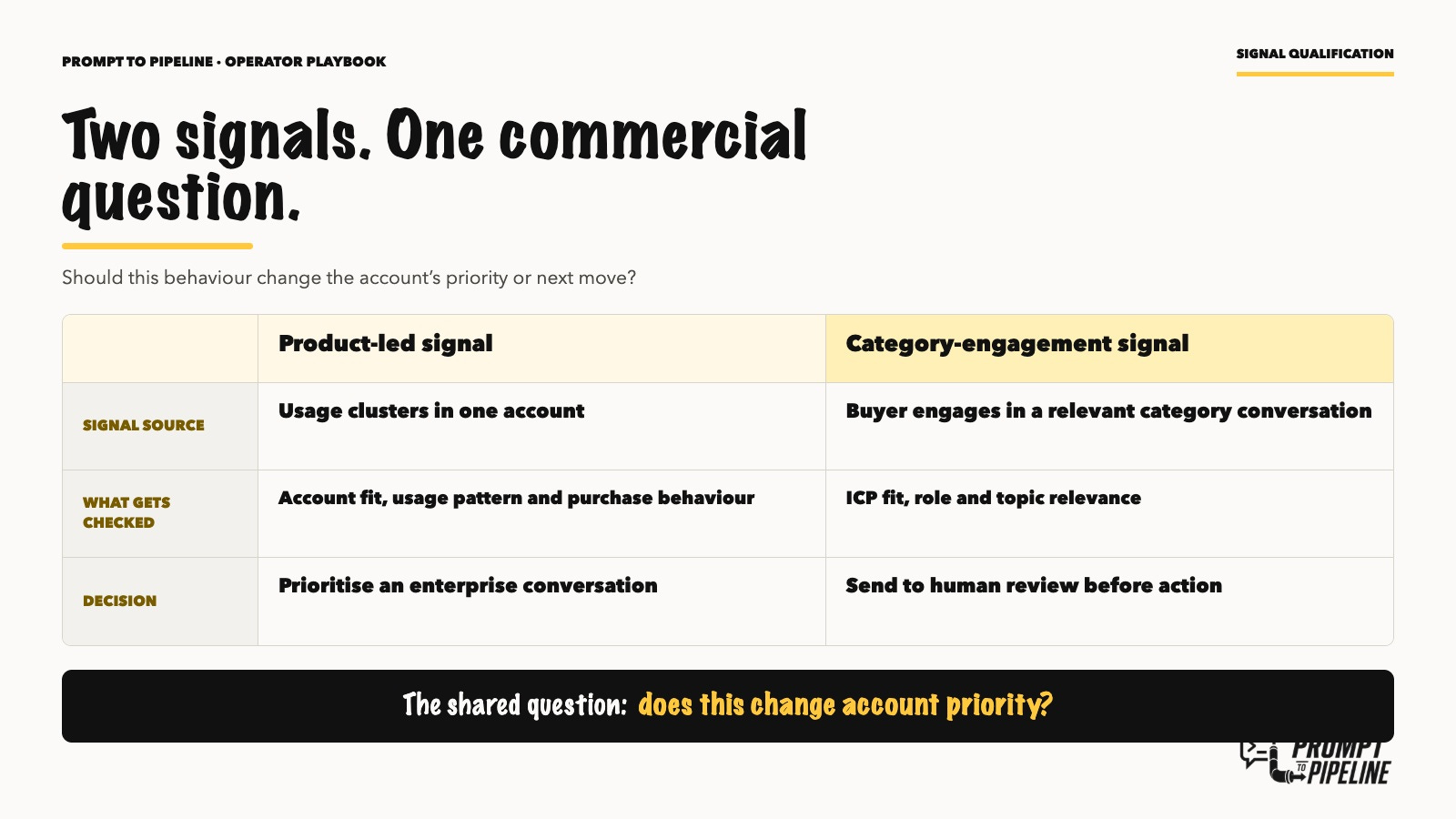
The workflows that hold together tend to follow the same sequence, even when the data work is difficult: capture the behaviour, connect it to the likely account, assess the pattern against the ICP, set a threshold for sales action, and write the result back to the CRM. This is how a signal becomes shared account history rather than another isolated data point.
What Teams Are Building Now
Custom signal qualification: Clay Signals illustrates the move from a single alert to a monitored account pattern: teams layer first- and third-party signals, enrich them with account context, then route only qualifying accounts to a human or workflow.
From Signal to Response: Routing and Accountability
A signal only matters when it changes what the company does next. In a product-led motion, that may be several self-serve users from the same company and a paid upgrade. In signal-based outbound, it may be a person engaging in a relevant category conversation who also matches the ICP. Both patterns give the business a reason to pay attention to an account. In the teams I work with, the handoff that follows is where an otherwise useful workflow usually breaks down: when an account changes, who owns the next move?
A Slack alert with no owner is simply a faster way to create a future apology.
The next decision is the commercial response. Should the system update an account score, create a task, prepare an account brief, notify the owner, draft outreach or wait for human review? Routing and accountability define which response follows, which steps happen automatically, and who owns the result.
The more mature AI RevOps workflows are adding three controls. Access defines which systems a workflow can read and which fields it can write. Escalation defines which customer-facing, high-value or difficult-to-reverse actions need approval. Traceability lets the team inspect the instructions, scoring rules, failures and commercial outcomes behind a decision.
That is the operating change beginning to show up in GTM teams. Account response is moving from something a seller or manager discovers and reconstructs individually to a shared workflow that interprets, routes and records it. Routine steps can run quickly; managers and sellers retain ownership of the commercially consequential move. That creates the conditions for the next layer: using AI to prepare commercial work without handing away the judgment inside it.
What Teams Are Building Now
Signal-to-owner orchestration: LeanData is a mature example of the routing layer: lead-to-account matching, assignment, scheduling and auditability around buyer signals. It reflects the operating logic beginning to show up in more AI-enabled revenue systems.
Actions: From Automated Output to Human Commercial Judgment
Routing determines who receives a signal and what response follows. The next design decision is what reaches that person: AI can assemble account evidence, identify exceptions and prepare a recommendation before a manager, seller or founder makes a commercial call.
That is how GTM work is changing. AI is moving upstream into preparation, while a named person remains responsible for interpreting the evidence and owning the customer, deal, message or coaching decision.
Keith Cordeiro, Revenue Leader and GTM Strategist, shows this in an internal revenue workflow. His system gathers the relevant evidence before a rep 1:1, so the manager can spend the meeting on the conversation and decision that follow.
The biggest lift for my team has been converting manager prep time into coaching time. A rep 1:1 used to start with me stitching together a CRM pull, notes from the last review, and a few call recordings. That assembly work now runs as an agent: it pulls live pipeline, layers in call data and the prior review, compares against benchmarks, and hands me a coaching guide before the meeting. The guide surfaces exceptions I used to skim past: untouched leads at accounts with open opportunities, blank qualification fields, or deals that went single-threaded and quiet. AI is excellent at assembling evidence and flagging exceptions, but the conversation with the rep is where the value actually lands. That part stays human.
Keith’s workflow illustrates a boundary I see repeatedly in client work. Teams can automate plenty of preparation work; the harder design choice is deciding which judgment can be standardised and which still needs the person accountable for the deal. Here, the agent assembles the evidence and flags exceptions; the manager interprets it, coaches the rep and owns the action that follows.
That is where human-in-the-loop GTM matters most: customer-facing work needs the same division, with a tighter boundary. AI can research, structure and identify relevant signals, but the person accountable for the relationship still has to interpret the context, choose the angle and decide what should be said.
Monika Grycz, who works in GTM Partnerships & Content, sees the same boundary in customer-facing work:
For personal-brand-led GTM, the way I see it is that you as a human need to be behind the ideas: your POV, your experience, your specific take on things. AI helps you structure, write properly, format, maybe research, but the raw material has to come from you. The only thing AI truly can’t replicate is life experience. On the outbound side, AI is great at scale and bad at relevance when left alone. I use it to build lists, find signals, and move fast, but I still decide what that signal means for a specific person, what angle to take, and what not to say. The pattern I keep seeing: people who use AI as a thinking partner stay differentiated. People who outsource the thinking to it start sounding like everyone else.
The change is a redesign of work around a decision. In the emerging model, managers receive evidence before a coaching conversation, reps receive account context before outreach, and founders receive a clear account view before a strategic deal discussion. AI prepares the material; a named person remains accountable for the commercial judgment and the outcome.
What Teams Are Building Now
Human-approved execution: n8n is a useful implementation reference for AI workflows that include human approvals and observability. It represents an implementation model in which approval is a designed workflow step rather than a manual workaround after the output is produced.
Learning: From One-Off Workflows to Revenue Memory
Once a team has implemented agentic GTM workflows for research, scoring, routing and preparation, the next shift is to turn the commercial decisions those workflows support into a feedback loop. That is what revenue memory means in practice: the business captures why it acted, what it did and what happened next, so the next account decision starts from more than a one-off output.
The teams moving beyond one-off workflows are beginning to retain four parts of the decision: the trigger that started it, the recommendation or human judgment that followed, the action taken, and the commercial outcome.
Without that chain, an account brief, qualification decision or coaching analysis disappears into Slack, a document or an untracked chat thread. The team may gain speed, but it has no reliable way to see whether the workflow improved qualification, conversion, deal quality or rep performance.
Related Reading
For the broader operating-model view, read AI GTM in 2026: What High-Performing Teams Do Differently.
Revenue memory gives the next decision some history. A signal threshold can be revised because the previous one created poor-fit opportunities; a routing path can change because accounts repeatedly stalled; a coaching approach can improve because its effect is visible over time.
That is the change in the operating model. AI-assisted GTM becomes more valuable when each decision makes the next one better, rather than producing a new set of disconnected outputs every week.
What Teams Are Building Now
Decision-aware memory: Semantica offers an implementation pattern for retaining decision history and provenance in a custom enterprise system.
Agent evaluation: Salesforce Agentforce Observability is a useful reference for tracing and evaluating agent workflows in a CRM environment.
What I Would Watch Over The Next Six Months
The operating choices above will become more visible as AI go-to-market systems move from individual use cases into everyday GTM work. Four developments are likely to separate companies that have adopted useful tools from companies that are actually changing how revenue decisions are made.
The test I keep returning to is fairly mundane: when an account changes priority, can anyone outside the original team see why? If the answer is no, the business has added activity without creating shared commercial intelligence.
1. The buyer-side AI gap will widen
Buyers are adopting AI for research, comparison and internal problem framing faster than many GTM teams are adapting their commercial process. That raises the cost of generic positioning, generic content and generic outreach because a buyer can generate a competent summary of most category information without speaking to a vendor.
The companies worth watching will connect their category point of view, product evidence and account signals earlier in the buyer journey. Their commercial teams will need to add interpretation, relevance and proof that a buyer cannot get from a general-purpose assistant.
2. RevOps will become the AI control function
Once an AI workflow can read and write in the CRM, enrich an account, change a score or trigger a handoff, it becomes part of the revenue system. It needs an owner for permissions, data quality, versioning, audit trails and rollback paths.
This expands the RevOps role beyond buying software or cleaning fields. The strongest teams will define where the workflow can act, where it must escalate, and which commercial outcomes justify extending its scope.
3. The durable advantage will sit in commercial context
Models will keep becoming cheaper and more capable, while access to an assistant remains easy to copy. The harder asset is the company-specific context around it: the definition of a good-fit account, the evidence behind the positioning, the account history, the qualification standard, the handoff rules and the feedback from real outcomes.
That is why the most consequential AI GTM work sits below the interface. It lives in the decisions about what the revenue system should know, remember and improve.
4. Sales leadership will shift from activity management to decision quality
AI can assemble evidence, identify anomalies and prepare the work. Sales leaders still decide whether an account deserves attention, whether a deal has real momentum, whether a message carries a point of view, and whether a rep needs coaching or a process change.
The management question becomes sharper: where does more speed improve a decision, and where does it simply multiply low-quality activity?
Over the next six months, the meaningful divide will emerge in the revenue system itself. The companies making progress will use AI to improve how revenue work is informed, governed and learned from, not only to increase the amount of work produced.
Question Worth Sitting With
When the next strategic account moves, can the revenue system show what signal mattered, who made the call, what happened next, and what the previous decision taught it?
About me
I help founders and GTM teams build or upgrade AI-native GTM engines that turn signals, customer context and AI workflows into pipeline.
Want to work with me?