
Everyone is asking the same question: how are AI-native companies building a go-to-market motion before they have a sales team, a RevOps function, or a mature stack?
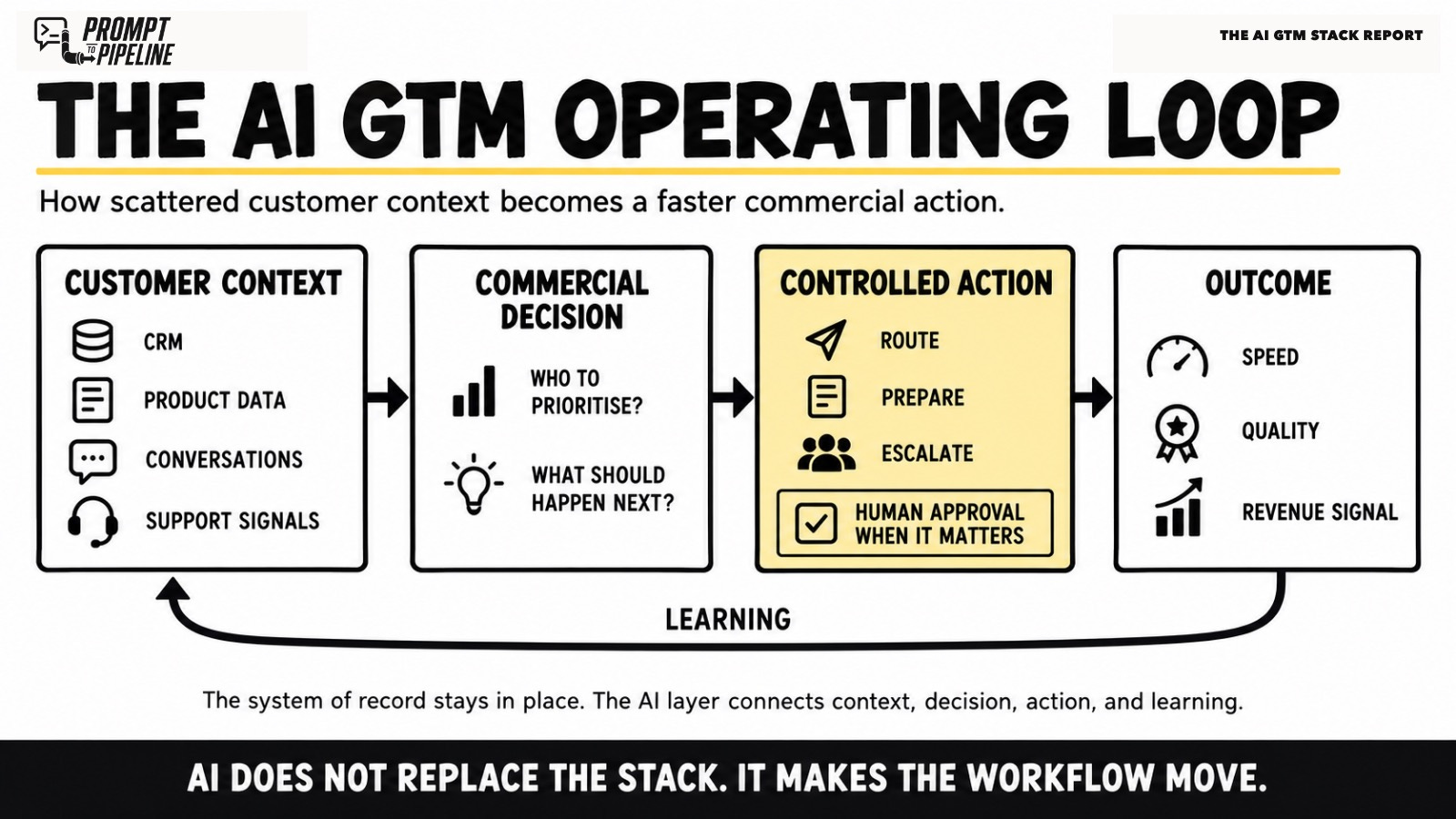
The question matters because the conventional answer - adding more tools around the CRM - is proving too slow. Customer context still sits across calls, product usage, email, and operator judgment, while critical decisions wait for someone to turn it into a clear next action.
The most interesting companies are attacking that gap first.
They start with high-friction commercial moments: which account deserves attention, how inbound should be qualified, why a deal has gone quiet, or how the next customer interaction should be prepared. Instead of waiting for a complete GTM organisation, they build a loop that connects the signal, a decision, an action, and what happens next.
This article looks at that shift from three angles: where the AI layer sits alongside the existing stack, why early GTM ownership stays close to the customer workflow, and how established teams can begin applying the same logic.
The AI Layer Sits on Top of the Existing Stack
The technical pattern is real. AI-native companies repeatedly describe an execution layer built from models, agents, context, workflows, integrations, evaluation, and deployment.
But when commercial systems appear, they are usually familiar: HubSpot, Salesforce, Slack, LinkedIn, email, Outreach, Gong, Segment, PostHog, Calendly, Shopify, spreadsheets, and vertical operating systems.
The old commercial plumbing has not disappeared. It is becoming the environment around which AI-native teams build.
The pattern looks different by company, but the underlying move is consistent:
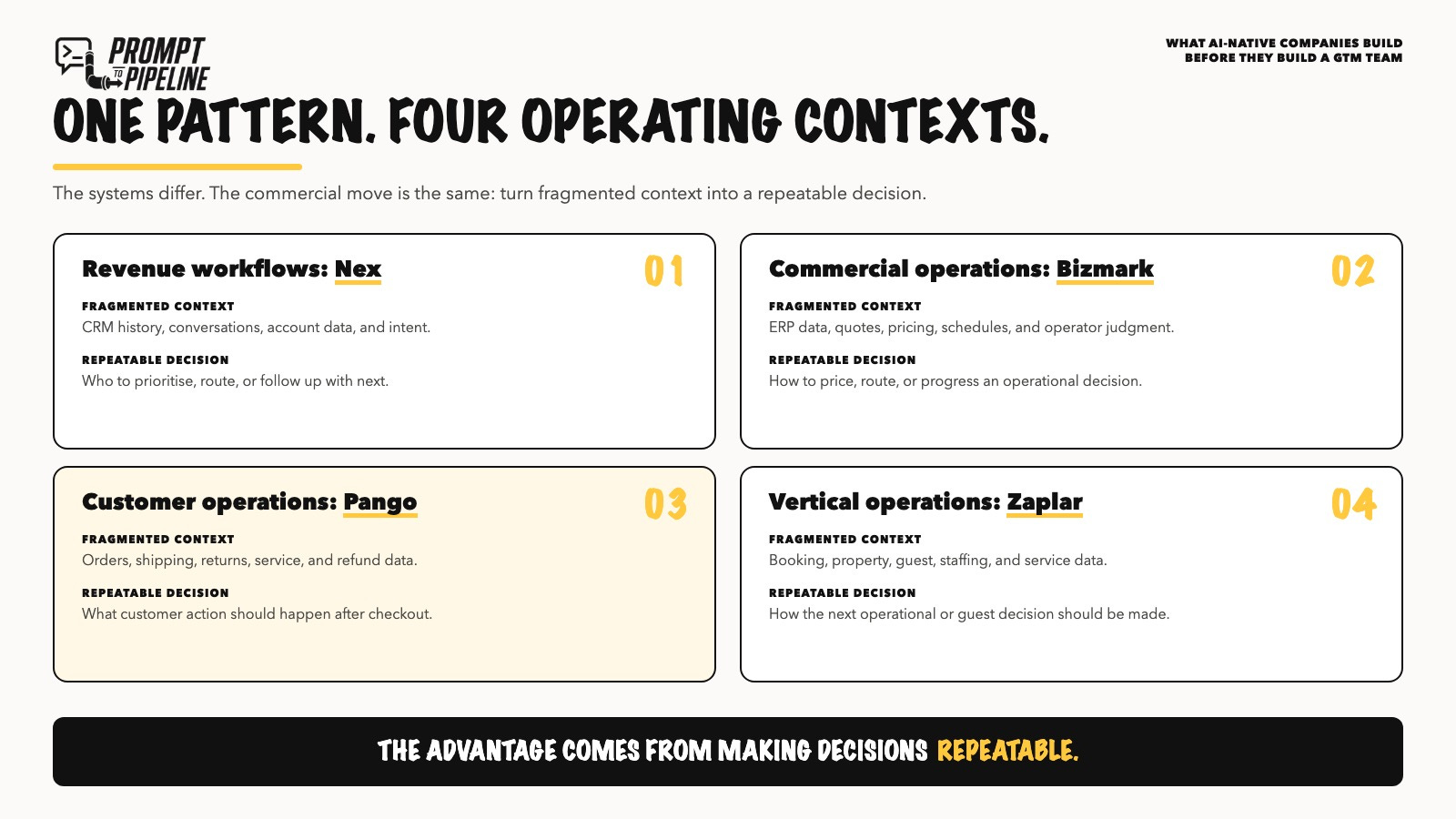
About these examples: The companies referenced here are independent market examples. The observations reflect their public positioning and product materials; they do not imply endorsement, a commercial relationship, or access to non-public systems.
Which recurring commercial decision can now move from trusted context to action with less manual coordination?
To go deeper on the operating model behind this shift, read AI GTM in 2026: What High-Performing Teams Do Differently. It explains why advantage comes from connecting signals, context, decisioning, execution, and learning rather than collecting isolated AI tools.
The First GTM Motion Has One Owner
Before a conventional GTM organisation exists, the commercial work is still too close to the product and the customer workflow to be separated cleanly into sales, RevOps, success, and implementation.
The transferable pattern is not founder heroics. It is a single accountable owner for the loop. In an early company, that person is often a founder. In an established team, it could be a revenue leader, customer leader, GTM engineer, deployment lead, or RevOps owner. What matters is that someone can connect the product, customer context, commercial decision, and outcome.
For the ownership question, 2026 State of GTM Engineering: Salary, Skills, Tools & Hiring Trends maps the roles and capabilities emerging around this work. It is especially useful if you are deciding whether the operating layer belongs to RevOps, GTM Engineering, or a new AI GTM function.
This is especially visible in founder narratives. Nex founders repeatedly frame the market problem through CRM cleanup, data quality, routing, re-engagement, and outbound execution. Bizmark’s founder story is grounded in the operational work of making, moving, and selling physical goods. Pango’s is grounded in the cost and complexity of post-purchase operations. These are not feature descriptions. They are explanations of where customer work breaks and what changes when a system can act.
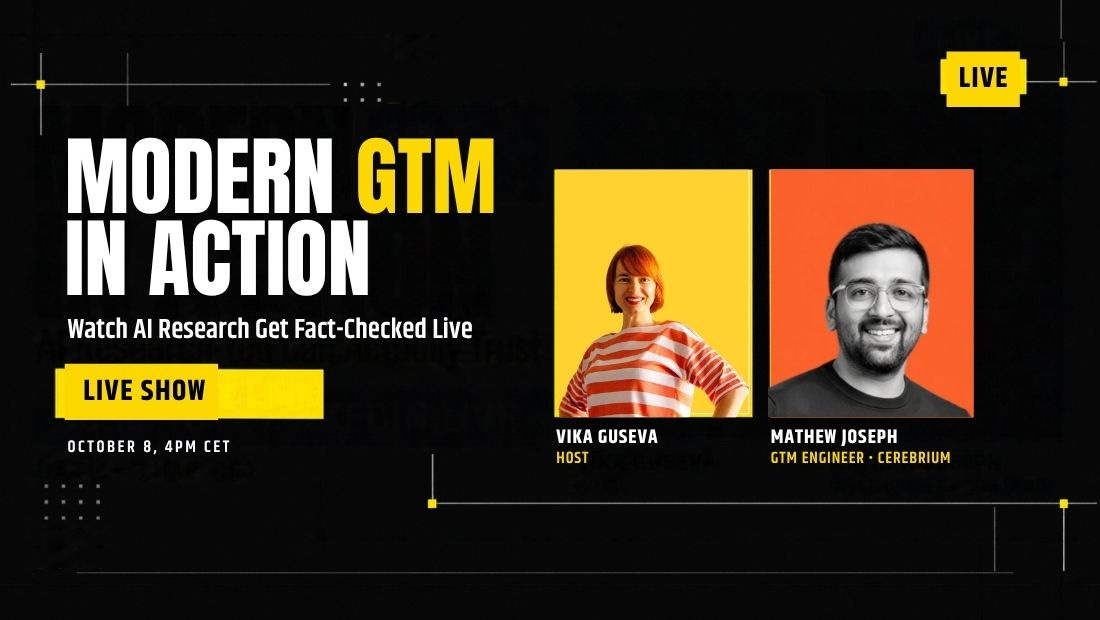
I’m launching Modern GTM in Action, a new LinkedIn Live series with a deliberately simple format:
30 minutes.
One practitioner showing a real GTM workflow live.
And your questions as we go.
For the launch, I’ll be joined by Mathew Joseph, GTM Engineer at Cerebrium.
We’ll talk about AI-powered market research and the verification layers needed to make it trustworthy.
The early GTM motion is not a department. It is an owned operating loop:
Find a painful, specific workflow.
Prove the product can change an outcome inside it.
Stay close enough to implementation to see where it breaks.
Turn that learning into the next product and commercial decision.
This is why a generic “hire sales earlier” interpretation misses the point. The first commercial hires in AI-native companies may not resemble a traditional SDR or demand-generation hire. They are more likely to sit at the junction of customer workflow, product, implementation, systems, and revenue.
Names for that emerging work already exist: AI GTM Engineer, customer engineer, deployment engineer, forward-deployed engineer, solutions engineer, RevOps engineer, workflow architect, and revenue systems architect.
The titles will vary. The work is converging.
Build One Controlled Commercial Loop
Established teams do not need to rebuild their stack or let AI act without control. The practical starting point is one commercial decision that is currently slow, inconsistent, or overly dependent on operator judgment. Keep the CRM and the systems around it. Improve the path from context to action inside them.
The useful test is whether a capability changes a commercial decision. Can it change which account receives attention, how a lead is qualified, how a deal is routed, how outreach is prepared, or how a renewal risk is surfaced? If it cannot, it may be a useful AI feature, but it is not yet an AI-enabled GTM operating model.
Start with one controlled loop:
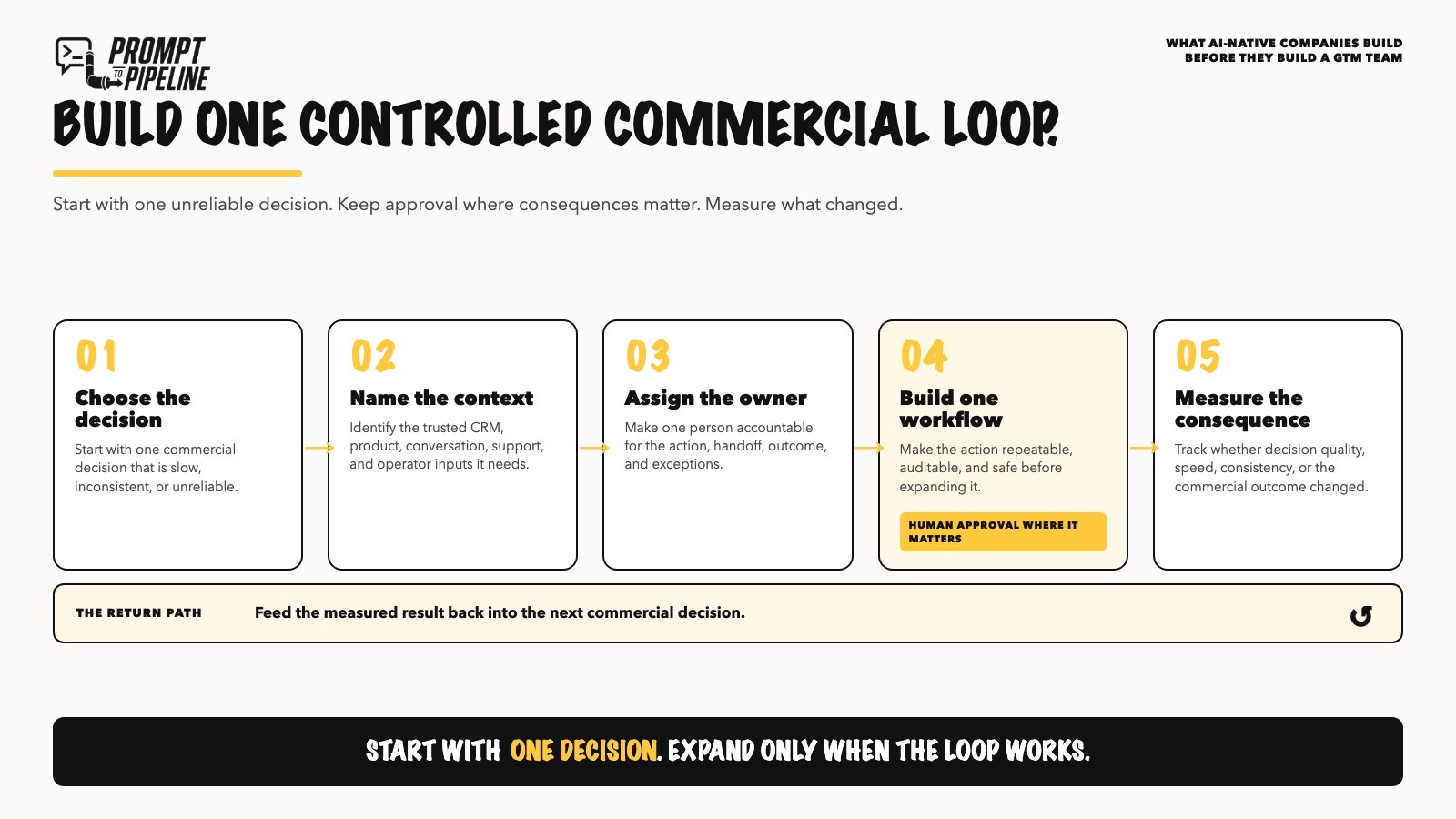
Choose one commercial decision that is currently unreliable.Examples: account prioritization, lead routing, renewal-risk review, outbound preparation, customer escalation, or pipeline hygiene.
Name the context required to make that decision well.This is usually spread across the CRM, product usage, conversations, support data, a spreadsheet, and individual operator knowledge.
Assign an owner for the action, not just the tool.Someone needs to own the handoff from signal to decision to execution, including the exceptions.
Build one repeatable workflow before expanding.Keep a human approval point where the action has commercial or customer consequences. A useful workflow can be audited, improved, and measured. A broad automation initiative usually cannot.
Measure the commercial consequence.Not prompts run or hours saved alone. Measure whether the quality, speed, consistency, or outcome of the decision changed.
The system of record still matters. So do email, Slack, analytics, vertical software, and the data model beneath them. The shift is in how work moves between those systems. This is a more disciplined way to adopt AI because it starts with the commercial system you already run. It does not ask you to replace everything at once.
To see the model translated into practical workflows, AI Agents for RevOps: 7 GTM Plays That Turn Existing Signals Into Warm Pipeline walks through seven concrete plays. Each one connects a usable signal to an accountable owner, human review, a commercial action, and CRM writeback.
What One Controlled Loop Looks Like
Example: re-engaging deals that have gone quiet
Decision: Which stalled opportunities deserve a re-engagement action now?
Context: CRM stage, last interaction, buying committee, product usage, and account changes.
Action: AI prepares the recommended next step and a draft message.
Control: The pipeline owner approves consequential outreach before it is sent.
Measure: Time to action, reactivation rate, and pipeline recovered.
Your Next Move
Before adding another AI tool, ask three questions:
Which commercial decision is least reliable today?
Is the context needed to make that decision available and trusted?
Who owns the action and the outcome once the system makes a recommendation?
The companies that pull ahead will not be those with the longest AI tool list. They will be the ones that make a few important commercial decisions faster, clearer, and more accountable.