
Every GTM team now has some version of the same conversation. Could an agent enrich inbound leads before sales sees them, monitor account signals, spot job changes, draft the first follow-up, update Salesforce, brief the AE before a call, flag renewal risk, or explain why a campaign influenced pipeline?
The capability is increasingly available, but the operating environment is where the trouble starts.
The company asking for autonomous lead routing may still have three lead-source definitions, duplicate account records, rep-owned spreadsheet logic, stale lifecycle stages, and a Slack channel where exceptions go to retire.
An agent can move through that kitchen faster than the team, but speed is not especially useful when the ingredients are mislabeled and nobody agrees on the recipe.
That is why customer conversations are moving from what agents can do to what they can safely do inside a live revenue system: teams are asking which data an agent should trust, which actions it can take without approval, when a human should intervene, and how to measure whether the decision improved a commercial outcome.
Salesforce frames the shift through context, work, insight, agency, and engagement; OpenAI emphasizes tracing, guardrails, handoffs, tools, and workflow state. The vocabulary varies, but the operating questions are remarkably similar.
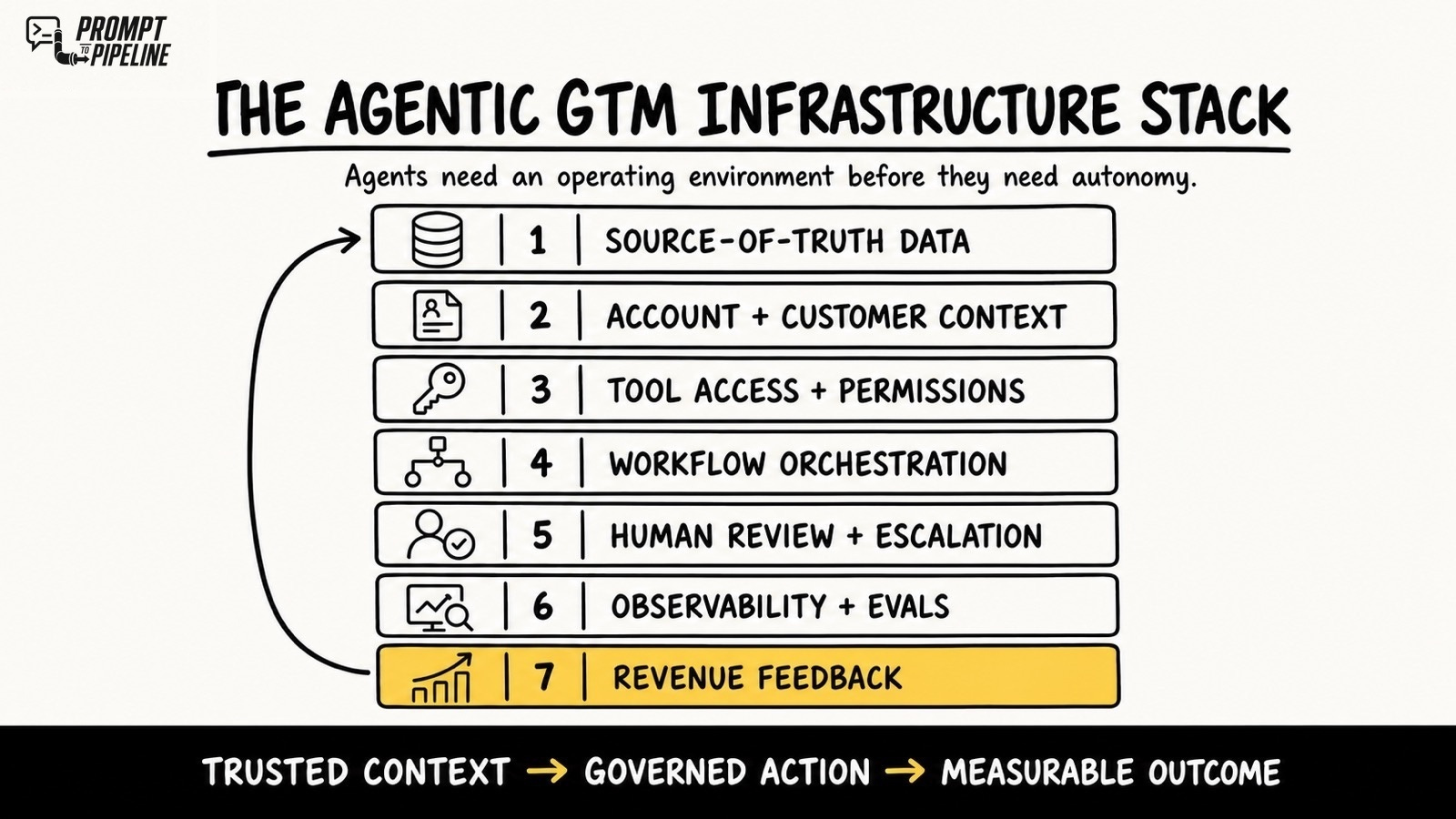
I call the layer that answers those questions The Agentic GTM Infrastructure Stack: it connects trusted data, commercial context, permissions, workflow logic, human review, observability, and revenue feedback. This article explains how that infrastructure works, where it tends to break, and how founders and GTM leaders can apply the framework to a real revenue workflow before adding another agent to the stack.
It also connects to the themes behind From AI Adoption to Revenue Architecture, which looks at context, signals, routing, actions, and learning as one commercial system, and MCP vs API vs CLI, which separates the interfaces, execution layers, and controls an agentic workflow needs. This article focuses on the infrastructure underneath both questions.
The teams that get this right will not simply automate more GTM tasks. They will build revenue systems where signals become decisions, decisions become governed actions, and the outcomes improve the next run.
What You Will Learn
This article shows what needs to exist before AI agents can operate across GTM workflows with any reasonable level of trust.
Why the agentic GTM conversation is shifting from tools and prompts to infrastructure.
The Agentic GTM Infrastructure Stack: seven layers behind useful GTM agents, from source-of-truth data to revenue feedback.
How to decide what an agent may read, recommend, write, send, and escalate.
Where agentic workflows usually fail first: CRM writeback, routing logic, field ownership, approval paths, and invisible decisions.
A practical audit for one GTM workflow before your team adds another agent to the stack.
What everyone is already saying about agentic GTM
The AI-in-GTM conversation has moved from assistants that draft, summarize, and research to agents that can act inside revenue workflows: enrich leads, route accounts, update CRM, inspect pipeline, and trigger follow-up.
Most market narratives now converge on three ideas: humans will orchestrate while agents execute; data and workflow quality will determine decision quality; and autonomy will require clear permissions, approval paths, and auditability.
That direction is useful, but it leaves the practical question unanswered: what must exist underneath the agent before a company can trust it inside a live revenue system?
Across platforms, the terminology varies, but the operating requirements are similar: trusted context, connected workflows, controlled access, human review, and observable outcomes.
Strip away the product vocabulary, and the pattern is clear: agentic GTM needs infrastructure.
The missing layer is infrastructure
Most GTM systems were built for humans who can work around ambiguity: a rep knows that lead source is unreliable and checks the campaign notes. RevOps knows which deprecated Salesforce field still feeds the board deck. Marketing Ops knows where the lifecycle workflow quietly fails.
Agents, though, do not inherit that street knowledge and it has to be translated into usable context, rules, permissions, and feedback.
Prompt quality cannot repair contradictory fields, unclear ownership, missing account history, invisible attribution logic, or a workflow with no rollback path. A confident answer becomes a liability when it triggers a CRM update, changes a forecast note, or reaches a customer.
The operating layer underneath agentic GTM must let an agent answer five questions before it acts:
What source of truth should I trust?
What context changes the decision?
What am I allowed to do?
When do I need a human?
How will the business know whether this worked?
Those questions are the first pass through The Agentic GTM Infrastructure Stack.
The Agentic GTM Infrastructure Stack
The Agentic GTM Infrastructure Stack is the set of operating layers that let agents work across revenue systems without creating more mess than they remove. It sits beneath Adaptive GTM™ as the infrastructure diagnostic: before the system can adapt, it has to know what to trust, what to access, who approves the action, and how the outcome is measured. Human-in-the-Loop GTM™ becomes one critical layer inside it: the judgment and approval boundary.
1. Source-of-truth data
Every agentic GTM workflow begins with a trust decision.
If Salesforce says an account is mid-market, HubSpot says enterprise, the warehouse has a different employee count, and the rep’s notes say the account is a strategic logo, which record should the agent use?
Humans often work around this silently. Agents need the hierarchy made explicit.
This layer defines field ownership, trusted systems, update frequency, matching logic, deduplication rules, and the difference between “known,” “inferred,” and “stale.” It also defines which records are safe for agents to touch and which should remain read-only.
Without this layer, agents do not personalize. They improvise with whatever fragment of truth they happen to retrieve.
For a founder or CRO, the practical test is simple: pick one ICP-fit account and ask where the team would find firmographics, engagement, opportunity history, product usage, champion movement, open support issues, and campaign influence. If those answers live in seven systems with no priority order, the agent has the same problem, only faster.
2. Account and customer context
Data is the raw material. Context is the commercial meaning.
An agent deciding whether to route, score, sequence, or escalate an account needs more than a company name and email address. It needs to understand the account’s segment, current business motion, prior relationship history, open opportunities, product usage, support risk, buying committee, competitor mentions, and why the account matters now.
This is where many GTM agent experiments flatten into generic automation. They can enrich a record, but they cannot explain why the moment deserves action. They can draft an email, but they do not know which business problem should shape the message. They can summarize a call, but they cannot connect it to the campaign, the product signal, and the AE’s next best move.
The infrastructure question is not “Do we have data?” It is “Can the system assemble the context a good operator would use before acting?”
This is why data activation matters. Warehouse-to-GTM workflows, such as the model Hightouch describes with sources, models, schema, destinations, and syncs, are not just plumbing for marketers. They are a way to move trusted customer and business data into the places where campaigns, sales motions, and account decisions happen.
3. Tool access and permissions
Once agents can act, tool access becomes a revenue-control problem.
A research assistant with read-only access to public web pages is one thing. An agent that can update CRM fields, trigger sequences, modify lead ownership, create tasks, enrich contacts, post Slack alerts, or influence forecast notes is another.
This layer defines the agent’s identity, scopes, credentials, and boundaries. It answers practical questions:
Can the agent read all accounts or only accounts in a territory?
Can it update fields or only recommend updates?
Can it create a task for a rep?
Can it send an external email?
Can it trigger a sequence?
Can it overwrite a field owned by RevOps?
Can it call enrichment vendors that create usage-based cost?
The MCP authorization specification is useful here because it makes the security point concrete: tool access is not just a connection problem. Tokens need to be issued for the right audience, validated by the receiving server, and restricted so credentials are not casually passed through systems where they do not belong.
For GTM leaders, the translation is blunt: do not give an agent admin-shaped access because the demo looked impressive. Treat agents as non-human operators with named jobs, scoped permissions, and a visible owner.
4. Workflow orchestration
An agent should not have to invent the business process every time it runs.
Many GTM workflows are partly deterministic and partly judgment-based. Lead routing may follow a defined territory model, but the agent may need to interpret messy job titles or infer account fit from recent signals. Renewal risk may have fixed thresholds, but the agent may need to summarize why the risk exists. Campaign follow-up may use a standard sequence, but the first human touch may need context and timing judgment.
That means orchestration matters as much as reasoning.
Workato's enterprise AI framing is a useful pattern: the best AI workflow is often only partly AI. A deterministic workflow can monitor for an event, gather context, call an agent for a judgment task, route the result through approval logic, and then execute known actions through governed systems. The agent contributes where uncertainty exists. The workflow handles everything that should be reliable.
This is especially important in GTM because many actions have downstream consequences. One bad field update can affect segmentation. One bad lifecycle-stage change can affect reporting. One bad sequence trigger can affect deliverability and account trust. One bad routing decision can affect rep behavior and response speed.
Agentic GTM should not mean asking the model to manage every step. It should mean designing the workflow so the model only owns the decisions where judgment is actually useful.
5. Human review and escalation
Human-in-the-loop design is not a compliance ornament. It is how GTM teams protect judgment, relationships, and revenue trust.
The review model should vary by action type.
Low-risk, reversible actions can move with limited review: enrich a missing company size, create an internal task, summarize account activity, flag a duplicate, or recommend a lifecycle-stage check.
Medium-risk actions may need sampled review or threshold-based approval: route an inbound lead, update lead score, draft an account-specific email, move an account into a campaign audience, or flag a deal as at risk.
High-risk actions need explicit human approval: sending external communication, changing opportunity stage, altering forecast category, suppressing an account from outreach, notifying an executive customer, or launching a campaign to a strategic segment.
The mistake is treating human review as a single checkbox. It should be a policy map.
For each workflow, define what the agent can do alone, what it can prepare for review, what it must escalate, and what it should never touch. Then make those rules visible to the people who live with the consequences: sales, marketing, CS, RevOps, finance, and leadership.
6. Observability and evals
If a human makes a bad GTM decision, you can usually ask them what happened.
If an agent makes a bad GTM decision, you need the system to show its work.
This layer captures the trace of the run: what triggered the workflow, what data was retrieved, which tools were called, what the agent decided, what guardrails ran, what was approved, what action happened, and what changed afterward. OpenAI’s Agents SDK tracing guidance describes traces that include model generations, tool calls, handoffs, guardrails, and custom events. That is the kind of shape GTM systems need if agents are going to operate inside revenue workflows.
Observability is not only for debugging. It is how the team learns what to trust.
If the agent keeps routing a certain segment incorrectly, that may reveal bad territory logic. If it drafts weak messages for one persona, that may reveal missing positioning context. If it frequently escalates one campaign type, that may reveal an unclear approval rule. If it spends too much on enrichment calls for low-fit accounts, that may reveal a unit economics problem.
Evals turn those patterns into a quality loop. The team should evaluate whether the agent selected the right tool, used the right context, followed policy, produced useful output, and improved the commercial outcome. Without evals, the GTM team is left with vibes, anecdotes, and a few screenshots from the demo environment.
That is not enough when the agent is touching pipeline.
7. Revenue feedback loops
The last infrastructure layer is the one many teams forget: outcomes.
If an agent recommends a lead route, what happened to response time, conversion, and accepted pipeline? If it triggered a renewal-risk alert, did the CSM intervene earlier? If it created an account brief, did the AE use it? If it enriched a campaign audience, did the campaign generate better meetings or just cleaner-looking dashboards?
Agentic GTM should be measured against commercial movement, not activity volume.
The feedback loop needs to connect agent actions to revenue outcomes over time. That includes conversion rate, sales cycle, win rate, meeting quality, response time, routed-account acceptance, override rate, campaign influence, expansion risk, and pipeline accuracy.
It also needs a way to improve the system. Useful corrections should flow back into data contracts, prompts, playbooks, routing rules, approval thresholds, and evaluation cases. The system should become more precise because the workflow ran, not merely because a human cleaned up after it.
This is where agentic GTM becomes interesting. A good system does not only execute work. It creates evidence about how GTM work should improve.
How teams are applying the Stack
The teams making progress are starting with one narrow revenue workflow and expanding the agent’s authority as the surrounding system earns trust.
At Archlet, the sequence began with ICP definition and CRM hygiene. The team then connected event-lead enrichment, inbound scoring and routing, structured meeting-note writeback, and reactivation plays across Clay and HubSpot. The vendor case study reports 2.5x BDR productivity and large reductions in weekly processing time. The useful lesson is the sequence: make the data and workflow legible before asking the agent to take on more authority.
Cursor shows a broader version of the same pattern. Its internal ChatGTM system sits above Salesforce, Gong, the warehouse, Slack, and other sources. It retrieves context on demand, drafts signal-based outreach and call briefs, supports account planning and forecast review, and lets sellers create repeatable skills and automations. The reported results are early and self-reported, but the architecture is instructive: live context, scoped tool access, rep review, and measurement against pipeline, ramp time, and sales-cycle metrics.
The systems are different in sophistication, but the operating logic is the same: establish trusted data, make the workflow explicit, keep ownership visible, and expand agent authority only after the team can inspect the result.
Where the Stack breaks
The failure modes are rarely glamorous: duplicate accounts, stale territory fields, segment-inappropriate messaging, unclear ownership, irreversible CRM writes, and attribution that cannot separate agent-assisted pipeline from everything else. The workflow may be faster, but the business still cannot tell whether the decision was right.
Agents expose these operating-model gaps because they remove the human workarounds: the manual double-check, the spreadsheet lookup, and the Slack message to the person who knows how the process actually works. That is why agentic GTM should be designed from one revenue workflow backward. The practical versions are covered in AI Agents for RevOps: 7 GTM Plays That Turn Existing Signals Into Warm Pipeline.
The Agentic GTM Breakpoint Audit
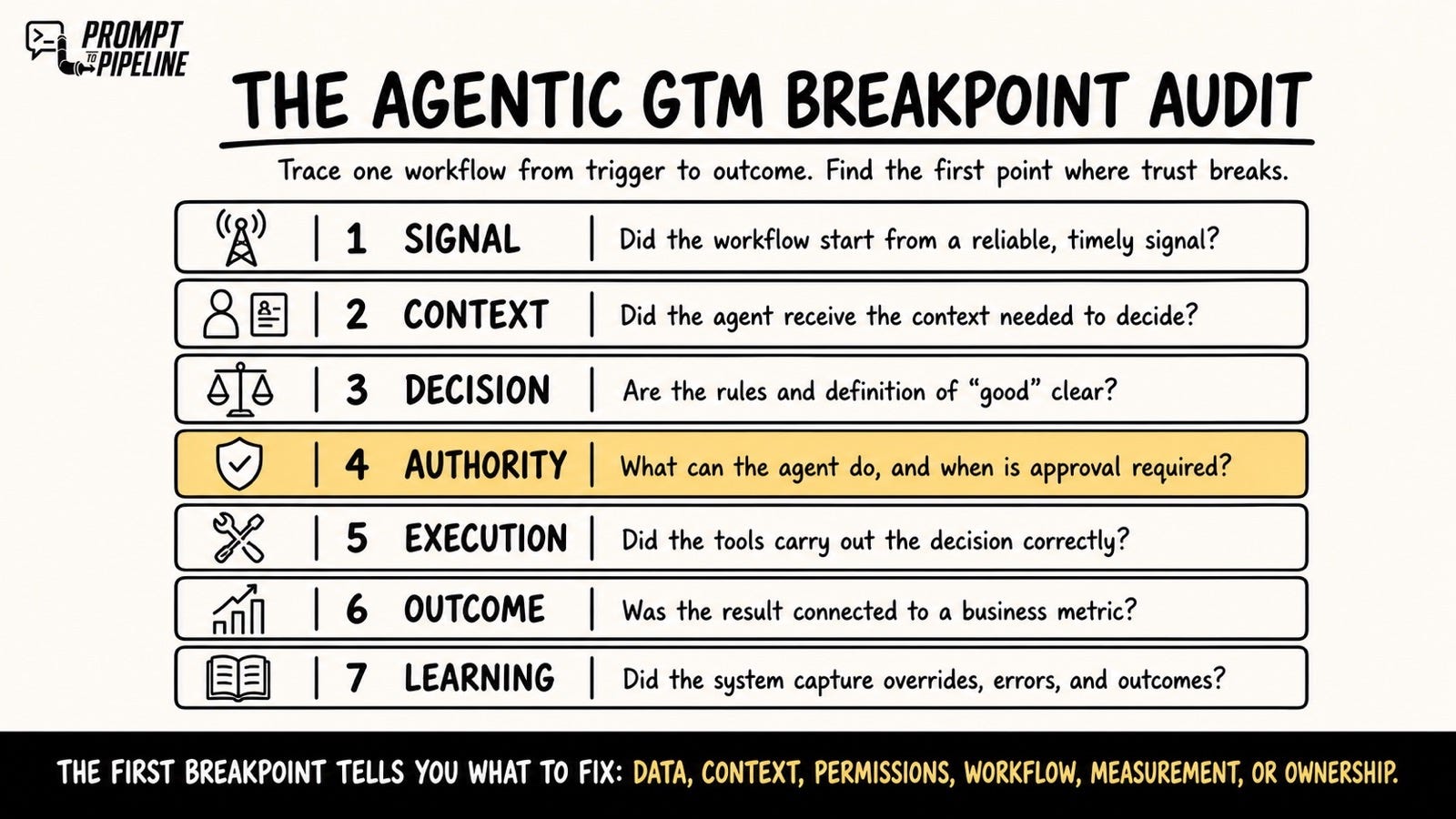
Trace one workflow from trigger to outcome and find the first point where trust breaks:
Signal: Did the workflow start from a reliable, timely signal?
Context: Did the agent receive the account and customer context needed to decide?
Decision: Were the rules, criteria, and definition of a good decision clear?
Authority: Was the agent allowed to take that action, and was approval required?
Execution: Did the workflow and connected tools carry out the decision correctly?
Outcome: Was the result recorded and connected to a business metric?
Learning: Did the system capture overrides, errors, and downstream outcomes?
That map will tell you whether you need an agent, a rules-based workflow, better data activation, a CRM cleanup project, a permission model, or a human process decision that nobody has wanted to write down.
How founders and CROs can apply the Stack
Before buying or building another GTM agent, choose one workflow and run this audit.
1. Define the commercial job
Do not start with “build an agent.” Start with the revenue motion.
Examples:
Route inbound demo requests within five minutes.
Identify expansion-risk accounts before renewal.
Turn website intent into account-owner alerts.
Prepare enterprise account briefs before discovery calls.
Re-engage closed-lost opportunities when new buying signals appear.
Detect champion job changes and recommend the right relationship move.
If the commercial job is vague, the agent will be vague with better formatting.
2. Map the signal path
List every signal the workflow depends on.
For inbound routing, that might include form fields, firmographics, account ownership, territory, company size, existing customer status, partner source, product interest, and rep capacity.
For expansion risk, it might include product usage, support tickets, NPS, executive sponsor changes, contract date, open opportunities, renewal owner, and recent call sentiment.
The goal is to see whether the signal path already exists or whether the agent would have to assemble it from fragments every time.
3. Name the source of truth
For each required field, decide which system wins.
CRM may own account stage. The warehouse may own product usage. Marketing automation may own campaign membership. Support may own open-risk signals. Finance may own contract value. Conversation intelligence may own call evidence.
This is tedious work. It is also the difference between a reliable workflow and an agent confidently choosing the wrong field.
4. Decide the action boundary
Write down what the agent may read, recommend, write, send, and escalate.
This should not live only in a vendor admin screen. It should be a GTM operating decision.
If the agent can write to CRM, define which fields. If it can draft emails, define when a human approves. If it can trigger workflows, define rollback. If it can use enrichment credits, define spend limits. If it can route records, define how exceptions are handled.
5. Instrument the workflow
Before launch, decide what must be logged.
At minimum:
trigger
input context
systems queried
tool calls
agent recommendation
approval decision
action taken
human override
downstream outcome
If the team cannot inspect why the agent acted, the workflow is not ready for meaningful autonomy.
6. Choose the outcome metric
Do not stop at hours saved.
Hours saved matter, but GTM leaders need to know whether the workflow improved revenue performance. Track the metric that corresponds to the commercial job: speed-to-lead, lead-to-opportunity conversion, meeting acceptance, opportunity creation, campaign-sourced pipeline, expansion-risk intervention, win rate, cycle time, or forecast accuracy.
If the workflow cannot be tied to a business outcome, keep it in an assistant or recommendation mode until the measurement model is clearer.
7. Build the correction loop
Every agentic workflow needs a way to get better.
When a human overrides the agent, capture why. When the agent uses bad data, fix the source or the data contract. When the agent routes the wrong account, inspect whether the territory rule, context retrieval, or scoring logic failed. When an output is weak, decide whether the issue is prompt, positioning, source context, or the task itself.
The correction loop is where the infrastructure compounds. Without it, every agent remains a clever intern with no memory of last week’s mistakes.
Operator Note
I would not start by asking which agent to add next. I would start with the revenue workflow the team can explain clearly enough for a non-human operator to run.
Name the signal, the source of truth, the owner, the permission boundary, the escalation path, and the outcome. If one of those is missing, the next useful investment is probably an operating decision or data fix rather than another agent.
The teams that build this clarity early will move faster later. They will know where autonomy is useful, where human judgment belongs, and whether an agent improved the commercial result rather than simply producing more activity.
Question Worth Sitting With
When an agent touches your GTM system next, can the team see what it knew, what it was allowed to do, who owned the decision, and what the business learned?
About me
I help founders and GTM teams build or upgrade AI-native GTM engines that turn signals, customer context, and AI workflows into pipeline.
Want to work with me?